Most hardware founders don’t get stuck because they can’t design.
They get stuck because they wait too long to touch the real world.
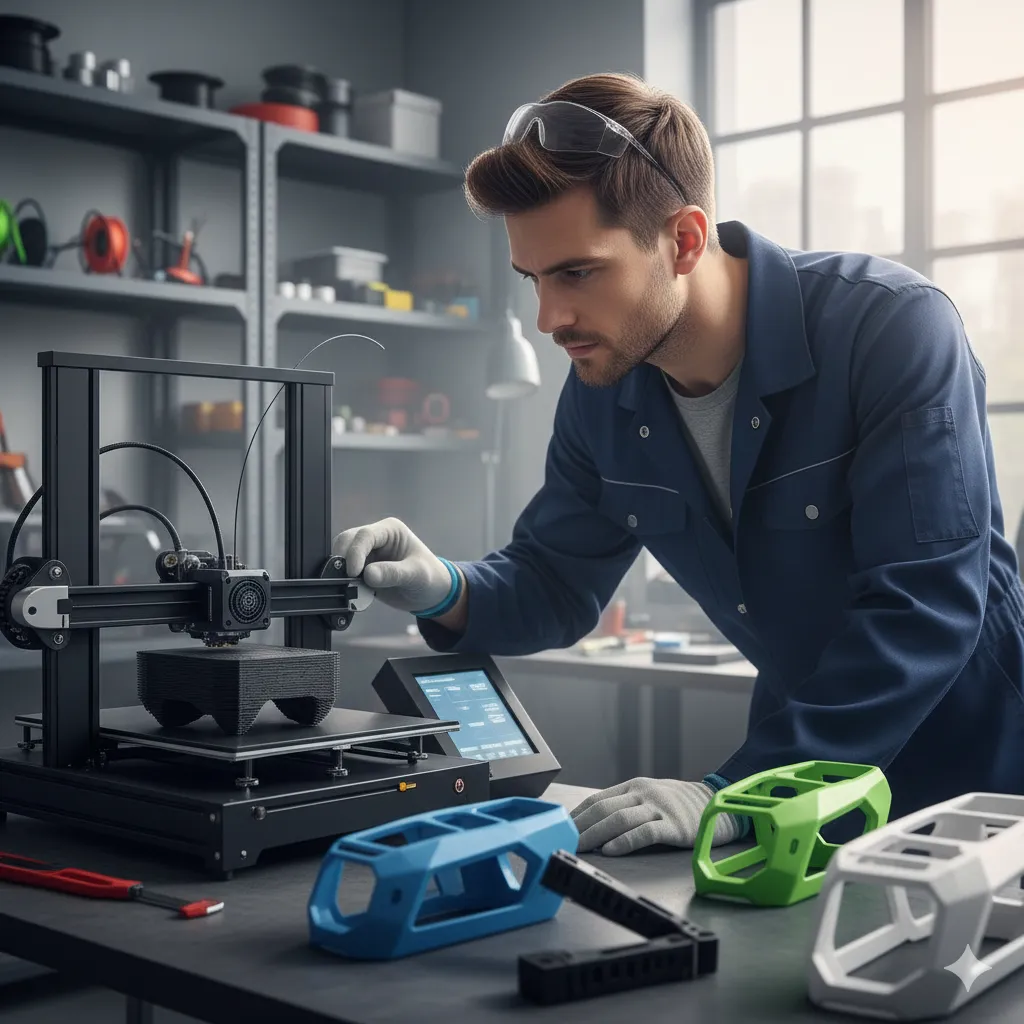
A 3D printing prototype removes that delay. It turns ideas, sketches, and CAD files into something that can be held, tested, and broken—often within days. For early-stage founders, that speed isn’t a convenience. It’s survival.
This article explains how 3D printing fits into rapid product development, how 3D modeling prototyping connects to physical iteration, what actually drives 3D printing prototype cost, and when 3D rapid print methods outperform traditional approaches.
What a 3D Printing Prototype Is (And Why It Matters Early)
A 3D printing prototype is not a demo model. It’s not a visual mockup. And it’s definitely not a finished product.
Its job is simple:
- Turn assumptions into physical facts
- Reveal problems CAD can’t show
- Enable fast iteration without long lead times
For startup-minded makers, the first prototype isn’t about polish. It’s about answering uncomfortable questions early—before money and timelines harden.
Why 3D Printing Is the Default for Early Prototyping
Compared to traditional fabrication, 3D printing offers one decisive advantage: speed without commitment.
It allows founders to:
- Iterate designs daily instead of monthly
- Test fit, form, and basic function cheaply
- Change geometry without retooling costs
That flexibility is why 3D printing dominates early-stage prototyping, especially when requirements are still evolving.
Why Product Development Experience Matters in 3D Printing
A 3D printer can produce parts quickly, but successful product development depends on knowing what those parts are meant to teach. The most effective prototypes are not necessarily the most polished or expensive. They are the ones that help founders uncover design flaws, validate assumptions, and make better decisions before investing in manufacturing.
PrototyperLab combines more than 20 years of product development and engineering experience with hands-on prototyping and manufacturing expertise. Having supported the development of more than 100 SKUs across consumer products, electronics, robotics, automation systems, and custom hardware projects, the team understands how 3D printing fits into the larger product development process.
Rather than treating 3D printing as a standalone solution, PrototyperLab uses rapid prototyping as part of a structured development pathway that includes CAD design, functional testing, design iteration, CNC machining, small-batch production, and manufacturing preparation. This helps founders identify technical risks earlier, reduce costly redesigns, and determine when a project is ready to move beyond printed prototypes and into production-ready manufacturing methods.
The combination of U.S.-based project oversight and Vietnam manufacturing capabilities also provides founders with access to rapid iteration, cost-effective engineering resources, and scalable production options. This allows teams to move quickly during early validation while maintaining a clear path toward manufacturing once the product has been proven.
For startups developing physical products, the real value of 3D printing is not speed alone. It is the ability to learn faster, make informed engineering decisions, and reduce uncertainty before committing significant time and capital to production.
From 3D Modeling Prototyping to Physical Reality
Most founders already start with CAD.
The mistake is stopping there.
3D modeling prototyping only becomes valuable once it meets physical constraints:
- Gravity
- Tolerances
- Assembly friction
- Human interaction
A design that looks perfect on screen often fails when printed. Walls flex. Fasteners don’t align. Clearances vanish.
That’s not a failure—it’s the point.
The fastest teams move back and forth between CAD and physical prints repeatedly, tightening the design with each cycle.
The Real Advantage of 3D Rapid Print Cycles
A 3D rapid print workflow compresses feedback loops dramatically.
Instead of:
Design → wait → review → redesign
Founders get:
Design → print → test → adjust → repeat
This creates momentum:
- Design decisions are grounded in reality
- Problems surface early, when they’re cheap
- Teams learn faster than competitors still “planning”
Speed compounds when iteration costs are low.
Understanding 3D Printing Prototype Cost (Without Guessing)
Many founders assume 3D printing is “cheap.” It can be—but only when used correctly.
3D printing prototype cost is driven by:
- Part size and volume
- Material selection
- Print resolution and tolerance requirements
- Number of iterations (this is the hidden one)
The biggest cost mistake isn’t printing—it’s overprinting.
Teams waste money when they:
- Print high-resolution parts too early
- Lock into final materials prematurely
- Reprint entire assemblies instead of modular sections
Smart teams print only what’s needed to answer the next question.
Rapid Manufacturing With 3D Printing: Where It Works Best
Rapid manufacturing 3D printing bridges the gap between prototyping and production—but it has limits.
It works well for:
- Small batch validation runs
- Complex geometries that tooling can’t justify yet
- Early customer testing units
It struggles when:
- Unit volumes increase
- Surface finish must be perfect
- Material properties must exactly match final production
Used correctly, rapid manufacturing extends learning—not replaces manufacturing strategy.
When 3D Printing Is the Wrong Tool
Fast doesn’t mean universal.
3D printing is not ideal when:
- Mechanical loads are critical
- Tight tolerances dominate performance
- The final product will be injection molded or machined metal
In those cases, 3D printing should still come first—but only as a learning step, not the final validation method.
This sequencing mistake is where many startups lose time and money.
How Experienced Teams Sequence 3D Printing Prototypes
Effective teams follow a progression:
- Low-fidelity prints to test concept and scale
- Functional prints to validate mechanisms
- Refined prints to test assembly and usability
- Transition to other processes once risks are exposed
Each stage answers a different question. Skipping steps usually creates blind spots that surface later—when fixes are expensive.
Why Early 3D Printing Improves Manufacturing Outcomes
Early prototypes don’t just inform design—they shape manufacturing decisions.
A well-used 3D printing prototype:
- Reveals tooling challenges early
- Improves communication with manufacturers
- Reduces back-and-forth during production prep
Founders who show factories a tested prototype get better quotes, clearer timelines, and fewer surprises.
3D Printing as a Learning Tool, Not a Shortcut
The most dangerous belief in prototyping is that speed alone guarantees success.
3D printing works when it’s used to:
- Learn deliberately
- Fail early
- Iterate intentionally
It fails when it’s used to:
- Chase visual perfection too soon
- Avoid hard design decisions
- Delay manufacturing reality
The value comes from what the prototype teaches, not how fast it prints.
Why 3D Printing Prototypes Are a Strategic Advantage
For early-stage hardware teams, the advantage isn’t the printer—it’s the mindset.
Founders who prototype early:
- Spend less guessing
- Move with evidence
- Make better downstream decisions
A 3D printing prototype is often the first moment an idea becomes real. That moment should happen as early—and as cheaply—as possible.
The Smart Next Step for Founders
If the goal is to validate a product without locking into expensive tooling or long factory timelines, 3D printing prototypes provide the fastest path forward.
Used alongside rapid iteration and small-batch thinking, they allow founders to test ideas, gather feedback, and move toward manufacturing with confidence instead of assumptions.That’s how speed becomes an advantage—rather than a risk. Let PrototypeLab help you, get your quote today!
Send over a sketch, a CAD file, or just a description of what the product needs to do. A real quote comes back within 48 hours.
Get a free quote