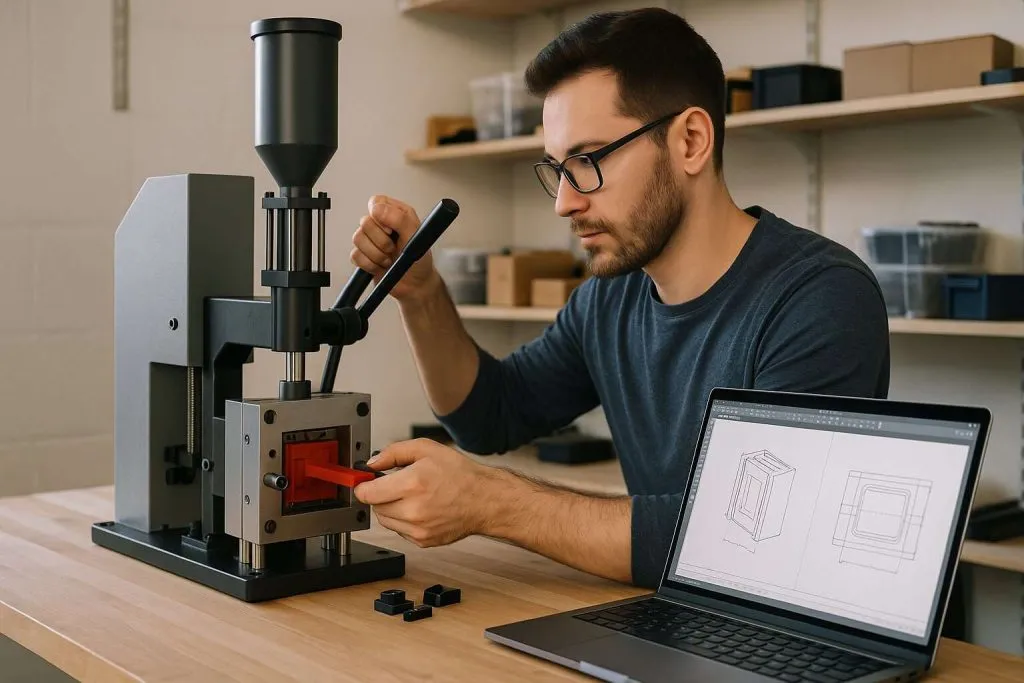
Desktop plastic injection molding has become a popular search among makers and startup founders. Affordable benchtop machines promise to deliver molded parts in-house without the expense of professional services.
For early-stage innovators, the idea of controlling manufacturing from a small workshop sounds like a shortcut to savings and speed.
But here’s the reality: while desktop plastic injection molding has its place, it often becomes a trap. Founders waste time on underpowered desktop tools, only to discover they can’t produce the quality or volume needed to test the market.
This article explains when desktop molding works, where it fails, and why professional small-batch injection molding is often the smarter path.
What Is Desktop Plastic Injection Molding?
Desktop (or benchtop) plastic injection molding uses compact, manually operated or semi-automated machines to form plastic parts. Unlike industrial presses, these machines are scaled down to fit a workshop. They typically:
- Use aluminum or resin-based molds.
- Handle simple thermoplastics like ABS, polypropylene, or polyethylene.
- Operate with low-tonnage pressure, sometimes via manual levers.
- Produce parts in very low volumes—usually a handful at a time.
For startups, this can seem like a budget-friendly way to create prototypes or a first batch of parts.
When Desktop Injection Molding Works
There are specific scenarios where desktop machines are useful:
- Proof-of-Concept Models
- Creating simple enclosures, test brackets, or housings for fit and feel.
- Works when surface finish and strength are less critical.
- Low-Volume Educational Use
- Popular in maker spaces and university labs where the goal is learning, not production.
- Very Early Prototype Iteration
- Founders experimenting with form factors may benefit from producing 5–10 parts quickly before investing more.
- Basic Plastics
- If the design can use low-cost plastics and doesn’t demand engineering-grade materials, a desktop machine may suffice.
For tinkering or validation, desktop plastic injection molding can be a helpful tool.
The Limitations of Desktop Injection Molding
Most founders eventually discover the ceiling of desktop equipment:
- Quality Gaps—Rough surface finish, flash, and tolerance issues make parts look unprofessional.
- Limited Material Options—Many engineering plastics can’t be processed at low tonnage.
- Throughput Bottlenecks—Producing even 20 identical units can take days of manual work.
- Mold Durability—Aluminum or resin molds degrade quickly, creating inconsistent results.
- Scaling Blockers—When demand rises, a desktop setup can’t keep pace.
These limits turn what looked like a cost-saving tool into a source of lost time and sunk costs.
Hidden Costs Founders Don’t See
Desktop plastic injection molding machines often sell for $2,000–$5,000, making them look cheaper than professional services. But the hidden costs add up fast:
- Molds—Even a basic aluminum mold costs hundreds to thousands of dollars.
- Trial and Error—Failed runs waste resin, energy, and time.
- Labor Time—Operating a manual press, trimming flash, and troubleshooting eats into founder hours.
- Opportunity Cost—Time spent learning to mold is time not spent pitching, selling, or validating the market.
What looks like savings on paper often translates to delays in reality.
Can Desktop Injection Molding Compete with Professional Services?
In short: no. Desktop molding cannot compete with professional injection molding when it comes to quality, consistency, and scalability.
- Professional low-volume injection molding uses steel tooling and higher tonnage presses for precise, production-ready parts.
- Desktop injection molding machines are limited by low pressure, weaker molds, and restricted material options.
Professional services also offer:
- Investor-ready surface finish and tolerances
- Faster turnaround for 20–100 units
- Access to engineering-grade plastics for functional prototypes
- Repeatable results that scale into larger production
For startups preparing for launch, professional injection molding services are the difference between a test-ready product and wasted cycles on underpowered machines.
Desktop vs. Professional Injection Molding: Side-by-Side
| Factor | Desktop Plastic Injection Molding | Professional Injection Molding |
| Upfront Cost | $2K–$5K for machine + molds | Higher tooling cost, but predictable per-part rate |
| Volume | 1–20 practical | 20–100+ efficient small-batch runs |
| Quality | Inconsistent, rougher finish | Production-grade, investor-ready |
| Time | Immediate, but slow for scaling | 7–30 days for tooling, then rapid output |
| Materials | Limited to basic plastics | Full range of engineering plastics |
Start Desktop Plastic Injection Molding Alternatives with PrototyperLab
Desktop plastic injection molding works as a learning tool or for extremely low-volume tests. But for most startups, it quickly becomes a bottleneck. The parts look unpolished, production is slow, and the equipment struggles with anything beyond the simplest designs.
Professional services, on the other hand, offer the quality, speed, and scalability needed to validate demand and impress investors. Instead of sinking money into a machine you’ll outgrow, it’s often smarter to leverage a partner that provides 30-day prototypes, 20-unit minimum runs, and transparent pricing.
Don’t waste time on underpowered desktop tools. Get high-quality, small-batch parts with professional injection molding support. Start desktop plastic injection molding alternatives, build a prototype with PrototyperLab today, and launch with the speed, quality, and scalability your startup needs.
Send over a sketch, a CAD file, or just a description of what the product needs to do. A real quote comes back within 48 hours.
Get a free quote