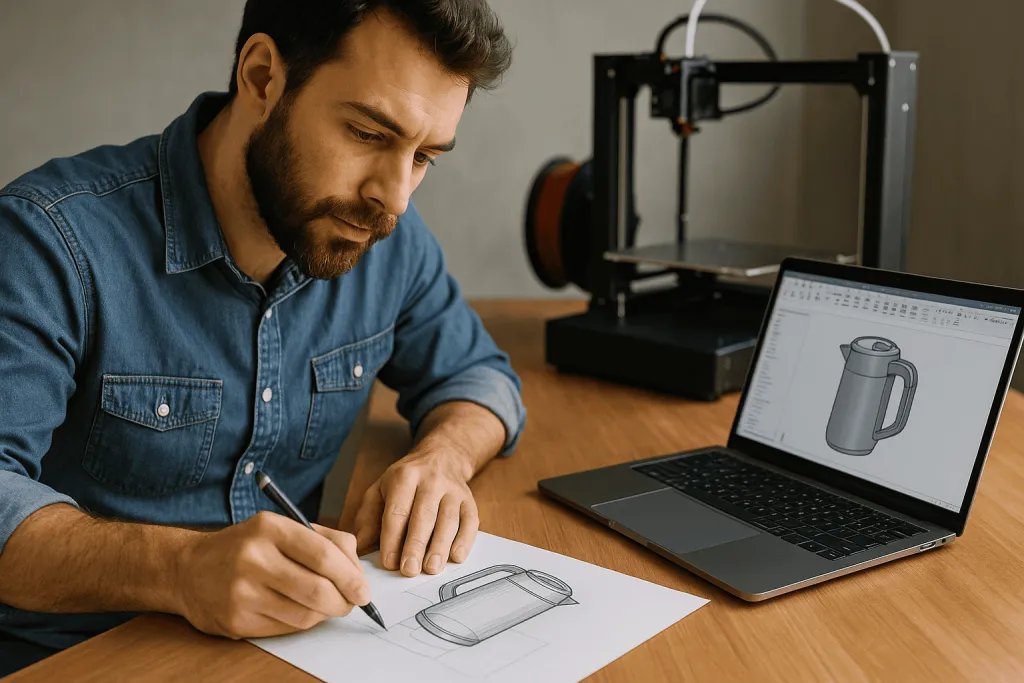
Bringing a physical product to market shouldn’t require a $50K budget, a six‑month timeline, or a 500‑unit commitment.
A lean product development strategy gives early‑stage founders a faster, lower‑risk way to build, test, and iterate a product, especially in hardware.
This guide breaks down what lean product development means for physical goods, how to apply it step‑by‑step, and how to avoid common pitfalls that kill early‑stage momentum.
What Is Lean Product Development?
Lean product development is a strategy that focuses on building the simplest version of a product—fast—so it can be tested and improved based on real‑world feedback. Originally developed for manufacturing, it’s now widely used in startup product teams to reduce waste, accelerate learning, and avoid overbuilding.
For hardware founders, lean product development means:
- Rapid prototyping with minimal cost
- Small batch production to validate demand
- Iterating based on customer feedback before scaling
Why Founders Use Lean Product Development
Lean product development is a streamlined approach to bringing new products to market faster, with lower cost and less risk. Instead of overbuilding upfront, it focuses on creating a functional version quickly so it can be tested, improved, and validated with real users.
This method is especially useful for hardware founders looking to avoid long timelines and high MOQs.
1. Minimize Upfront Costs
Traditional product development often requires major investments before seeing any customer reaction. Lean strategy reduces this risk by building only what’s needed for learning—then improving.
Use case: Instead of spending $10K on a fully polished prototype, use affordable 3D‑printed parts and off‑the‑shelf components to test functionality for $1–2K.
2. Accelerate Time‑to‑Market
A lean process prioritizes getting a testable version into real users’ hands in weeks—not months. That means faster validation, quicker pivots, and earlier revenue opportunities.
At PrototyperLab: Most prototypes are built in 30 days, with 20–100 unit production runs ready upon your go signal.
3. Avoid Overbuilding
Many founders invest in features users never ask for. Lean development prevents this by focusing only on what solves the core problem.
Key Steps in Lean Product Development for Physical Products
Lean product development isn’t just a mindset—it’s a step-by-step process built for speed, clarity, and customer feedback. For physical products, each stage must balance engineering feasibility with market validation. The goal is to create a testable version fast, learn from real users, and improve before scaling.
Step 1: Define the Problem and Value Proposition
- What problem is the product solving?
- Who is the customer?
- Why will they buy this instead of current alternatives?
Lean strategy starts with clarity. If the problem and solution aren’t clearly defined, product development becomes guesswork.
Step 2: Map Out Core Features Only
Strip the product down to what’s essential for functionality and feedback.
Ask:
- What are the must‑haves for a working version?
- Can any features be simulated or delayed until later?
Use CAD tools like Fusion 360 or SolidWorks to mock up the core design quickly.
Step 3: Build a Testable Prototype Fast
The prototype doesn’t have to be final—it just needs to work.
Tactics:
- Use 3D printing, laser cutting, or silicone molds
- Combine ready‑made components (e.g., Arduino, Raspberry Pi)
- Focus on proof of concept, not polish
PrototyperLab Advantage: Transparent $25/hour prototyping with in‑house 3D printing means founders can build affordably without hidden fees.
Step 4: Get Feedback with Small Batch Production
Once the prototype is approved, produce a small batch—typically 20 to 100 units—to validate the market.
Benefits:
- Lower investment
- Less inventory risk
- Real‑world usage data
Pain Point Solved: No more 500+ unit MOQs from factories. With lean production, a 20‑unit run is enough to test demand on Amazon, Shopify, or Kickstarter.
Step 5: Test, Measure, Iterate
Use the small batch to:
- Collect customer reviews
- Spot design flaws
- Understand buying behavior
- Validate pricing and packaging
Then return to the prototype stage if needed. This cycle—build, test, improve—is the core of lean product development.
Common Mistakes to Avoid
- Over‑Engineering the First Version: A perfect product that nobody wants is a waste. Focus on “good enough to test.”
- Skipping the Prototype Phase: Jumping to tooling or bulk orders without testing increases the odds of product failure.
- Ignoring Manufacturing Feasibility: Design choices in CAD may not be manufacturable at scale. Work with engineers who bridge design and production.
- Relying on Unverified Freelancers: Many founders get burned by unreliable vendors. Choose partners with U.S. contracts and clear communication.
Tools and Services That Support Lean Development
Building a product the lean way requires the right tools at every stage—from design to testing to launch. These tools and services help founders move quickly, cut costs, and stay focused on validation instead of perfection. Here’s what supports an efficient lean product development workflow.
- CAD Software: Fusion 360, SolidWorks
- Rapid Prototyping: 3D printing, CNC machining, silicone molding
- Small Batch Manufacturing: Injection molding, laser cutting, short‑run PCB assembly
- Platforms for Launch: Kickstarter, Amazon, Shopify
- Validation Tools: Pre‑order landing pages, email waitlists, small influencer campaigns
Lean Product Development at PrototyperLab
PrototyperLab is built specifically for lean product development. From 30-day prototyping to small batch production runs, every service is designed to help founders move fast, stay lean, and validate early.
How It Works
- Prototype in 30 Days
- As few as 20 Units for testing
- $25/hr transparent pricing
- US‑based contracts + Vietnam‑based cost advantage
Services Include
- CAD design and engineering
- 3D printing, molding, and low‑volume manufacturing
- Small batch production and packaging
- Logistics from Vietnam to the US or Europe
When to Use a Lean Product Development Strategy
Lean product development is ideal when:
- You have a new product idea and want to validate demand quickly
- You’re launching a Kickstarter campaign or Amazon test
- You’re bootstrapping and need to control costs
- You need a functioning product but not a mass‑manufactured version
It’s not ideal if:
- You’ve already raised funding and need to scale immediately
- You’re replicating an existing product with known market demand
Stop Overbuilding. Start Testing.
If you’ve got a physical product idea, don’t waste months or thousands before knowing it works.
PrototyperLab can help you go from concept to prototype in 30 days—and launch with just 20 units.
Get a transparent quote today. No upfront payment. No inflated costs. Just real progress.
Request a Project Quote
Frequently Asked Questions (Lean Product Development)
Q: What is lean product development?
Lean product development is a process that focuses on building a simplified version of a product to validate functionality and demand with minimal time, cost, and waste.
Q: How do I start lean product development for a physical product?
Start by identifying the core problem you’re solving, designing only essential features, building a quick prototype, and testing it through small batch production (20–100 units).
Q: What tools are best for lean product development?
To validate market demand, use tools like Fusion 360 for CAD, 3D printers for prototyping, and platforms like Kickstarter or Shopify.
Q: Can I use a lean strategy for hardware products, not just software?
Yes. Lean development is beneficial for hardware because it reduces the high costs and risks of physical product launches.
Q: How long does it take to build and test a product using lean methods?
With partners like PrototyperLab, you can go from idea to small batch production in as little as 30–45 days.
Send over a sketch, a CAD file, or just a description of what the product needs to do. A real quote comes back within 48 hours.
Get a free quote