Startup manufacturing is no longer about placing a 500-unit order with an overseas factory and hoping the market responds. Today’s founders—especially bootstrapped innovators and early-stage e-commerce entrepreneurs—need a faster, safer, and more cost-efficient way to bring a physical product to life.
Small batch manufacturing delivers exactly that. When paired with rapid prototyping and 20–100 unit micro-production runs, startup manufacturing becomes a weapon for validation, speed, and smarter spending.
The most efficient hardware founders aren’t gambling on mass production—they’re using strategic small batch manufacturing to test demand, refine their design, and launch with confidence.
Why Startup Manufacturing Works Best in Small Batches
Traditional manufacturing demands large MOQs, slow timelines, and high upfront investment. But startup manufacturing needs something different:
- Speed over perfection
- Cost control over a large inventory
- Flexibility over rigid factory schedules
- Validation over speculation
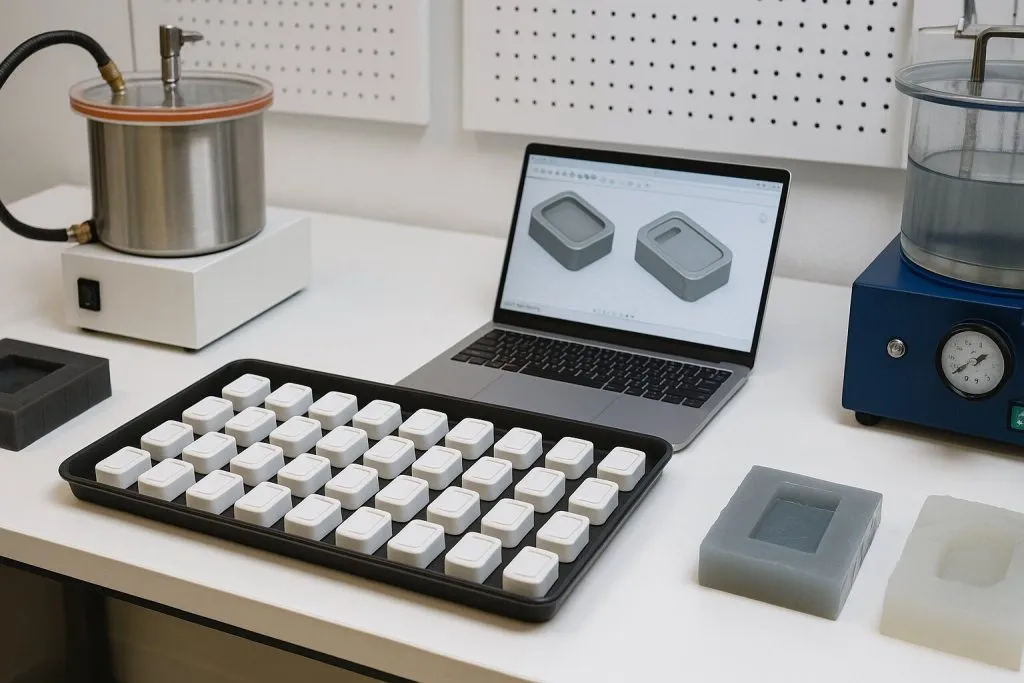
Small-batch manufacturing (typically 20–100 units) directly addresses every major pain point a founder faces in early development—while avoiding the financial burn of mass production.
The 20–100 Unit Advantage: The Sweet Spot for Modern Startup Manufacturing
Large factories never tell founders this, but here’s the truth: 20–100 units is the most efficient batch size for early-stage hardware validation.
This range gives founders access to:
1. Fast, low-risk testing
Producing 20 or 50 units eliminates the guesswork. Founders can immediately test:
- Real customer interest
- Amazon conversion rate
- Kickstarter traction
- Mechanical reliability
- Unboxing experience
- Reviews and returns
All without committing to warehouse-level inventory.
2. Meaningful customer feedback
Five prototypes won’t reveal real-world feedback. Twenty to 100 units will.
Startup manufacturing in this range allows for statistically useful testing before committing to mass production.
3. The ability to improve your design before scaling
Once a founder sees how customers actually use the product, refinement becomes easier—and far cheaper—than trying to fix flaws after a 500-unit mistake.
This is where microbatch manufacturing outperforms mass production every single time.
4. Rapid market entry
Once the prototype is approved, a small batch production run can follow in about 30 more days.
Founders get to market before competitors, before trends fade, and before cash flow tightens.
How Small-Batch Startup Manufacturing Saves Time
Startup manufacturing is about compressing the entire product development cycle. Small batches make that possible because they eliminate the slowest parts of traditional factory work:
No long waiting times for tooling
Injection molding for 1000+ units can take months.
For 20–100 units, processes like urethane casting, low volume injection molding, or CNC fabrication can start immediately.
No drawn-out factory negotiations
Factories want large orders. Small batch specialists know how to execute on day one.
No delays waiting for mass-production slots
Micro-production gets prioritized because it requires smaller setups and less line time.
Fast iteration loops
Startup manufacturing thrives on iteration. When a founder receives a 30-day prototype, makes adjustments, and begins a 20-unit run immediately, the timeline collapses from months to weeks.
This speed gives small teams their competitive edge.
How Small-Batch Startup Manufacturing Saves Money
Founders don’t just save time—they protect capital.
1. No massive upfront inventory investment
Instead of paying $10K+ for a 1000-unit run, a founder might spend a few hundred to a few thousand dollars to validate demand first.
2. Lower risk of dead inventory
Most early-stage failures come from buying too much inventory too soon.
Producing 20–100 units prevents that.
3. Transparent cost control
With processes like:
- Rapid prototyping
- Low-volume injection molding
- Urethane casting
- CNC machining
Founders receive transparent cost-per-unit pricing and can scale gradually.
4. No warehouse fees
Small-batch manufacturing allows founders to avoid long-term storage or 3PL fees until the product proves itself.
5. Smart reinvestment
Instead of sinking everything into the first run, founders can:
- Test
- Refine
- Raise funds
- Reinvest
- Scale wisely
This is exactly how modern hardware startups grow sustainably.
Why Startup Manufacturing Works Best with a 30-Day Prototype
A fast prototype isn’t just convenient—it’s strategic.
1. It reduces iteration time
One prototype per month is useless for hardware startups.
A 30-day prototype allows multiple design cycles in a single month.
2. It reveals manufacturing issues early
Designing in CAD is one thing. Seeing a fundamental part in your hand is another.
3. It prevents expensive mistakes
Fixing a design before production is a hundred times cheaper than fixing it afterward.
4. It aligns perfectly with microbatch production
Once the prototype is validated, the small batch run starts immediately—keeping momentum strong.
Founders launch faster, refine faster, and learn faster.
How Startup Manufacturing Using Small Batches Builds Product-Market Fit
Startup manufacturing isn’t just about producing parts—it’s about validating a business.
Here’s how 20–100 units help founders build real product-market fit:
1. Immediate customer feedback
Amazon reviews, Kickstarter comments, and early adopter insights guide the next iteration.
2. Real conversion rate data
Founders see:
- How well the listing performs
- What messaging resonates
- What pricing converts
- Where customers hesitate
This data is more valuable than any survey.
3. Proof for investors
Investors trust traction—not ideas.
A startup showing conversion data from a 20-unit batch has stronger leverage than a founder with nothing but a prototype.
4. Smoother transition into mass production
Once demand is validated, founders know:
- What needs to be improved
- What features matter
- What customers complain about
- What packaging works
This reduces tooling mistakes and increases manufacturing confidence.
The Hidden Advantage: U.S. Contracts + Vietnam Production
Most founders don’t know they can have both:
- U.S.-based legal protection
- Vietnam-based manufacturing costs
This hybrid reduces risk and preserves budget. It also eliminates common frustrations like:
- Unreliable overseas suppliers
- Hidden fees
- Ghosted communication
- Poor quality control
Startup manufacturing works best when a founder has fast, reliable engineering and affordable production—without sacrificing legal protection.
This operational model is one of the strongest advantages for any early-stage product developer.
What Startup Manufacturing Looks Like in Practice (From CAD to 100 Units)
Here’s the simplified, founder-friendly workflow:
1. CAD Concept
Requirements, dimensions, materials, and functionality defined.
2. Rapid 30-Day Prototype
Using 3D printing, machining, or molding.
3. Test → Refine → Improve
Adjustments are made quickly before committing to production.
4. Produce 20–100 Units
Using low-volume manufacturing methods like:
- Urethane casting
- Low-volume injection molding
- CNC machining
5. Validate in Real Market Conditions
Sell, test, gather reviews, and measure.
6. Scale with Confidence
Using the data to determine whether to invest in mass production.
This is the modern startup manufacturing pipeline—lean, fast, and far more predictable than traditional models.
Why Startup Manufacturing Works Best with a Partner Built for Speed
Early-stage founders don’t need a giant factory.
They need a small, technical, fast-moving team focused on:
- Rapid prototyping
- Small batch production
- Transparent pricing
- IP safety
- Engineering clarity
- Reliable Vietnam-based manufacturing
- U.S. contracts and protection
This combination accelerates development while protecting the founder’s runway.
Small-Batch Production Is the Smartest Path for Startup Manufacturing
Founders who embrace small batch manufacturing save time, reduce risk, and launch faster—with far less capital. Startup manufacturing isn’t about guessing. It’s about validating your idea with the smallest investment possible, then scaling confidently based on what the market tells you.
In a world where speed and capital efficiency define winners, microbatch manufacturing is no longer optional—it’s the foundation of a smart hardware launch.Ready to build smarter? Get a quote and start your startup manufacturing project today.
Send over a sketch, a CAD file, or just a description of what the product needs to do. A real quote comes back within 48 hours.
Get a free quote