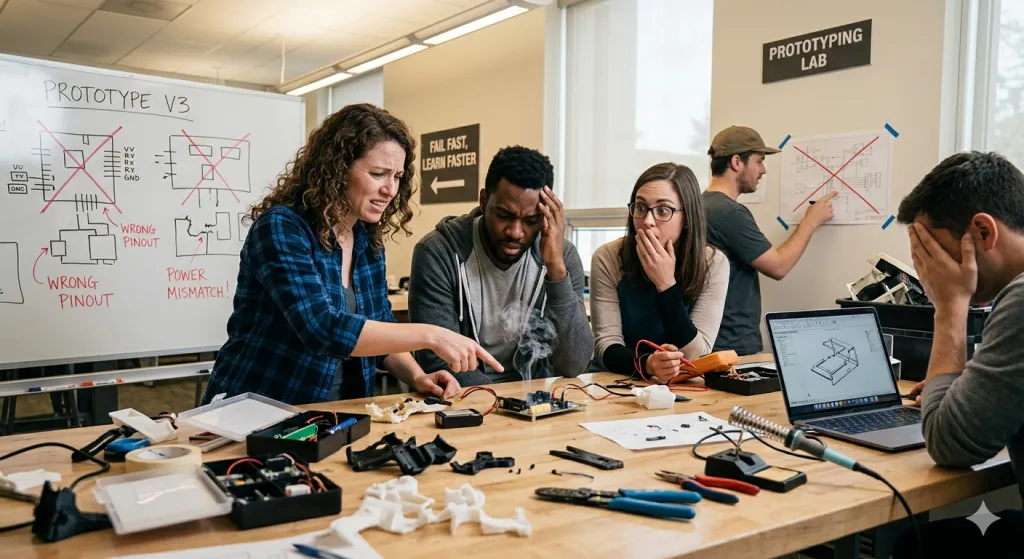
Most physical product startups don’t fail at launch. They failed six months before it, when a founder decided to wait.
Wait until the design is perfect. Wait until the funding comes through. Wait until they find a manufacturer willing to take them seriously. The logic feels responsible. In practice, it’s one of the most expensive decisions a founder can make.
The mistake isn’t moving too fast. It’s confusing preparation with progress. And in physical product development, there’s a specific version of this trap that catches first-time founders again and again: delaying the prototype.
Why Founders Wait (And Why It Costs Them)
The reasoning is understandable. Prototyping sounds expensive. It sounds like something you do after the idea is fully baked, after the pitch deck is done, after a manufacturer agrees to work with you. Founders assume they need to have everything figured out before they can build anything physical.
That assumption is wrong, and it compounds quickly.
Every week spent refining a concept on paper instead of in hand is a week of delayed feedback. No amount of CAD files, mood boards, or investor conversations will tell a founder what holding the actual product reveals in 30 seconds. Does it feel right? Is the weight off? Does the mechanism work the way the drawing suggested?
The founders who wait the longest are often the ones who’ve invested the most in the idea emotionally. They want it to be perfect before anyone, including themselves, can evaluate it critically. That instinct is human. But in product development, it’s fatal.
The Real Cost Isn’t the Prototype. It’s the Delay.
Here’s the math that rarely gets discussed. A prototype built at $25 per hour for 40 hours costs $1,000. That’s a real number. It feels significant.
Now consider the alternative. A founder spends three months refining specs, sourcing a factory that requires a 500-unit minimum order, and commits to a $40,000 production run before a single unit has been tested in the real world. One design flaw, one sizing issue, one material problem discovered after the fact doesn’t cost $1,000. It costs everything.
Rapid prototyping exists specifically to close that gap. The point isn’t to build the final product. It’s to build something physical, fast, so the feedback loop starts before the big bets are placed.
What Rapid Prototyping Actually Means for a Startup
Rapid prototyping is the process of turning a product concept into a physical object quickly, using manufacturing methods like 3D printing, CNC machining, or silicone molding, depending on what the product requires.
For a tech startup, that might mean:
- A 3D-printed housing for an IoT device to test form factor and ergonomics
- A CNC-machined aluminum component to validate tolerances before committing to tooling
- A silicone-molded grip or seal to test material behavior under real conditions
- An electronics prototype to confirm that the control logic works before the enclosure is finalized
Each of these can be produced in days, not months. And each one answers a question that no design file can answer on its own.
PrototyperLab builds these kinds of prototypes in about 30 days, with a dedicated engineer assigned to each project and transparent pricing at $25 per hour. There’s no ticketing queue, no account manager relay. The engineer building the prototype is the person the founder talks to.
The ‘Perfect Conditions’ Trap
There’s a specific version of the waiting mistake worth naming directly: the perfect conditions trap.
It sounds like this:
- “I’ll prototype once I have the full spec finalized.”
- “I’ll prototype once I raise my seed round.”
- “I’ll prototype once I find a manufacturer who can scale with me.”
- “I’ll prototype once I know exactly what I want.”
The problem with each of these is that prototyping is how founders get to “exactly what I want.” It’s not the reward for figuring it out. It’s the tool for figuring it out.
Waiting for perfect conditions before prototyping is like waiting to feel confident before doing the thing that builds confidence. The sequence is backwards.
Small Batch Manufacturing Changes the Risk Equation
One reason founders delay prototyping is that they conflate it with full production. They imagine that moving from concept to physical product means committing to hundreds or thousands of units.
That’s a legacy assumption from an era when it was true. It isn’t anymore.
Small batch manufacturing, starting at as few as 20 units, lets founders test a validated prototype with real customers before scaling. It’s not a compromise. It’s the smarter sequencing. Build 20. Sell 20. Learn what those 20 customers think. Then decide whether to build 200 or redesign entirely.
That loop, from idea to prototype to small batch to real customer feedback, is what separates founders who launch successfully from founders who spend 18 months building something nobody asked for.
What to Do Instead of Waiting
The alternative to waiting isn’t recklessness. It’s structured speed. Here’s what that looks like in practice:
- Start with a rough concept, not a finished spec. The prototype will inform the spec, not the other way around.
- Choose the right prototyping method for the question being asked. Form factor questions call for 3D printing. Mechanical tolerance questions call for CNC. Material behavior questions call for silicone molding.
- Set a clear objective for the prototype. What specific question does this physical object need to answer?
- Build it, test it, and write down what changed. That document becomes the foundation of the next iteration.
- Move to small batch only when the prototype has answered its questions. Not before. Not after months of additional delay.
The Founders Who Move Fast Win More Often
This isn’t a philosophical argument for speed over quality. Quality matters. Durability matters. Getting the product right matters enormously.
But the founders who prototype early, test physically, and iterate quickly are the ones who arrive at quality faster. They catch problems at the $1,000 stage instead of the $40,000 stage. They validate demand before they over-invest in supply. They show up to manufacturer conversations with a tested physical product instead of a PDF.
That last point matters more than most founders realize. A manufacturer who sees a physical prototype treats the founder differently than one who receives a concept deck. It signals seriousness, clarity, and reduced risk on their end too.
Stop Waiting. Start Building.
The prototyping mistake that kills products before they launch isn’t building the wrong thing. It’s building nothing while waiting for the perfect moment to begin.
That moment doesn’t arrive on its own. It gets created, by founders who decide that an imperfect physical prototype beats a perfect design file every time.
Ready to build your first prototype?
PrototyperLab works with early-stage founders and eCommerce entrepreneurs to turn product ideas into physical prototypes in about 30 days. Small batch production starts at 20 units. Pricing is transparent at $25/hour. U.S.-based leadership, Vietnam-based production.Reach out at PrototyperLab to start the conversation with a dedicated engineer who’ll work directly on your project.
Send over a sketch, a CAD file, or just a description of what the product needs to do. A real quote comes back within 48 hours.
Get a free quote