Every hardware founder eventually runs into the same problem: prototyping quotes that feel like lottery numbers. Factories promise “affordable” development but deliver vague estimates, unexpected upcharges, and a final bill far beyond the original quote. For startup-minded makers who need traction fast, opaque pricing is more than a nuisance—it’s a threat to runway, timelines, and investor confidence.
Transparent prototyping pricing solves that problem. And for early-stage founders, a clear $25/hour engineering rate is often the difference between making a prototype happen and shelving the idea entirely.
This guide breaks down why transparent pricing matters, how hidden factory costs quietly drain your budget, and why structured hourly billing gives founders more control, more clarity, and better results.
Why Transparent Prototyping Pricing Matters More Than Ever
Founders in the early build stage are juggling three urgent priorities:
- Get a working prototype fast
- Keep development affordable
- Avoid surprise costs that blow up the budget
Traditional factories make this harder than it needs to be. Their quotations usually fall into one of the following patterns:
- A range so large it’s meaningless (“$800–$1,500 depending on complexity”)
- A flat rate that hides labor, markup, and rework fees
- A teaser price designed to hook founders before adding change-order charges
These pricing structures force founders to guess where their money is going. Transparent prototyping pricing eliminates the guesswork completely.
Hidden Fees: The Cost Trap Most Factories Never Talk About
Factories rarely break down what’s actually included in their quote. That lack of clarity becomes expensive fast. Common hidden prototyping costs include:
1. Redesign Fees
Even small revisions—button placement, screw bosses, wall thickness—are charged as separate line items. Factories treat improvements as “scope changes,” not iteration.
2. Markups on Materials
Many factories bundle material costs into a single fee. The founder never sees the real cost of resin, silicone, aluminum, or electronics.
3. Tooling & Setup Charges
These often appear after development begins, framed as “required for production.” For early prototypes, many of these tools aren’t necessary at all.
4. Specialized Labor Fees
Hand-finishing, mold repair, CAD corrections—factories add these later rather than disclosing them upfront.
5. Cost Creep During Testing
Testing and adjustments eat into the budget quickly because factories price every new test as a separate milestone.
This isn’t dishonesty—it’s simply how most traditional manufacturing economics work. But for early-stage founders validating an idea, hidden fees are a structural disadvantage.
A flat $25/hour engineering rate eliminates these traps because every hour is accounted for.
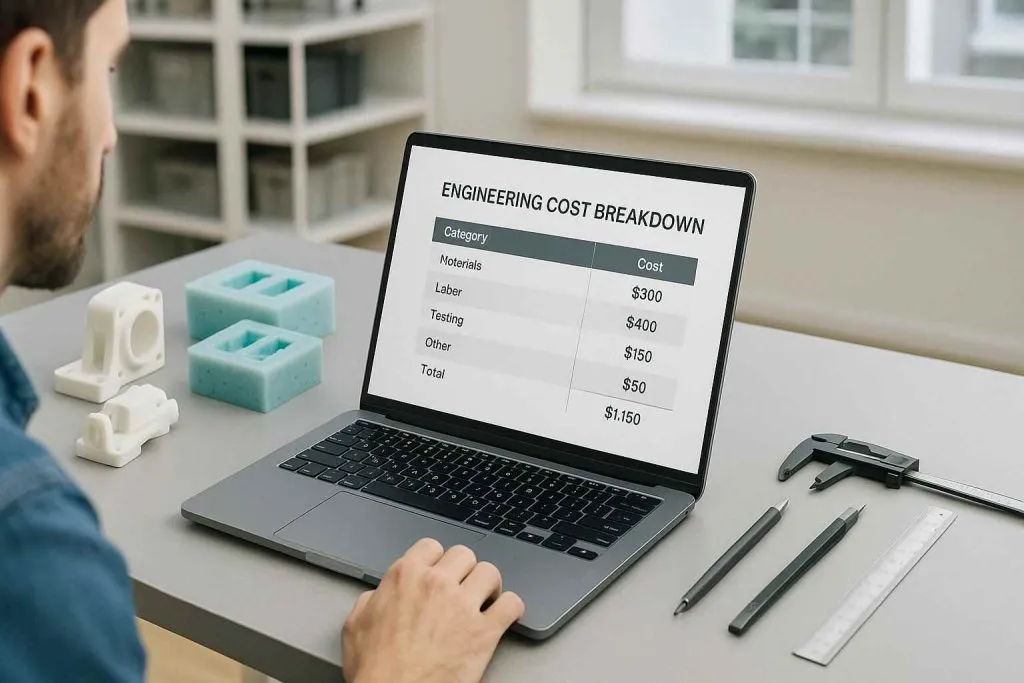
Prototyping Cost Breakdown: What $25/Hour Actually Covers
Transparent hourly pricing works because it separates the real effort from the mystery markup. For founders comparing prototyping hourly rates, here’s what’s typically included in structured, transparent billing:
1. CAD & Mechanical Engineering
- 3D modeling
- Design for manufacturing
- Tolerance planning
- Integration of electronics
2. Iteration Cycles
You know exactly how long each revision took and how many hours were used.
3. Prototype Fabrication
This includes 3D printing, silicone mold preparation, resin casting, or small CNC runs—billed only for the time required, not padded.
4. Testing & Refinement
Mechanical fit, function testing, stress checks, and improvements are included in trackable engineering hours.
5. Documentation & Final Adjustments
Founders get complete visibility into what was done, when it was done, and how long it took.
No bundled fees.
No inflated “complexity surcharges.”
Just a clean, traceable cost structure.
This is exactly what startup-minded makers want: clarity, control, and predictable cash flow.
Why $25/Hour Beats Factory Quotes That “Look Cheaper” on Paper
Many founders assume that overseas factories cost less because the quoted number looks low. In reality, the lack of transparency almost always results in higher costs.
Here’s why transparent hourly pricing wins.
1. It Prevents Cost Creep
Factories often present a low entry quote, then increase it after:
- Fixes
- Redesign requests
- Tolerance adjustments
- Test failures
- Finishing needs
A transparent prototyping cost breakdown stops that cycle entirely because every activity is already included in billable engineering hours.
2. It Gives Founders True Budget Control
Startup founders hate surprises. Hourly pricing lets them:
- Pause work
- Change direction
- Allocate hours intentionally
- Protect cash flow
This is impossible with factories, where work often begins before details are finalized.
3. It Reflects Real Work—Not Bundled Numbers
Factories blend the following into a single figure that hides actual engineering time:
- Labor
- Materials
- Rework
- Tooling
- Markup
- Revisions
With hourly billing, founders see:
- Minutes tracked
- Hours allocated
- Iteration time
- Engineering complexity
This builds trust and confidence.
4. It Follows a True Lean Hardware Development Mindset
Founders validating an idea need:
- Low-cost prototype development
- Fast iteration
- Small test batches
- Clear, predictable spending
Hourly pricing supports a lean development loop: Build → Test → Improve → Repeat without committing to a massive budget upfront.
5. It Helps Startups Avoid “Prototype Drift”
Prototype drift happens when factories make changes internally that the founder doesn’t see.
Transparent pricing aligns incentives. The engineering goal is simple:
Shape the product exactly to spec, as efficiently as possible.
Factories, on the other hand, are incentivized to maximize billable milestones.
Why Startup Founders Prefer the US–Vietnam Hybrid Model
A transparent hourly pricing model becomes even more powerful when combined with a cost-effective production setup.
A US–Vietnam hybrid system offers:
- U.S. contracts and legal protection
- On-the-ground Vietnam engineering for cost savings
- Low-cost prototyping for startups
- 20–100 unit small batch manufacturing
- Real-time communication with experienced engineers
This structure gives founders reliability and affordability without the trade-offs of traditional offshore factories.
How Transparent Pricing Safeguards Founders From Hidden Factory Risks
Integrating your supporting keywords naturally, these are the biggest risks transparent pricing eliminates:
- Hidden prototyping costs
- Hidden manufacturing fees
- China factory hidden fees
- Unclear overseas vs U.S. pricing differences
- Unexpected small batch production costs
Factories bury these fees because they protect their margin. Founders absorb them because they have no visibility.
A transparent hourly structure puts founders back in control.
What Transparent Pricing Looks Like in Practice
Here’s a sample scenario for a simple consumer electronics prototype:
- CAD + design: 8 hours
- Initial 3D print + finishing: 4 hours
- Testing + adjustments: 3 hours
- Final revision: 2 hours
Total: 17 hours × $25/hr = $425
Materials billed separately at actual cost.
The founder sees every hour and can adjust the scope at any point.
Transparent Pricing Is More Than a Cost Model—It’s a Competitive Advantage
Founders operating on a limited runway need predictability. Transparent pricing provides:
- Budget discipline
- Clear timelines
- Aligned incentives
- Founder confidence
- Faster iteration cycles
When early prototypes determine whether a product gets investor-ready, Kickstarter-ready, or Amazon-ready, clarity isn’t optional—it’s an advantage.
Get a Prototype Built With Transparent $25/Hour Pricing
If you’re building your first version—or refining a next-gen concept—you deserve a prototyping partner who tells you exactly where your money goes.
PrototyperLab offers:
- 30-day rapid prototyping
- $25/hour transparent engineering
- 20–100 unit small batch manufacturing
- U.S. contracts + Vietnam production cost savings
- No hidden fees. No surprise charges. No inflated factory quotes.
Build your first 20–100 units with no hidden costs. Get a quote today and start building your prototype.
Send over a sketch, a CAD file, or just a description of what the product needs to do. A real quote comes back within 48 hours.
Get a free quote