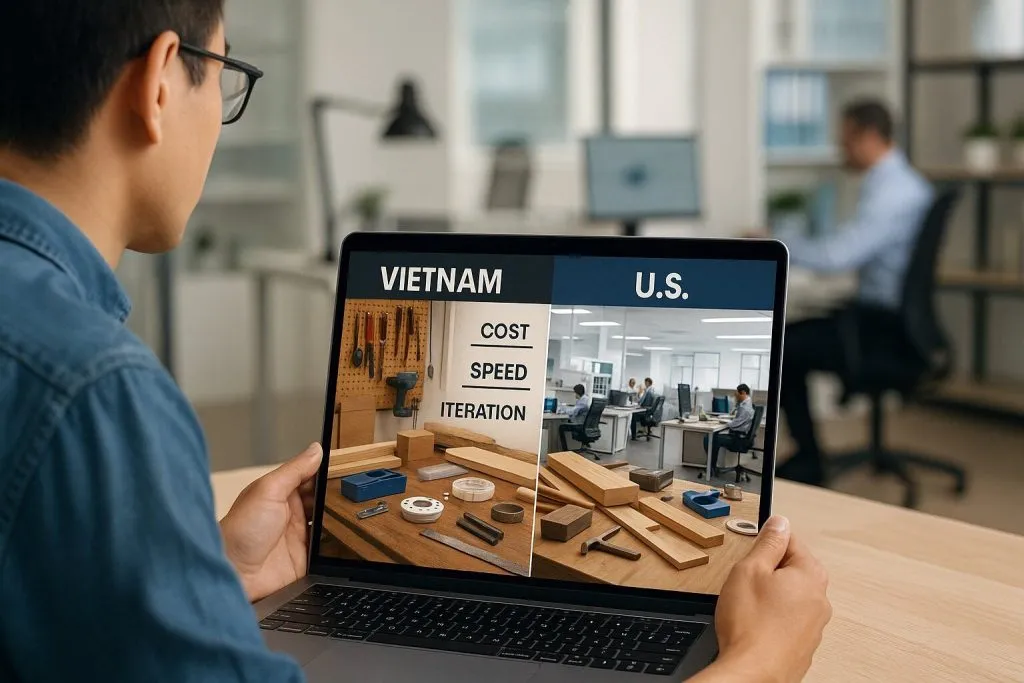
Founders evaluating where to build their physical product almost always end up comparing Vietnam vs. US product development. It’s the most direct way to understand how cost, speed, quality, and IP safety shift between regions—and how those factors affect time-to-market. For early-stage innovators, Amazon sellers, and Kickstarter founders, the choice determines whether the first 20–100 units get built quickly or whether the project becomes another stalled idea.
The decision carries weight. U.S. development offers familiarity and strong legal protection, but the cost is steep. Vietnam offers unmatched affordability and access to skilled trades, but requires effective oversight to remain aligned with U.S. market expectations. Understanding the pros and cons of offshore product development is essential before committing a real budget.
This article breaks down what founders need to know about both regions, explains why the Vietnam prototyping cost structure has become a significant advantage, and shows how combining U.S. engineering expertise with Vietnam-based fabrication creates a safer, faster, and more cost-effective path from idea to prototype.
Why Founders Research Vietnam vs. US Product Development
The typical search stems from very real constraints:
- U.S. engineers bill at $100–$150/hr
- Vietnam engineering starts at $25/hr
- Every physical product requires multiple iterations
- Offshore teams introduce IP and communication concerns
- U.S. prototyping cycles move too slowly for fast-testing founders
- Offshore prototyping can’t stand alone without tight leadership
Startup-minded makers don’t have the time or budget for slow, expensive, or risky development cycles. They need a build-test-improve loop that matches eCommerce timelines—not corporate ones.
U.S. Product Development: Advantages and Limitations
When comparing Vietnam vs. the U.S. product development, founders naturally start with the U.S. because it feels safer and more predictable. But the trade-offs become clear as soon as the prototype quote arrives.
Advantages of U.S. Product Development
1. Strong Insight Into the U.S. Consumer Market
One of the biggest advantages in the US engineering vs. Vietnam engineering debate is understanding how Americans use and evaluate products. U.S. engineers instinctively understand local ergonomics, safety expectations, regulatory norms, and consumer behavior.
This makes it easier to align early prototypes with:
- U.S. preferences
- Product review standards
- Market expectations on Amazon and Shopify
2. Superior Legal Protection
The U.S. is the safest jurisdiction to protect IP when outsourcing product development. NDAs are enforceable. Contracts hold weight. Patent strategy is easier to coordinate. Founders immediately know their rights and can rely on the legal system if something goes wrong.
3. Clean Communication and Cultural Alignment
Complex ideas translate more clearly when the engineer is familiar with:
- U.S. communication norms
- Niche product categories
- Subtle functional decisions
Fewer misunderstandings occur in early design phases.
Limitations of U.S. Product Development
1. Significantly Higher Cost
U.S. engineers typically charge $100–$150 per hour. When early-stage founders compare estimates, the first shock is financial. Even a simple consumer product can burn through $10K before the first working model exists.
2. Slow Iteration Cycles
This is the most underrated weakness of U.S.-based development.
Local engineers often do not have easy access to:
- Wood shops
- Metal fabrication teams
- Plastic molding technicians
- Textile workers
Every trade must be subcontracted, scheduled, and shipped between teams. That slows iteration from days to weeks.
3. Expensive Multiple Iterations
Every physical prototype needs revisions. No matter how strong the initial design is, testing always reveals new problems. In the U.S., each iteration adds significant engineering hours and material cost, making the process slow and costly.
Vietnam Product Development: Advantages and Limitations
Vietnam has become one of the most compelling ecosystems for early-stage prototyping and small-batch production. When founders analyze the pros and cons of offshore product development, Vietnam consistently stands out as a cost-efficient and high-speed option.
Advantages of Vietnam Product Development
1. Vietnam Prototyping Cost Advantage ($25/hr)
This is the biggest reason founders shift their search from the U.S. to Vietnam. Engineering starts around $25 per hour, allowing more design exploration and more testing without draining the budget.
A founder can accomplish:
- More iterations
- More prototypes
- More refinements
2. Immediate Access to Skilled Trades
Vietnam’s manufacturing districts give engineers real-time access to:
- Wood carpenters
- CNC machinists
- Welders
- Plastic fabricators
- Textile and fabric technicians
This is a major advantage in the US engineering vs. Vietnam engineering comparison. Prototypes can be built, tested, modified, and rebuilt within days—not weeks.
3. Faster Iteration and Production Cycles
Because fabrication shops are local and affordable, Vietnam can complete full prototypes in about 30 days. This pace aligns with startup expectations and allows founders to validate fast.
4. Small-Batch Manufacturing (20–100 Units)
Vietnam excels at limited-quantity production. This makes it ideal for Amazon test launches, pre-order fulfillment, or Kickstarter validation.
Limitations of Vietnam Product Development
1. Limited Awareness of U.S. Market Expectations
Vietnamese engineers often excel technically but may lack knowledge of:
- U.S. user behavior
- Western ergonomics
- Competitive benchmarks
- Typical U.S. product issues
Without guidance, designs can drift away from what American customers expect.
2. IP Protection Is Not as Strong When Contracting Directly Overseas
Vietnam is safer than China, but offshore contracts are still offshore. Enforcement is harder, and founders have limited recourse if problems occur.
3. Communication Gaps and Misinterpretation Risks
Language barriers can complicate feature discussions or functional nuances. This often leads to preventable rework unless an experienced U.S. engineer supervises.
The Best-of-Both-Worlds Hybrid Model: U.S. Contracts + Vietnam Engineering
This is where founders find the real solution. A U.S.-based company that oversees Vietnam engineering combines the strengths of both environments while eliminating their weaknesses.
Why This Hybrid Model Works
1. U.S. Engineers Provide Strategic Oversight
American engineers ensure:
- Customer expectations are met
- Functionality aligns with U.S. standards
- Market fit is not overlooked
- IP strategy is protected and enforceable
This addresses the primary challenge in U.S. engineering versus Vietnam engineering: achieving U.S.-level design quality at Vietnam-level costs.
2. Vietnam Engineers Deliver Fast, Affordable Execution
The proximity to skilled material trades and fabrication shops significantly compresses development cycles. Prototypes can go from CAD to physical builds in days.
3. U.S. Contracts Protect Your IP
Because founders sign with a U.S. entity, all agreements fall under U.S. jurisdiction. This is the safest way to protect IP when outsourcing product development while still benefiting from offshore affordability.
4. Rapid Iteration That Matches Startup Timelines
Engineers design. Tradesmen build. Engineers revise. Tradesmen rebuild.
All in one tightly connected workflow.
This eliminates slow, fragmented handoffs and gives founders the ability to test quickly and adapt their product in real time.
5. Small-Batch Runs for Early Validation
Vietnam’s ability to produce 20–100 units makes validation simple and affordable. Founders can test packaging, durability, ergonomics, conversion rates, and reviews before committing to large-scale manufacturing.
Which Path Should a Founder Choose?
Choose U.S. Product Development if:
- Legal protection is the top priority
- The product demands deep knowledge of U.S. consumer expectations
- Budget is flexible
- Timelines are not urgent
Choose Vietnam Product Development if:
- Cost-efficiency is important
- Fast iterations matter
- Early small-batch units are needed
- Physical trades (wood, metal, plastic, fabric) are involved
Choose the Hybrid Model if:
- You want U.S. oversight with Vietnam speed
- You need strong IP protection
- You want transparent pricing (like $25/hr)
- You want a 30-day prototype
- You need 20–100 units for early validation
- You want the lowest-risk approach overall
For most early-stage founders, the hybrid model delivers the optimal mix of affordability, protection, and speed.
Making the Smart Call on Vietnam vs. US Product Development
Choosing where to develop a physical product determines how quickly a founder can test demand, gain reviews, secure pre-orders, and refine the design. The U.S. offers strong IP protection and market understanding, but moves more slowly and costs significantly more. Vietnam offers rapid iteration, affordability, and access to skilled trades, but needs experienced oversight to maintain U.S.-focused quality.
The hybrid model—utilizing U.S. contracts, U.S. engineering leadership, and Vietnam-based execution—addresses the shortcomings of both. It gives founders the confidence to move fast, spend smarter, and get a working product without unnecessary risk.
Get Your Quote for Vietnam vs. US Product Development
Build your prototype in 30 days, validate quickly with 20+ units, and launch with confidence under complete U.S. legal protection. Get your quote from PrototyperLab today!
Send over a sketch, a CAD file, or just a description of what the product needs to do. A real quote comes back within 48 hours.
Get a free quote