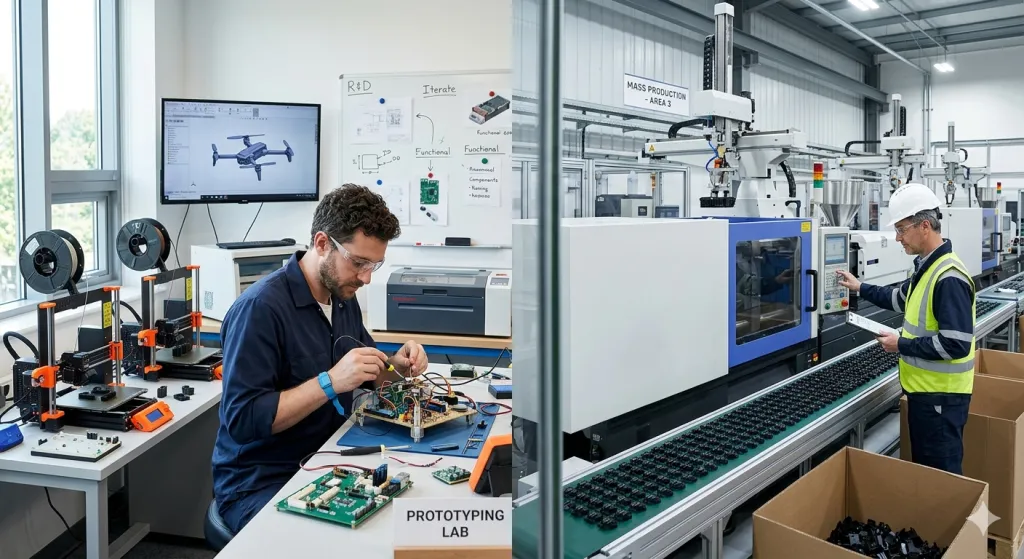
You have a product idea. Maybe it’s been sketched on a napkin for months, or it’s already been mapped out in CAD software. Either way, you’ve arrived at the same pivotal question almost every hardware founder eventually faces: do you take your concept straight to a manufacturer, or do you go through a prototyping company first?
The short answer: almost always, you prototype first. But the longer answer—the one that actually saves you money, time, and heartbreak—requires understanding why rapid prototyping is needed in the first place, and what happens to founders who skip it.
The Traditional Product Development Process (And Why It Fails Startups)
For decades, the traditional product development process looked something like this: ideate, design, source a manufacturer, produce a large batch, then sell. This works reasonably well for large corporations with deep pockets and established supply chains. But for a startup or small product team, it’s a minefield.
Here’s why: manufacturers are optimized for volume. Their entire operation—from tooling to line setup to quality control—is built around batch production vs. mass production economics. When you show up with an unvalidated design and ask for a small run, you’re either going to pay an enormous premium, get deprioritized, or—most dangerously—receive a product with design flaws baked in at scale.
Going directly to a manufacturer before validating your design is one of the most expensive mistakes a hardware founder can make.
Why Rapid Prototyping Is Needed: The Real Reasons
So why do designers make prototypes? There are several answers to this, and they compound on each other.
1. To uncover design flaws before they cost you. A flaw discovered during prototyping costs you days. The same flaw discovered after a production run costs you months and tens of thousands of dollars—sometimes the entire company.
2. To validate form, fit, and function. Why are prototypes made? Because no amount of virtual product design fully replaces holding something in your hands. CAD models and renders can look flawless while hiding ergonomic problems, assembly issues, or material incompatibilities that only surface in a physical build.
3. To communicate with manufacturers more effectively. When you eventually do approach a manufacturer, a validated prototype is your most powerful negotiating tool. It communicates your intent precisely, reduces ambiguity, and gives manufacturers something to quote against accurately.
4. To iterate cheaply. Prototyping lets you test multiple versions of a design rapidly before committing to tooling. This is the core principle behind lean product development for hardware—build, test, learn, repeat, then scale.
What a Prototyping Company Actually Does
A prototyping company (sometimes called a prototype manufacturing lab) specializes in building low-volume, high-accuracy physical versions of your product. They are not trying to make a thousand units. They are trying to make the right unit.
Their toolbox typically includes:
- 3D Printing/Additive Manufacturing: 3D printing prototype work is the most common entry point. It’s fast, relatively affordable, and available in a wide range of rapid prototyping materials—from standard PLA and ABS to engineering-grade resins, nylon, and even metal-filled filaments. For early-stage form validation, 3D printing is hard to beat.
- CNC Machining: For parts that need tighter tolerances or need to be made from specific metals or engineering plastics, CNC machining steps in. Prototype sheet metal work falls here too—brackets, enclosures, structural components that need to behave exactly like production parts.
- Prototype PCB Boards: For products with electronic components, a prototype PCB board is a critical deliverable. Prototype PCBs are typically produced in very small quantities (sometimes just 5–10 boards) to validate circuit design before committing to production-volume PCB fabrication.
- Prototype Tooling: Some prototyping companies offer prototype tooling and manufacturing—creating soft tooling or bridge tooling that allows injection-molded parts to be produced at low volumes before full hardened production tools are made. This is especially valuable when you need to test injection-molded geometry.
The key differentiator of a prototyping company is speed and flexibility. They’re set up for rapid prototyping techniques—quick turnaround, design iteration, and close collaboration with your engineering team.
What a Manufacturer Is Actually Good At
A manufacturer is a production machine. They are optimized for consistency, volume, and cost-per-unit at scale. This is exactly what you need—but only after your design is locked.
Where manufacturers excel:
- Producing hundreds or thousands of identical units with consistent quality
- Sourcing materials at volume pricing
- Running established production processes (injection molding, die casting, automated PCB assembly)
- Managing supply chains for long production runs
Where manufacturers struggle:
- Design iteration (every change costs money and delays)
- Small-batch flexibility
- Accommodating unvalidated designs
- Tolerating the ambiguity that naturally exists in early-stage product development
Going to a manufacturer before you’ve validated your design is like hiring a contractor to build your house before the architect has finished the blueprints.
Where to Get a Prototype Made: Your Options
If you’re wondering where to get a prototype made, you have more choices than ever:
- Dedicated prototype manufacturing labs—Full-service shops that handle everything from 3D printing to CNC to small-batch PCB assembly. Best for complex, multi-component products.
- Online rapid prototyping services—Platforms that let you upload a CAD file and receive machined or printed parts within days. Great for individual components and quick geometry checks.
- University and makerspaces—If budget is extremely tight, many cities have prototype labs with equipment access. Slower, but low cost.
Your eventual manufacturer’s NPI (New Product Introduction) team—Some larger manufacturers have in-house prototyping capabilities. This can work well if you’re close to production-ready, but it tends to be less flexible for early-stage iteration.
The Lean Product Development Case for Prototyping First
Lean product development for hardware is built on one foundational idea: validate assumptions as cheaply and quickly as possible before scaling. Every dollar spent on prototyping is insurance against spending ten dollars (or a hundred) fixing mistakes in production.
Here’s a simplified comparison:
| Stage | Prototyping Company | Direct to Manufacturer |
| Cost to iterate design | Low | Very High |
| Turnaround time | Days to weeks | Weeks to months |
| Volume flexibility | High | Low |
| Tolerance for design changes | High | Low |
| Cost per unit | High | Low |
| Best for | Validation & learning | Scaled production |
The conclusion is clear: prototyping companies and manufacturers serve different stages of your product journey. They are not competing options—they are sequential partners.
A Note on Virtual Product Design
Modern virtual product design tools—CAD software, FEA simulation, digital twins—have dramatically reduced the number of physical iterations needed before a good prototype. But they have not eliminated the need for physical validation.
Simulation tells you how a design should behave. A prototype tells you how it actually behaves. Both are valuable. Neither replaces the other.
Why Rapid Prototyping Is Needed Before You Ever Talk to a Manufacturer
If you’re early in your product journey, go to a prototyping company. Invest in rapid prototyping techniques, validate your design with real prototype product builds, fix what’s broken, and only then approach a manufacturer with a locked, validated design.
If you’re later in the journey—design validated, materials chosen, production volumes defined—a manufacturer is exactly who you need.
The founders who try to skip the prototyping phase in order to save time almost always end up spending more of both. Understand why rapid prototyping is needed, respect what it does, and use it to set yourself up for a production run you can actually be confident in.Looking to find a prototype manufacturing lab or understand which rapid prototyping materials are right for your project? The right partner at the prototyping stage can make all the difference in getting to a manufacturer-ready design.
Send over a sketch, a CAD file, or just a description of what the product needs to do. A real quote comes back within 48 hours.
Get a free quote