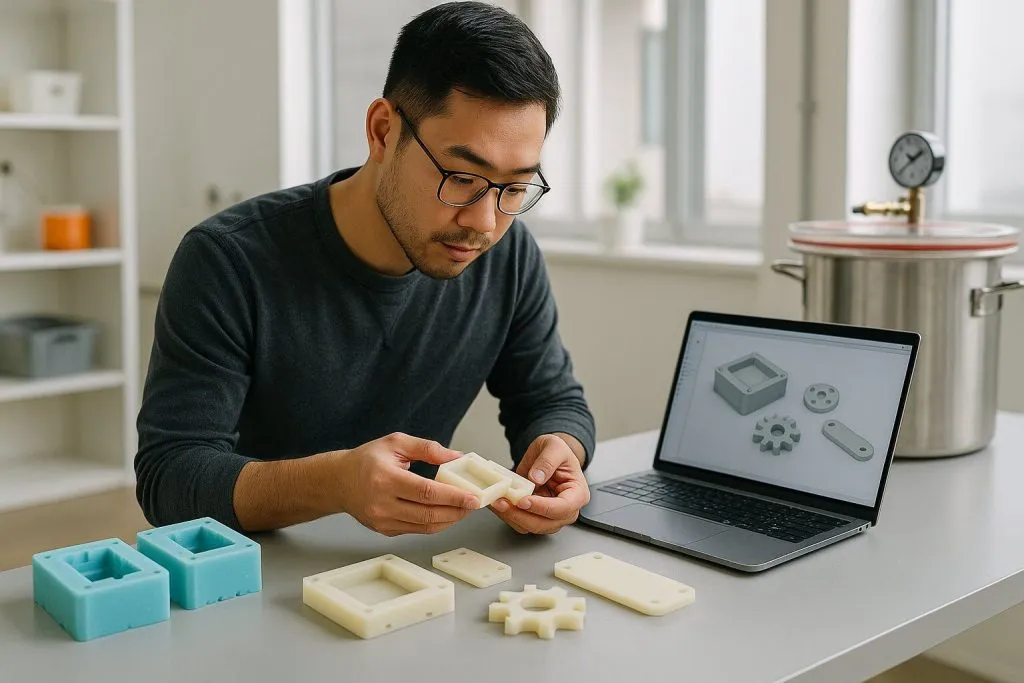
Urethane casting is one of the most practical ways for founders to produce small batches of plastic parts that look and feel like injection-molded products—without paying for expensive tooling. It’s fast, flexible, and cost-effective. But when handled carelessly, the process can turn costly, wasting both time and validation opportunities.
Early-stage founders often jump into casting with limited technical support or vendor oversight, assuming it’s as simple as 3D printing. The reality is that urethane casting mistakes—from poor mold design to curing shortcuts—can completely derail a launch timeline.
This guide breaks down the five most common errors founders make and offers practical fixes that keep your prototypes functional, consistent, and ready for testing.
1. Ignoring the Basics of Mold Design
One of the most damaging urethane casting mistakes happens before the first pour—at the CAD stage. Founders often hand over 3D files that were meant for printing or CNC machining, not for flexible silicone molds. That oversight leads to warped, incomplete, or inaccurate parts.
Common Problems
- Sharp internal corners that create stress points in the silicone
- Insufficient draft angles that make demolding difficult
- Wall thickness under 2mm, which leads to collapse during curing
- Ignoring material shrinkage (typically 0.3–1%)
Because urethane molds are elastic, even small design errors can distort geometry. When the mold isn’t engineered specifically for casting, dimensional accuracy suffers, forcing reprints or mold rebuilds.
How to Avoid It
Review your CAD files with an engineer who understands urethane casting design principles. Proper draft angles, wall thickness consistency, and vent placement are crucial. A well-designed mold minimizes distortion, reduces air traps, and extends mold life—saving both time and cost per part.
2. Skipping Proper Material Selection
Choosing the wrong urethane resin is one of the most overlooked but costly errors in small-batch production. Founders often prioritize aesthetics—color, texture, or finish—without verifying mechanical behavior, such as hardness, flexibility, or temperature resistance.
Common Results
- Prototypes that are too soft and flexible when rigidity is needed
- Overly brittle parts that crack during testing
- Sticky or uneven surfaces from incorrect mixing ratios
- Unexpected yellowing or degradation over time
Each resin has a specific Shore hardness and curing profile. Without matching material properties to function, prototypes can fail under simple load or environmental stress.
How to Avoid It
Start with your use case—does the part need impact resistance, flexibility, or stiffness? Engineers can help you choose the right resin blend and curing agent to simulate production-grade plastics like ABS or Nylon. This ensures your small-batch parts behave like their final versions, reducing risk when scaling to injection molding.
3. Overlooking Air Bubbles and Surface Defects
Among all common urethane casting problems, bubbles and surface defects are the most visible—and frustrating. They not only ruin the professional look of your parts but also weaken structure and compromise precision.
Why It Happens
- Mixing too fast introduces air into the resin
- Skipping vacuum degassing before casting
- Inadequate venting in the mold design
- Casting in humid environments (moisture reacts with urethane)
These flaws are especially damaging when the prototype needs a flawless appearance for investor presentations or crowdfunding photography.
How to Avoid It
Professional-grade urethane casting involves vacuum chambers, preheated molds, and controlled pour rates. The degassing process eliminates trapped air from both resin and mold cavities. Maintaining proper temperature and humidity ensures clear, smooth, and bubble-free finishes—essential for visual prototypes or functional pre-production parts.
4. Rushing Through Curing and Demolding
For founders on tight deadlines, waiting for parts to cure can feel like wasted time. Unfortunately, impatience often leads to warped or tacky prototypes. Rushing the demolding process also damages silicone molds, cutting their lifespan and increasing production cost.
Typical Issues
- Parts warp when removed before full cure
- Sticky or soft surfaces from undercured resin
- Mold tearing or losing shape after only a few cycles
Urethane materials require stable curing conditions—temperature, humidity, and time directly affect quality. Ignoring these parameters leads to failed parts or costly mold rebuilds.
How to Avoid It
Follow the resin manufacturer’s recommended cure schedule and let molds rest undisturbed. Most resins require 8–24 hours for full cure, depending on hardness. Use a high-quality release agent to prevent sticking and extend mold usability. The goal is consistency: every cycle should produce the same dimensional accuracy and finish quality.
5. Treating Urethane Casting as Final Production
One of the biggest strategic errors is assuming urethane casting can replace large-scale production. While it’s ideal for low-volume manufacturing and prototype testing, it’s not meant for thousands of units.
Why Urethane Casting Experience Matters
Successful urethane casting requires more than creating a silicone mold and pouring resin. Material behavior, mold design, curing conditions, venting strategies, dimensional tolerances, and production objectives all influence whether a prototype becomes a useful validation tool or an expensive setback.
PrototyperLab combines more than 20 years of product development and engineering experience with hands-on manufacturing expertise to help startups avoid the common mistakes that often derail early-stage projects. Having supported the development of more than 100 SKUs across consumer products, electronics, robotics, automation systems, and custom hardware products, the team has extensive experience selecting the right prototyping and low-volume manufacturing methods for different product requirements.
This experience is particularly valuable during the transition between prototyping and production. Decisions involving resin selection, mold design, surface finishes, part durability, and manufacturing scalability can significantly affect both development costs and product performance. By identifying these factors early, founders can reduce rework, improve prototype reliability, and make more informed decisions before investing in higher-volume production methods.
Rather than treating urethane casting as an isolated manufacturing process, PrototyperLab integrates rapid prototyping, vacuum casting, silicone molding, CNC machining, small-batch production, and manufacturing planning into a structured product development workflow. Supported by U.S.-based project oversight and Vietnam manufacturing capabilities, founders gain access to both engineering expertise and production resources designed to accelerate validation while minimizing risk.
For startups developing physical products, the goal is not simply producing parts quickly. The goal is using each prototype to gather meaningful feedback, validate assumptions, and build a stronger foundation for future production.
Common Founder Scenarios
- Launching a crowdfunding campaign with 50 urethane parts, then scaling prematurely
- Sending urethane parts directly to customers before stress-testing
- Ignoring that per-unit cost rises significantly after 100–200 parts
Urethane casting’s true strength lies in validation—not mass manufacturing. It’s your bridge between prototype and injection molding.
How to Avoid It
Use urethane casting for functional testing, market validation, and early pre-orders. Once feedback confirms demand, move to CNC-machined aluminum molds for injection molding or pressure die casting. This phased approach minimizes risk and preserves cash flow, especially for bootstrapped founders.
Why These Mistakes Matter
Each of these urethane casting mistakes does more than ruin a few parts—they disrupt launch timelines and investor confidence. A single rework can set back production by weeks, costing thousands in wasted materials and lost opportunities.
For lean startups, every hour and dollar counts. A well-executed casting process gives founders what they need most: speed, consistency, and proof of concept. With expert engineering oversight, urethane casting becomes a powerful accelerator instead of a bottleneck.
PrototyperLab’s Advantage: Engineered for Startups
PrototyperLab was built to remove the friction founders face in early-stage manufacturing. Its model combines U.S.-based leadership and legal protection with Vietnam-based engineering and production—delivering precision and cost-efficiency few others can match.
What Founders Gain
- 30-Day Rapid Prototyping: Get functional prototypes in your hands within about 30 days
- 20-Unit Minimum Production: Validate your idea affordably before scaling
- Transparent $25/hour Pricing: Know your exact engineering cost—no hidden markups
- End-to-End Service: From CAD design to silicone molding, casting, testing, and shipping
- US Contracts, Vietnam Production: Secure, efficient, and startup-friendly
Every urethane project goes through design review, vacuum casting under controlled conditions, and quality checks to ensure surface finish, hardness accuracy, and dimensional consistency. Founders get production-level results without mass-production minimums.
Prototype Without the Pitfalls
Urethane casting remains one of the best tools for validating physical products quickly and affordably. But like any manufacturing process, it requires precision, patience, and the right partner. Avoiding the five mistakes above can save your startup from unnecessary rework, delays, and missed opportunities.
Smart founders understand that every prototype isn’t just a part—it’s a milestone toward launch. When done right, urethane casting bridges the gap between concept and scalable production.
Avoid costly rework and delays—get your urethane casting done right the first time. Get a quote and build the right prototype today.
Related Reads
- Vacuum Casting vs. Injection Molding: Which Is Better for Low-Volume Production?
- How to Choose the Right Casting Method for Low-Volume Prototypes
- Pressure Die Casting forLow-Volume and Complex Metal Prototypes
Send over a sketch, a CAD file, or just a description of what the product needs to do. A real quote comes back within 48 hours.
Get a free quote