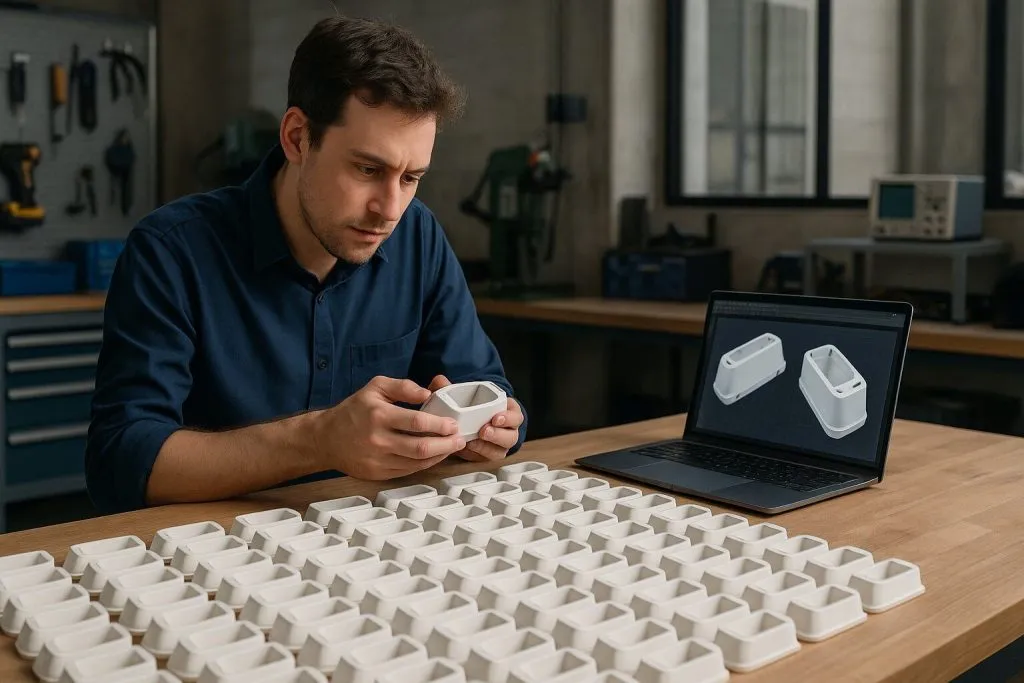
Every startup founder eventually asks the same question: “How do I get high-quality plastic parts without committing to thousands of units or spending $10,000 upfront?”
For early production runs, the debate often comes down to vacuum casting vs. injection molding. Both create professional-grade plastic parts, but they serve very different purposes.
If you’re trying to launch with 100–500 units, this article breaks down the pros, cons, and costs of each method—so you know exactly when vacuum casting makes sense.
What Is Vacuum Casting (And Why Founders Use It)?
Vacuum casting is a low-volume manufacturing process that uses a silicone mold under vacuum pressure to create parts from polyurethane resin.
Here’s why it matters for startups:
- It produces parts that look and feel like injection-molded plastics
- It works best for runs of 10–500 units—perfect for early customers
- It avoids the $5,000–$25,000 tooling bill of injection molding
Think of vacuum casting as a bridge between prototyping and mass production—giving you customer-ready units without a massive financial gamble.
What Is Injection Molding?
Injection molding is the go-to process for large-scale manufacturing. Molten thermoplastic is injected into metal molds (usually aluminum or steel), producing consistent parts at extremely low per-unit costs.
But here’s the catch: those molds are expensive to make. Unless you’re producing thousands of units, the upfront tooling cost outweighs the benefits.
Vacuum Casting vs. Injection Molding: Key Differences
| Factor | Vacuum Casting | Injection Molding |
| Best For | 10–500 parts | 1,000+ parts |
| Tooling Cost | Hundreds (silicone mold) | $5,000–$25,000 (steel/aluminum mold) |
| Turnaround | 2–4 weeks | 8–12 weeks (including tooling) |
| Unit Cost | Higher per part | Lower per part at scale |
| Flexibility | Easy to change design | Hard to change once the mold is made |
For founders, the difference is clear: vacuum casting is for speed and affordability at low volumes, while injection molding pays off only once you’re scaling.
When Should Startups Choose Vacuum Casting?
Vacuum casting fits best when you:
- Need 100–500 functional units for beta testing or pilot sales
- Want to ship Kickstarter rewards quickly without draining your campaign funds
- Need polished prototypes for investor meetings or retail photography
- Expect to iterate designs before committing to mass production
Example:
- A smart-home gadget founder needs 300 early units to test demand on Amazon
- A toy inventor wants to fulfill 200 Kickstarter backer rewards without blowing the budget
- A medtech startup needs 150 demo units for investor pitches
In all three cases, vacuum casting delivers production-quality parts fast and affordably.
Cost Breakdown: Vacuum Casting vs. Injection Molding
Founders often ask, “Is vacuum casting cheaper than injection molding?” The answer depends on volume.
- Vacuum Casting Costs
- Tooling: Hundreds of dollars for silicone molds
- 200 parts: ~$3,000–$6,000 depending on material/complexity
- Injection Molding Costs
- Tooling: $5,000–$25,000 upfront
- 200 parts: ~$10,000+ when tooling is factored in
At low volumes, vacuum casting is far more cost-effective. Injection molding only becomes cheaper once you’re producing 1,000+ parts.
Benefits of Vacuum Casting for Founders
- Affordable entry point: Skip the massive tooling bill
- Fast turnaround: 2–4 weeks instead of months
- High-quality finish: Smooth, detailed parts comparable to injection-molded plastics
- Flexible design changes: Easy to adjust between runs
- Customer-ready units: Suitable for shipping, selling, or demoing
This makes vacuum casting an essential tool for lean startups following the “build small, test fast, scale smart” playbook.
Real Startup Scenarios
Here’s how founders are already using vacuum casting:
- Amazon Test Run: A hardware startup launches with 250 units to gauge real-world demand
- Kickstarter Campaign: 300 polished units go to backers on time, without $10K sunk into tooling
- Investor Demo: Founders hand over production-like samples at pitch meetings, building confidence without overspending
These scenarios highlight why vacuum casting is a founder-friendly path to validation.
Why Not Always Choose Vacuum Casting?
Vacuum casting isn’t a forever solution. It’s perfect for low-volume production, but once demand scales beyond 1,000+ units, injection molding becomes more economical.
That’s why the smartest path is often:
- Prototype → 3D printing or CNC
- Pilot Production → Vacuum casting (100–500 units)
- Scaling → Injection molding (1,000+ units)
This staged approach lets startups validate demand before locking into expensive tooling.
How PrototyperLab Guides Startups
Choosing between vacuum casting and injection molding can feel overwhelming. That’s why PrototyperLab works as a partner, not just a service provider.
- 30-day prototyping to create your master model
- 100–500 unit vacuum casting runs for pilot production
- Injection molding support when it’s time to scale
- Transparent $25/hour engineering with no hidden fees
- U.S. contracts + Vietnam production for cost savings and legal safety.
This approach ensures you use the right process at the right time—saving both money and stress.
The choice between vacuum casting vs. injection molding depends on your stage:
- Use vacuum casting for 100–500 units when speed, affordability, and flexibility matter
- Use injection molding once you’ve validated demand and need thousands of units at scale
For startups, vacuum casting is often the safer first step—giving you the freedom to test, learn, and grow without a risky upfront commitment.
Work with PrototyperLab—the startup-friendly partner that helps you choose the best path. From 100-unit vacuum casting runs to full-scale injection molding, you’ll get honest advice and startup-ready production. Talk to PrototyperLab and get a quote for your low-volume production.
FAQ: Vacuum Casting vs. Injection Molding
1. What is the main difference between vacuum casting and injection molding?
Vacuum casting is best for 10–500 parts with low tooling costs, while injection molding is best for 1,000+ parts with higher upfront investment.
2. Is vacuum casting cheaper than injection molding for startups?
Yes—for small runs. Injection molding only becomes cheaper when producing thousands of units.
3. How long does vacuum casting take compared to injection molding?
Vacuum casting takes 2–4 weeks, while injection molding can take 8–12 weeks due to tooling.
4. Can vacuum casting parts be shipped to customers?
Yes. Vacuum-cast parts are durable and polished enough for early customer shipments, beta tests, or investor demos.
Send over a sketch, a CAD file, or just a description of what the product needs to do. A real quote comes back within 48 hours.
Get a free quote