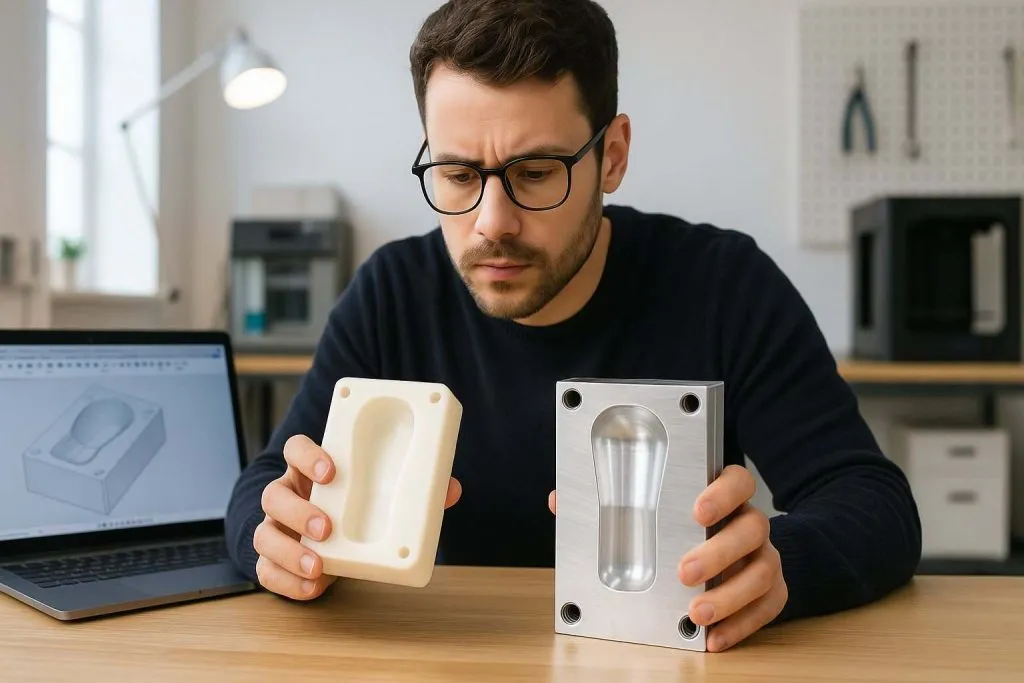
For many startup founders, the first big decision in injection molding isn’t what product to make—it’s what kind of mold to use.
3D printed molds promise speed and low cost, making them attractive for early prototypes. Aluminum molds, on the other hand, deliver durability and production-like quality but cost more upfront. Choosing the wrong one at the wrong stage can mean wasted money, lost time, and prototypes that don’t reflect the final product.
This guide breaks down 3D printed vs. aluminum injection molds with real-world context: cost, speed, quality, and when startups should use each. By the end, you’ll know exactly how to avoid the common mistake of confusing prototype tooling with production-grade molds.
Why Mold Choice Matters for Startups
Unlike 3D printing or CNC machining, injection molding requires tooling. That means before you make a single part, you need to invest in a mold. For a lean founder, this decision feels like a gamble:
- Spend too little, and your prototypes may not survive real testing
- Spend too much, and you blow your budget before you’ve even validated demand
The key is understanding that molds aren’t one-size-fits-all. 3D printed molds and aluminum molds serve very different purposes.
What Are 3D Printed Injection Molds?
3D printed molds are created from high-strength polymers or resins using SLA or DLP 3D printing. Instead of machining metal, you literally “print” the mold in hours.
Advantages for startups:
- Fast turnaround → print a mold in 1–3 days instead of weeks
- Low cost → $300–$800 compared to thousands for metal
- Iterative flexibility → if the design changes, just print another mold
- Good for early-stage testing → helps confirm dimensions, assembly, and initial fit
Limitations founders need to know:
- Low durability → typically lasts 20–50 injection cycles before warping
- Material restrictions → best for low-temp plastics; can’t handle high-performance resins
- Surface finish → parts may look rougher and require post-processing
- Not scalable → you can’t produce 100+ identical parts reliably
Think of 3D printed molds as “prototype tooling”: cheap, fast, and flexible—but not ready for prime-time production.
What Are CNC Aluminum Injection Molds?
CNC aluminum molds are cut from solid blocks of aluminum using precision machining. They sit between cheap printed molds and expensive steel production tooling.
Advantages for startups:
- Durability → supports 1,000–10,000 cycles depending on design
- Material flexibility → works with engineering-grade plastics like nylon, polycarbonate, and glass-filled resins
- Better surface finish → parts look nearly production-grade
- Repeatability → parts stay consistent across dozens or hundreds of cycles
Drawbacks to consider:
- Higher upfront cost → $2,000–$5,000 depending on complexity
- Longer lead time → 1–3 weeks compared to days for 3D printed
- Less forgiving of mistakes → once machined, design changes mean new tooling
Aluminum molds are “low-volume production tooling”—perfect when your design is validated and you need 20–100+ units for testing or early market release.
Cost Breakdown: 3D Printed Mold vs. CNC Aluminum Mold
| Factor | 3D Printed Mold | CNC Aluminum Mold |
| Upfront Cost | $300–$800 | $2,000–$5,000 |
| Lead Time | 1–3 days | 1–3 weeks |
| Lifespan | 20–50 cycles | 1,000–10,000 cycles |
| Material Options | Limited to low-temp plastics | Full range, including engineering resins |
| Surface Finish | Basic, less polished | High-quality, near production-grade |
| Best Use Case | Early-stage prototypes & fast iterations | Small-batch runs (20–100+ parts) |
This side-by-side shows why the decision isn’t about “which is better”—it’s about when to use each.
When Startups Should Use 3D Printed Molds
- Pre-validation prototyping
- Use when you need to check if parts assemble correctly before investing in real tooling
- Example: testing a snap-fit case for a new IoT gadget
- Investor or demo units
- Great for making 10–20 quick units to show function, even if they aren’t polished
- Iterative design cycles
- If you’re still adjusting part geometry, cheap printed molds let you pivot fast
- Learning and exploration
- Useful if you’re experimenting with mold design basics in a low-risk way
When Startups Should Use Aluminum Molds
- Design is validated
- Once your CAD files are locked in, aluminum molds ensure consistency
- Small batch production
- Need 20–100+ units for beta testers, Kickstarter backers, or Amazon pilots? Aluminum molds are ideal
- Higher material requirements
- If your product requires durability (e.g., hinges, enclosures, mechanical parts), aluminum is necessary
- Quality expectations
- When investor demos, trade shows, or retail buyers are involved, presentation matters
The Pain Point: Confusing Prototype vs. Production Molds
Here’s where many founders go wrong:
- They expect a 3D printed mold to handle real production. It fails, parts warp, and money is wasted.
- Or they jump straight to aluminum molds before confirming the design. They pay thousands, only to realize changes are still needed.
This confusion burns time and budget—two things startups can’t afford.
Hybrid Approach: 3D Printed First, Aluminum Next
The smartest path isn’t choosing one over the other—it’s using both, in sequence.
- Step 1: 3D Printed Mold
- Print fast, validate fit and function, test early prototypes.
- Step 2: CNC Aluminum Mold
- Once validated, upgrade to aluminum for small-batch production and better quality.
This hybrid path saves founders from over-investing too early or wasting time on underpowered tools.
How PrototyperLab’s Hybrid Model Helps
This is where PrototyperLab delivers unique value to founders. Instead of forcing you to pick, PrototyperLab offers a hybrid mold strategy:
- Rapid 3D printed molds → fast prototypes in days
- Small-batch aluminum molds → scalable runs starting at just 20 units
- Transparent pricing → $25/hour engineering rate + clear material costs
- 30-day prototyping timeline → get from CAD to molded part in about 30 days
- Vietnam-based production + U.S. legal protection → affordable without legal risk
For founders, that means:
- Iterate affordably
- Validate quickly
- Scale confidently
All without wasting time on mold mistakes.
The Startup Founder’s Takeaway
The debate between 3D printed vs. aluminum injection molds isn’t about which is better—it’s about which is better for your stage.
- Use 3D printed molds for validation and speed
- Upgrade to aluminum molds when you require consistency and high-quality production parts
- Avoid confusing prototype molds with production molds
With PrototyperLab’s hybrid model, startups get the best of both worlds: lightning-fast validation with 3D printed molds and reliable small-batch runs with aluminum molds.
Start Smart with 3D Printed vs. Aluminum Injection Molds
Don’t waste budget on the wrong mold type. Get fast validation with 3D printed molds and scale with aluminum runs. Get a quote for your prototype now. Start 3D printed vs. aluminum injection molds with PrototyperLab today and take the guesswork out of tooling decisions.
Send over a sketch, a CAD file, or just a description of what the product needs to do. A real quote comes back within 48 hours.
Get a free quote