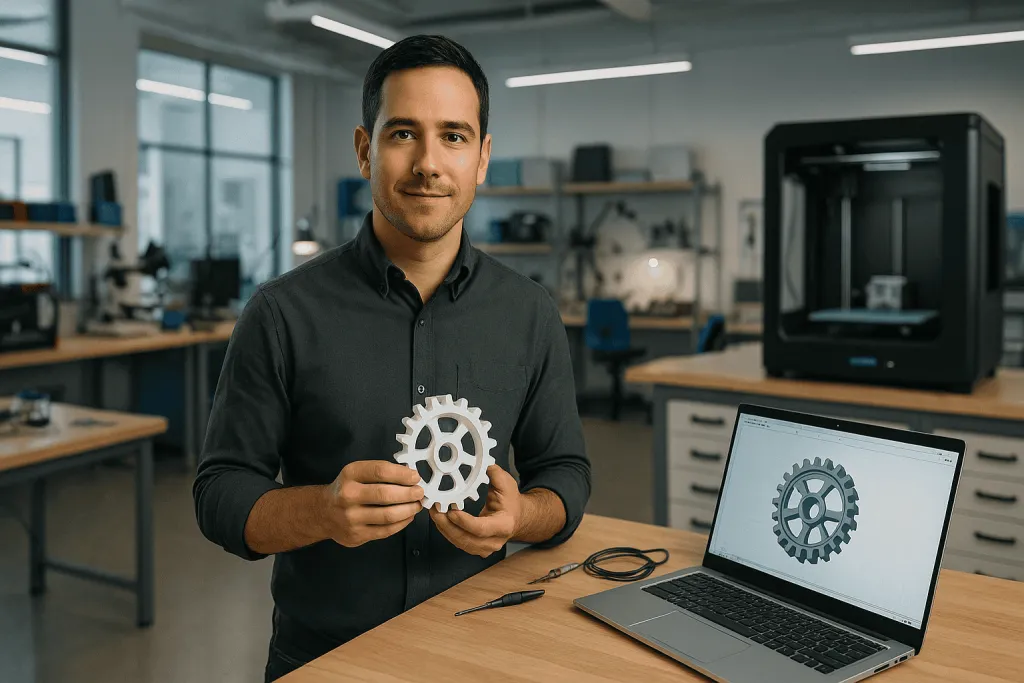
Why do startups choose 3D printing for prototypes production? Speed, affordability, and flexibility.
That’s why 3D printing has become the go-to solution for hardware startups and eCommerce founders who need a functional prototype fast—without draining their budget.
In 2025, 3D printing isn’t just for concept models. With the right materials and method, founders can build testable, market-ready units in days—not weeks. And with small batch 3D printing, you can validate your idea with as few as 20 units before committing to mass production.
What Is 3D Printing for Prototypes?
3D printing for prototypes refers to the process of creating physical product samples using additive manufacturing. Instead of molding or machining, a printer builds your design layer by layer from materials like plastic, resin, or nylon.
It’s fast, cost-effective, and perfect for early-stage product development—especially if you need quick revisions and low-volume production.
When to Use 3D Printing in Your Startup’s Product Journey
Use 3D printing when you need to:
- Test product functionality without large upfront costs
- Validate product-market fit before scaling
- Build a presentation model for investors or Kickstarter
- Run a pilot batch for early customers or Amazon reviews
If you’re still refining your CAD model or working through small design changes, 3D printing gives you the flexibility to iterate fast.
Pros and Cons: 3D Printing vs. Traditional Prototyping
| Factor | 3D Printing for Prototypes | Injection Molding / CNC Machining |
| Cost for low volumes | Low ($25/hour + material costs) | High (tooling can cost $5K+) |
| Turnaround time | Fast (as little as 7 days) | Slower (2–6 weeks) |
| Design flexibility | Easy to iterate and update | Tooling changes are expensive |
| MOQ (Minimum Order Qty) | As low as 1–20 units | Usually 500+ units |
| Material variety | Plastics, resins, nylons, composites | Wider options, better finishes |
| Surface finish/strength | Functional but sometimes rough | High strength, polished look |
For early validation and iteration, 3D printing wins. For the final production of 1,000+ units, traditional methods still have their place.
Types of 3D Printing and When to Use Each
FDM (Fused Deposition Modeling)
- Best for: Basic prototypes, enclosures, functional testing
- Affordable, quick, decent strength
SLA (Stereolithography)
- Best for: Detailed visual models, cosmetic parts
- Smooth finishes, good for fit testing
SLS (Selective Laser Sintering)
- Best for: Strong mechanical parts, hinges, snap fits
- Durable, no support structures needed
MJF (Multi Jet Fusion)
- Best for: Low-volume production runs, commercial prototypes
- High strength, faster than SLS, excellent detail
Not sure which to use? An engineering team can help match the printing method to your product’s needs.
How to Go from CAD File to Physical Prototype (Step-by-Step)
- Design in CAD Software: Tools like Fusion 360 or SolidWorks are standard. Export as STL or STEP files.
- Choose Your 3D Printing Method: Based on function, budget, and material requirements.
- Request a Prototype Quote: Look for services with transparent pricing—ideally hourly engineering rates and no hidden fees.
- Print and Inspect: Your first unit should be functional. If not, tweak and reprint.
- Test and Improve: Use your prototype for real-world feedback, then refine the design.
- Start Small Batch Production: Run 20–100 units to test demand before scaling.
Real Talk: Common Mistakes Startups Make with 3D Prototyping
- Spending $10K on the first prototype before validating market need
- Ignoring material constraints (resin ≠ nylon strength)
- Skipping IP and patent research before printing
- Ordering 500 units without testing functionality with a small batch
- Assuming all 3D printing services are the same (many freelancers don’t offer production-ready quality)
Avoiding these mistakes can save you time, money, and headaches down the road.
What to Look for in a 3D Prototyping Partner
- Fast turnaround (30-day prototyping standard)
- Transparent pricing (e.g., $25/hour engineering model)
- Low MOQs for small batch production (20+ units)
- Direct communication with engineers (not salespeople)
- US-based contracts for IP safety
- Vietnam-based production for affordable scaling
These factors matter when every dollar and week counts.
Is 3D Printing Right for Your Startup?
If your goal is to test a product idea, impress investors, or launch on Amazon without committing to a 500-unit order, 3D printing is your best friend in 2025.
It’s not about having the perfect final product. It’s about getting a functional, testable version out the door so you can validate, learn, and improve.
Build Your Prototype Fast
Don’t waste time or money. Get your 3D printed prototype in 30 days—with transparent $25/hour pricing and minimums as low as 20 units.
How Startups Leverage 3D Printing for Growth
For early-stage companies, 3D printing has become one of the most effective ways to transform an idea into a physical product. Unlike traditional manufacturing, which often demands costly molds and lengthy setup times, additive manufacturing provides a faster, more affordable path to prototyping and small-batch production. Startups gain the ability to validate designs, test usability, and attract investors with tangible models. Prototyperlab supports this approach by offering advanced 3D printing services that help founders refine ideas and bring products to market more quickly.
Key Benefits for Startups
Speed
A design can be turned into a physical part within hours or days rather than weeks. Faster iteration reduces time to market and allows teams to stay ahead in competitive sectors such as consumer electronics and medical devices.
Cost Savings
Traditional tooling, such as injection molds, can cost tens of thousands of dollars. With 3D printing, startups avoid these upfront expenses, making small-batch production affordable.
Rapid Iteration
Designs can be adjusted in CAD software and reprinted immediately. This continuous loop of testing and refinement helps improve product quality and user satisfaction.
Flexibility and Complexity
Additive manufacturing enables the production of complex geometries and lightweight structures that would be impossible with subtractive methods. This is particularly important in industries like aerospace where weight reduction improves performance.
Functional Testing
High-quality resins, nylons, and even metal powders allow startups to produce prototypes that behave like end-use parts, giving accurate data on strength, durability, and fit.
Customization
Startups serving niche markets benefit from the ability to create limited runs or bespoke products tailored to customer needs without committing to mass production.
How Startups Use 3D Printing
- Idea Visualization: Quickly move from digital design to tangible model for stakeholder review.
- Market Feedback: Present prototypes to customers and investors to validate demand and guide design changes.
- Functional Development: Build working prototypes that undergo mechanical testing before scaling.
- Small-Scale Production: Produce limited batches of finished goods to test the market before investing in mass production.
Example in Action
Hopper Mobility, a young transport company, relied heavily on 3D printing for prototyping vehicle parts. This approach allowed them to test performance, gather real-world data, and refine designs long before committing to expensive manufacturing lines.
3D printing provides startups with agility, cost efficiency, and data-driven insight, making it one of the most effective pathways from idea to launch.
Start Your Prototype Now
Send over a sketch, a CAD file, or just a description of what the product needs to do. A real quote comes back within 48 hours.
Get a free quote