About the Client: OWLHAUS
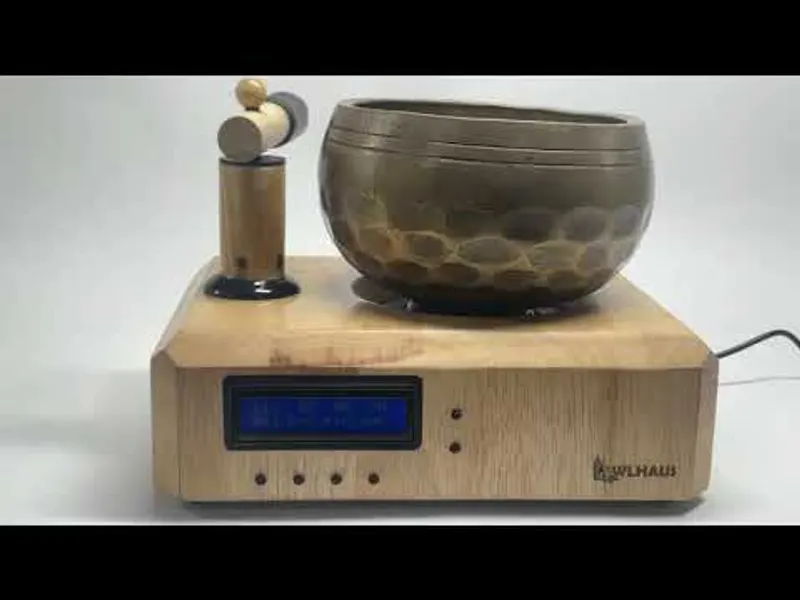
Danne approached us with a concept but without a detailed design or an internal mechanism for execution. The client identified a market need—an automatic Tibetan Singing Bowl that could strike itself at intervals. The idea was to create a device with a Singing Bowl, a mallet, and a smart control system to manage striking intervals, either at fixed times or randomly.
Features of the Automatic Tibetan Singing Bowl
- Real Tibetan Singing Bowl and Mallet – A genuine Tibetan bowl sourced from Nepal. Produces an authentic sound that closely mimics manual striking.
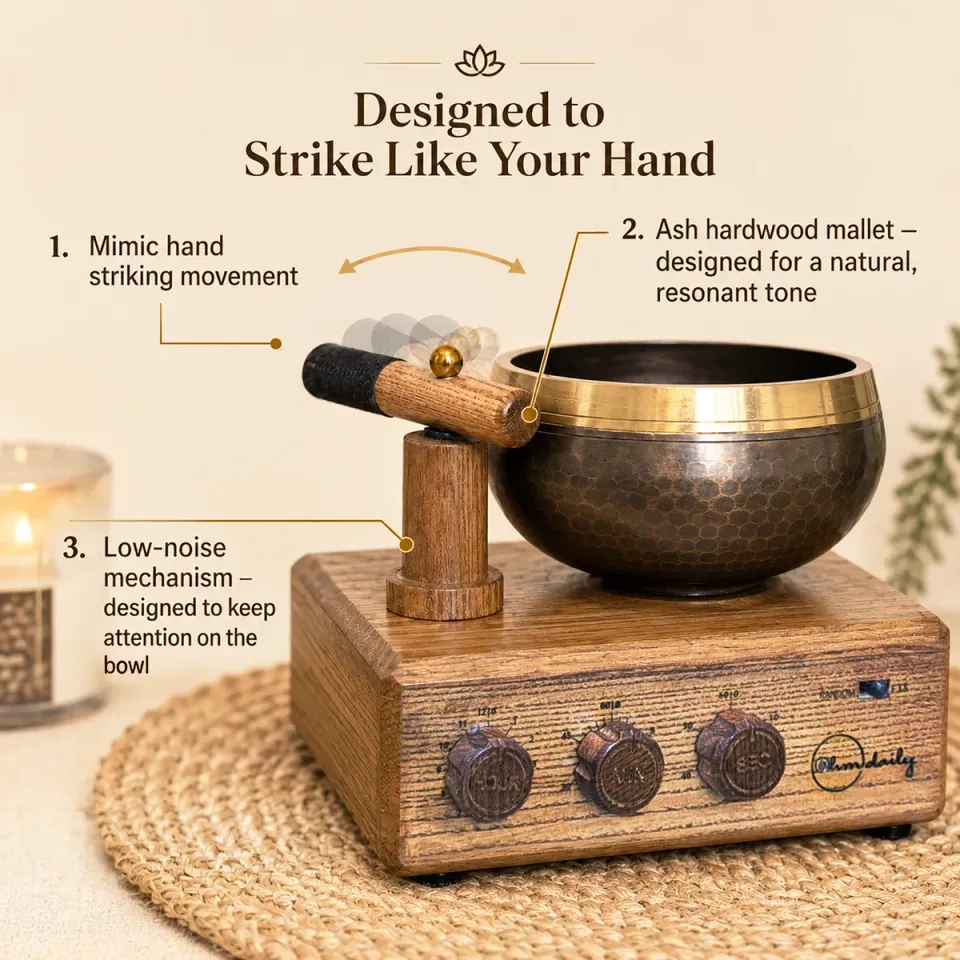
- Striking Mallet Swing Mechanism – Designed to simulate human hand movement.
- Randomized or Fixed Striking Intervals – Prevents predictability and enhances meditative experiences.
- Quiet Motor – Ensures minimal operational noise to avoid distractions.
- User-Controlled Settings – Allows customization for different meditation practices.
Development Process
Phase 1: Consultation
The client had a clear vision of the problem but required guidance on implementation. Our team worked closely with Owlhaus to define the product’s key functionalities, aesthetics, and feasibility.
- Initial Production Goal: 80 units
- Development Hours: 150 hours
Phase 2: Prototyping
Our engineers developed a prototype that included:
- A striking mechanism that mimics human movement.
- A smart control system for timing settings.
- A structure to house the electronics and maintain durability.
Phase 3: Testing & Problem Solving
During testing, we encountered three major challenges:
- Motor Noise:
- Issue: The motor’s operational sound interfered with the bowl’s resonance.
- Solution: Implemented a weak but quiet motor that gradually pulls back a spring-attached striker. When released, the striker hits the bowl with enough force while keeping the motor noise minimal. We also adjusted the voltage for the motor to ensure optimum vibration, strength and speed.
- Aesthetic Requirements:
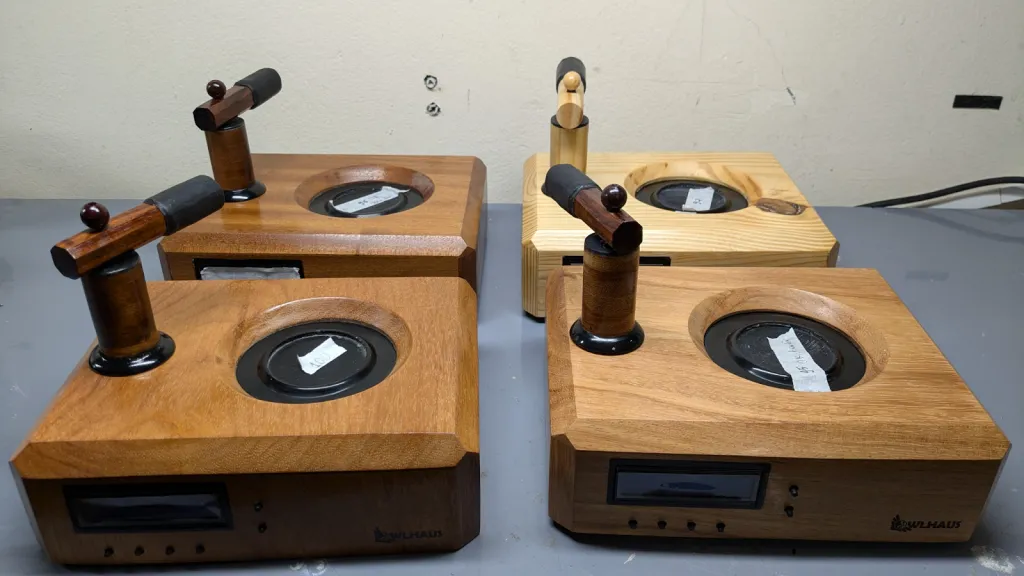
- Issue: The client decided to use a full wooden case instead of plastic to align with customer preferences for a natural look.
- Solution: We sourced affordable, high-quality wood and refined the design to ensure a polished, elegant finish.
- Mallet Movement:
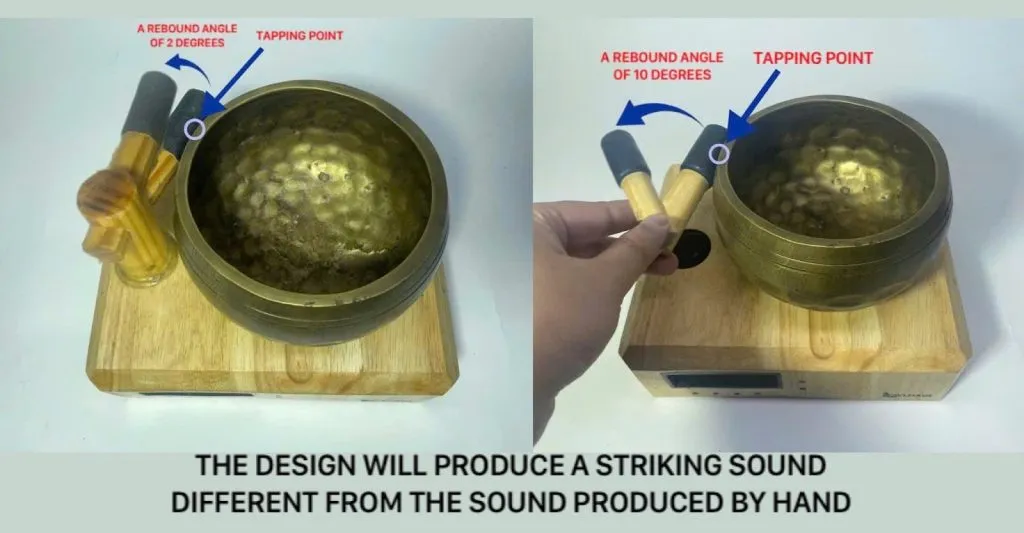
- Issue: The mallet needed to move freely to replicate a natural hand-striking motion.
- Solution: Designed a loose-hanging mallet that swings like a whip to achieve a realistic striking effect.
Phase 4: Production
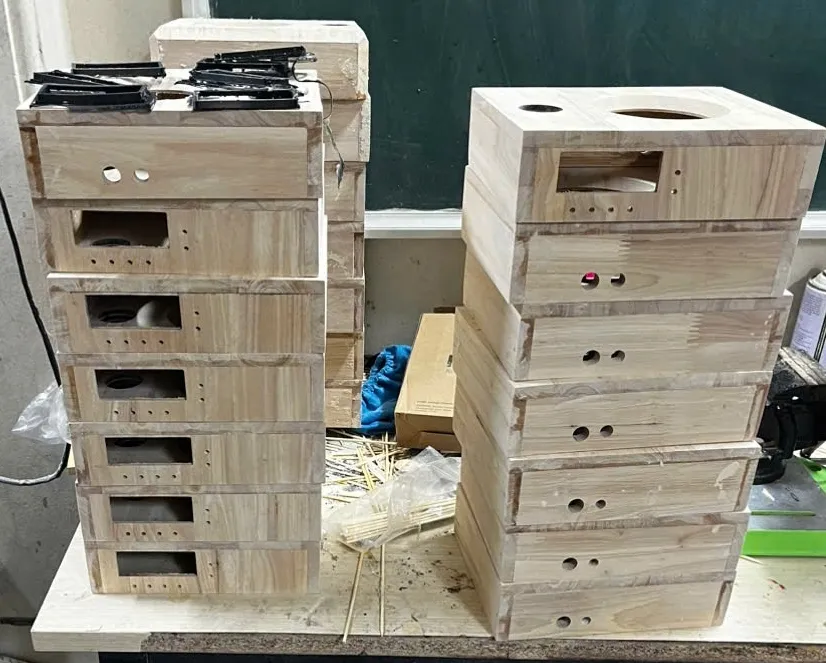
After finalizing the design, we moved into production, assembling 80 units. Each unit was crafted using a combination of sourced Tibetan bowls from Nepal and locally manufactured casings and electronics.
Market Reception & What Came Next
The first production run sold out on Amazon with a 4.8-star rating, validating the automated-striking concept with real meditation practitioners. Customers called out the natural sound quality, the quiet motor, and the aesthetically pleasing design.
What customers said about the first version
“It serves as a good reminder to stop and be present in the moment… Build quality is high.” — Amazon customer, 5 stars
“I love to ground myself and find it such a relief that I don’t have to break my concentration just to tap the bowl.” — Amazon customer, 5 stars
“Brings you back to the present moment.” — Amazon customer, 5 stars
Feedback that shaped the second version
Early users and reviewers also told us what to improve. Every point became a design change in the second generation:
| What users said | What changed in the second version |
|---|---|
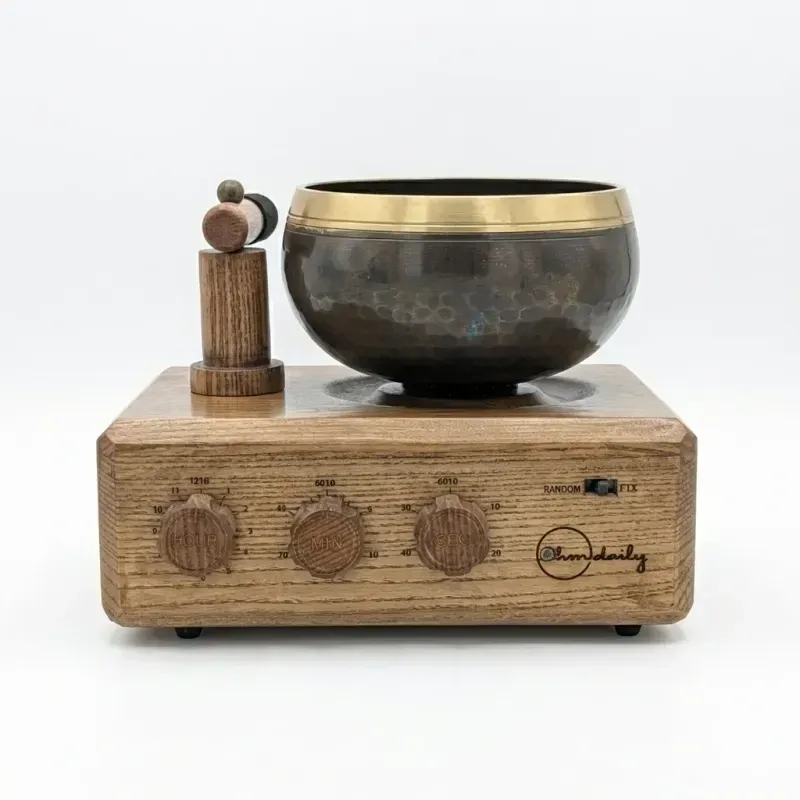
| “The screen is a bit buggy.” | Completely screenless. Three analog wooden dials replace all digital controls, so there is nothing to glitch and nothing to look at. |
| “The sound doesn’t resonate as much as my Tibetan bowl.” | A hand-hammered brass bowl sourced from Nepal. Hand-hammered bowls sustain longer and vibrate more richly than cast ones. |
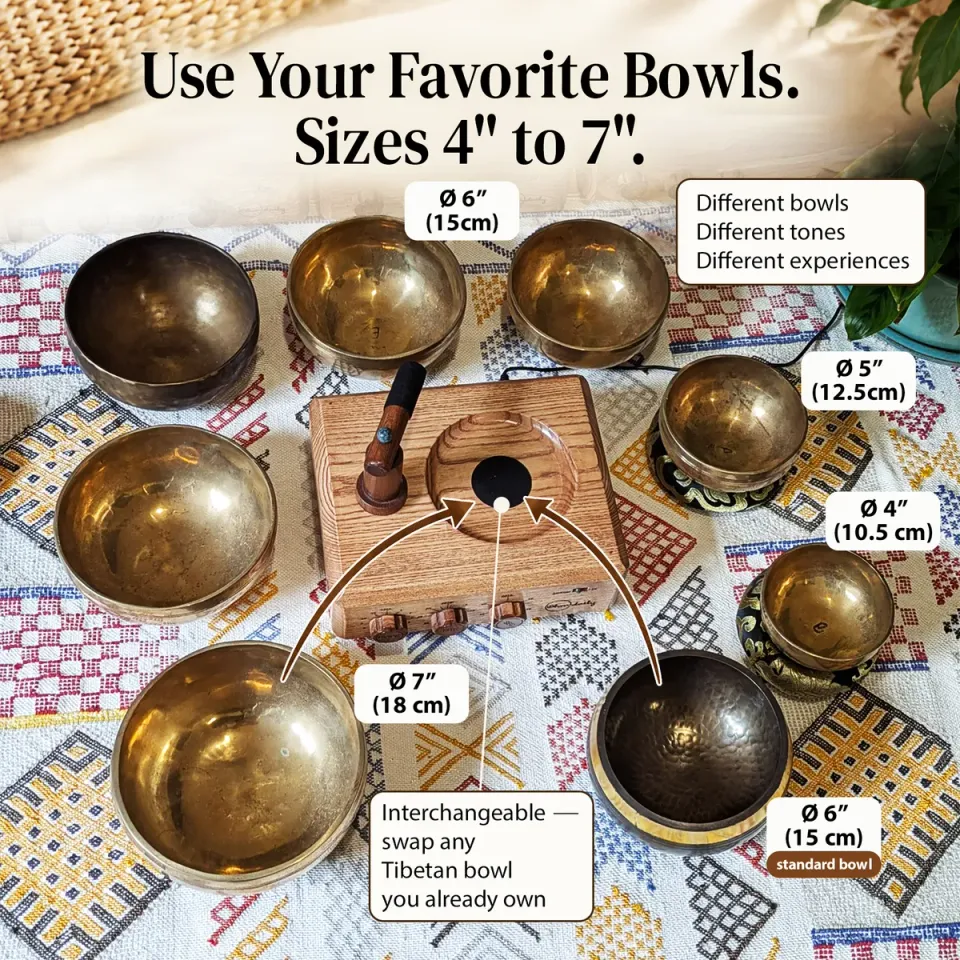
| “Would be cool if I could use my own bowl.” | The base accepts any Tibetan bowl from 4 to 7 inches in diameter. |
| “The buttons aren’t labeled.” | No buttons at all: Hour, Minute and Second dials, plus a FIX / RANDOM switch. |
From the first version to the second
| Component | First version | Second version |
|---|---|---|
| Interface | Digital screen | Screenless, analog wooden dials |
| Controls | Digital buttons | Physical wood and steel knobs |
| Bowl | Cast bowl, fixed | Hand-hammered brass from Nepal, interchangeable (4–7 in) |
| Base | Rubberwood and plastic | Ash hardwood throughout |
| Mallet and post | Plastic | Ash hardwood, which carries the strike’s vibration better |
| Knob and fittings | Plastic | Steel, more durable and more tactile |
| Motor | Quiet motor, but audible during the strike | Redesigned again so you hear the bowl, not the machine |
Second-generation specifications
| Specification | Detail |
|---|---|
| Bowl | Hand-hammered brass, 6.25 in (included); accepts 4 in to 7 in bowls |
| Base, mallet and post | Ash hardwood |
| Knob and fittings | Steel |
| Controls | Three analog wooden dials: Hours, Minutes, Seconds |
| Modes | FIX (strikes at the exact interval) or RANDOM (strikes at an unpredictable moment within the interval) |
| Interval range | 10 seconds to 12 hours |
| Power | AC adapter, 110–240 V / 50–60 Hz, 60 W (works with any standard outlet worldwide) |
| Dimensions | 10.6 × 8.2 × 7.5 in (27 × 21 × 19 cm) |
| Weight | 5.5 lb (2.5 kg) |
| Interface | Fully screenless: no display, no app |
| Origin | Designed in Atlanta, made in Vietnam |
How it works
- Place and plug in. Set the unit on a flat surface and connect the AC adapter. That is the only setup.
- Set the interval. Turn the Hour, Minute and Second dials, then choose FIX or RANDOM. In FIX mode the bowl rings at exactly the interval you set. In RANDOM mode it rings at an unpredictable moment within that window, closer to the feel of a monastery bell. Any seconds value up to 10 rounds up to the 10-second minimum.
- It rings. You pause. When the bowl sounds, stop, take a breath and notice where your attention is.
Example settings from real use: 25 minutes FIX for a Pomodoro-style focus reset, 3 minutes RANDOM for a meditation session, 60 minutes FIX for an hourly pause bell at a desk, and 5 minutes RANDOM for a sound-bath class so the instructor can stay focused on playing.
Learn more about the second-generation model and its Kickstarter backer community.
Review from the OWLHAUS:
“We found PrototyperLab through a recommendation from another brand, and to be honest, we weren’t sure what to expect. We shared one of our new product ideas and its use case, and within a few days, they had a physical plastic prototype ready. I was seriously impressed! The pricing is super reasonable, which means we can test out even more product idea, especially those with electronics or automation. It’s a huge time-saver for us, letting our team focus more on launching and marketing instead of getting stuck in long development cycles.”
Danne, US – OWLHAUS
⭐⭐⭐⭐⭐