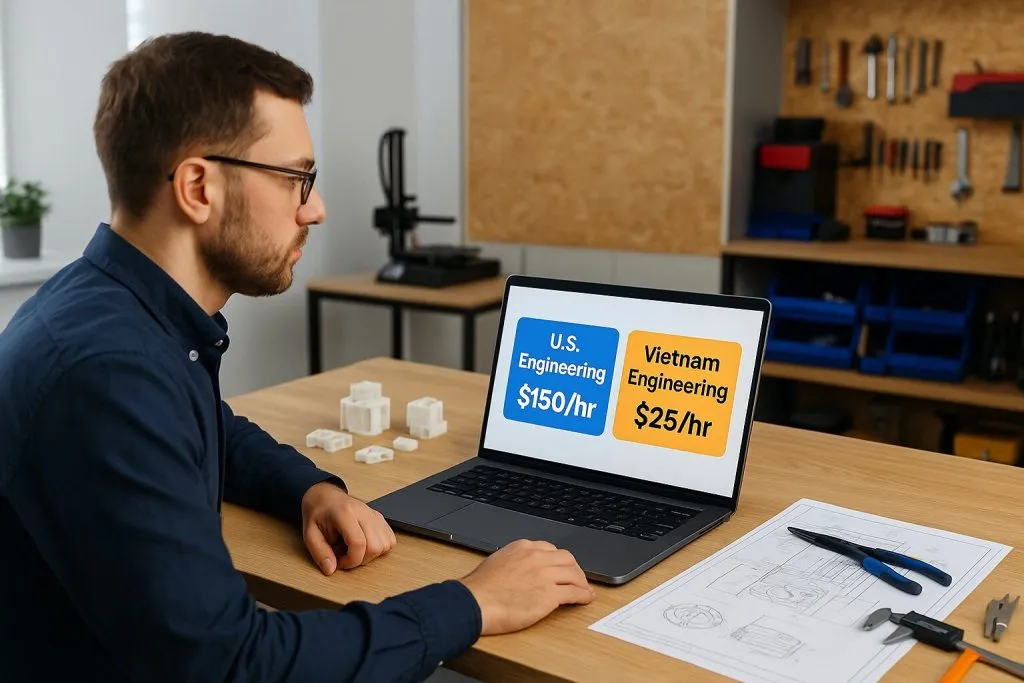
Startup founders often have the same reaction when reviewing their first engineering quotes.
A U.S.-based engineering firm comes back with rates ranging from $120 to $180 per hour. An overseas engineering team—often in Vietnam—quotes $25 to $40 per hour for what appears to be similar work.
The immediate question is unavoidable:
Why are engineering costs in the US so high—and is paying that premium ever worth it?
The answer is not emotional or political. It’s structural. And more importantly, higher cost does not automatically mean better value.
This article explains why engineering costs are 3–5× higher in the US, what founders are actually paying for, and when U.S. engineering is worth the investment—and when it isn’t.
Why Engineering Costs in the US Are So High
U.S. engineering rates reflect far more than technical skill. They include layers of cost and risk that don’t exist—or exist differently—overseas.
1. Labor Economics and Business Overhead
U.S. engineers are expensive before any engineering work even begins.
Hourly rates must cover:
- High base salaries
- Health insurance and benefits
- Payroll taxes and workers’ compensation
- Office space, software licenses, and compliance costs
- Non-billable time spent in meetings and documentation
An engineering firm charging $150 per hour is not paying an engineer $150 per hour. Much of that rate goes toward overhead and operational risk.
This is one of the primary reasons engineering costs in the US remain structurally high, regardless of industry.
2. Liability, Compliance, and Legal Risk
U.S. engineering operates in a high-liability environment.
Engineers are expected to account for:
- Product liability exposure
- Safety and compliance standards
- Traceability and documentation
- Legal accountability if a product fails in the market
That risk is priced into every hour billed.
For certain products—especially electronics, children’s products, or safety-critical components—this legal exposure significantly increases product development costs in the US.
3. Enterprise-Oriented Engineering Processes
Most U.S. engineering firms are built to serve enterprise clients.
Their processes prioritize:
- Extensive documentation
- Multiple approval layers
- Long development timelines
- Conservative design decisions
This approach is excellent for mature companies—but often misaligned with startup needs.
Early-stage founders frequently pay for:
- Meetings instead of iterations
- Reports instead of prototypes
- Perfection instead of speed
This mismatch is a hidden contributor to why U.S. engineering feels expensive for startups.
Why Overseas Engineering Costs Are Lower
Lower overseas engineering costs are not automatically a quality issue.
Engineering teams in Vietnam and other regions benefit from:
- Lower cost of living
- Strong technical education pipelines
- Leaner team structures
- Fewer administrative layers
In many cases, the technical skill level is high. The risk is not capability—it’s context, communication, and oversight.
This distinction matters when comparing US vs offshore engineering.
The Real Cost Is Not Hourly Rate—It’s Waste
Founders often fixate on hourly rates and miss the bigger picture.
The most expensive engineering work is not the highest hourly rate.
It’s misapplied effort.
Common waste scenarios include:
- Paying U.S. rates for simple CAD revisions
- Outsourcing complex system architecture without oversight
- Rebuilding designs due to miscommunication
- Losing weeks to unclear requirements and iteration delays
The right question is not:
“Where is engineering cheaper?”
The right question is:
“Where does this task create the most value?”
When U.S. Engineering Is Worth the Cost
There are specific stages where U.S. engineering justifies the premium.
1. System Architecture and Product Definition
Early decisions compound.
U.S.-based engineers excel at:
- Defining product architecture
- Setting technical constraints
- Making tradeoff decisions
- Aligning designs with U.S. consumer expectations
Mistakes at this stage are expensive to fix later. For foundational decisions, U.S. engineering oversight often pays for itself.
2. User Experience, Ergonomics, and Market Fit
For consumer products sold in the U.S., details matter:
- Ergonomics
- Compliance expectations
- Fit and finish
- Perceived quality
U.S.-based engineers tend to have stronger intuition for these market expectations, especially for first-generation products.
3. Regulatory and Compliance Pathways
Products involving the following often benefit from U.S. engineering involvement to avoid costly rework or compliance failure.:
- Electronics
- Children’s use
- Safety components
- Certifications (FCC, CPC, etc.)
In these cases, the higher engineering cost can prevent significantly larger downstream expenses.
When U.S. Engineering Is Not Worth the Cost
Paying premium rates for the wrong tasks drains budgets quickly.
1. Iterative CAD and Drafting Work
Once product architecture is defined:
- CAD refinements
- DFM adjustments
- Part optimization
These tasks are execution-heavy, not decision-heavy, and are ideal for lower-cost engineering teams.
2. Prototype Fabrication and Small Batch Builds
Hand-built prototypes, silicone molding, CNC parts, and small-batch assembly can often be completed faster and more affordably overseas—without sacrificing quality—when properly structured.
This is especially relevant for small-batch manufacturing engineering.
3. Clearly Defined, Repeatable Tasks
If a task can be:
- Clearly documented
- Reviewed easily
- Iterated quickly
Paying U.S. rates is often unnecessary.
Founder Checklist: How to Spend Engineering Budget Wisely
Before deciding where to spend engineering dollars, founders should ask:
- Is this decision difficult or expensive to undo later? If yes, U.S. engineering oversight is often worth it.
- Does this task require deep market, regulatory, or user-context knowledge? If yes, U.S. engineering adds value.
- Is this task execution-heavy rather than decision-heavy? If yes, overseas engineering often delivers better ROI.
Smart founders allocate engineering budget strategically—not emotionally.
The PrototyperLab Approach to Engineering Costs
PrototyperLab is built to eliminate engineering waste.
The model combines:
- U.S.-based leadership and contracts
- Vietnam-based engineering execution
- Transparent $25/hour engineering rates
- Rapid prototyping in days, not weeks
- Small batch production starting at 20 units
This structure allows founders to:
- Spend money on decisions, not overhead
- Move fast without sacrificing control
- Avoid enterprise pricing for startup-stage needs
Engineering costs in the US are higher for real, structural reasons.
But higher cost does not automatically mean smarter spending.
The most successful founders don’t choose between U.S. or overseas engineering.
They choose when and where each adds the most value.
Engineering budgets should be optimized for:
- Leverage
- Speed
- Intelligent allocation
Ready to Optimize Your Engineering Budget?
Founders don’t need to choose between quality and affordability.
- Book a consultation to review your engineering scope
- Get a transparent engineering cost breakdown
- Prototype faster with a hybrid U.S. + Vietnam model
PrototyperLab helps founders build smarter—not more expensively.
Send over a sketch, a CAD file, or just a description of what the product needs to do. A real quote comes back within 48 hours.
Get a free quote