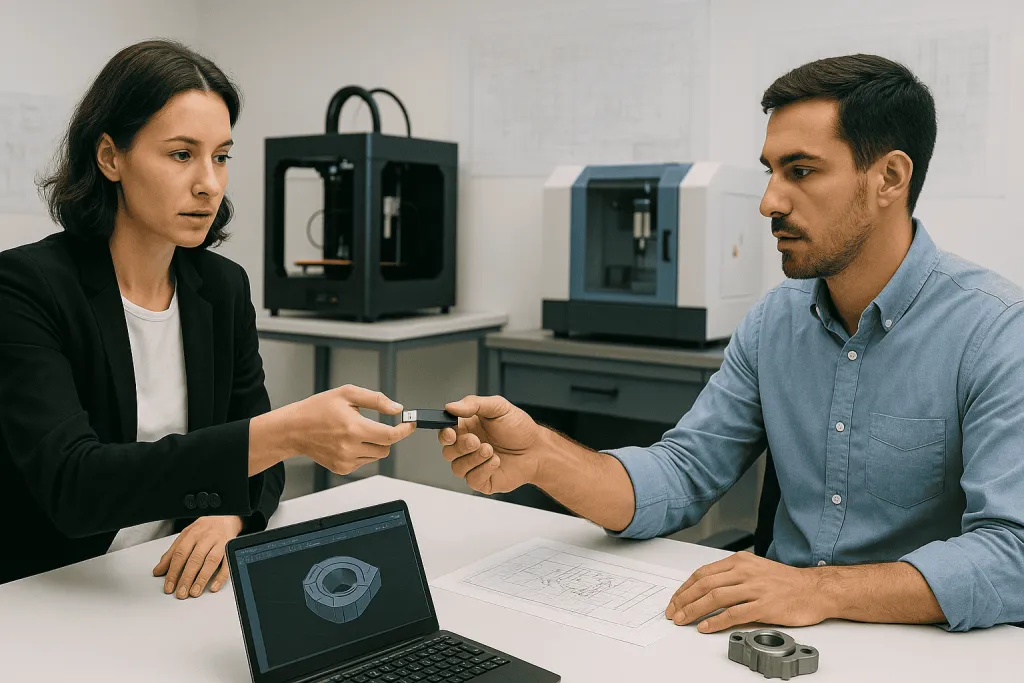
If you’ve got a CAD file and a big idea, the next step—turning that 3D design into a real, testable product—can feel overwhelming. Most founders hit a wall right here: too many unknowns, too many costs, and too many slow or unreliable vendors.
Here’s the truth: from CAD file to prototype doesn’t have to be confusing or expensive. This step-by-step breakdown shows how startup-minded makers and lean eCommerce brands can move from digital design to physical product—fast, affordably, and with minimal risk.
Step 1: Submit Your CAD File and Requirements
The prototyping workflow starts with the CAD model—the digital blueprint of your product. At this point, you or your designer should have a 3D file ready (typically in formats like .STEP, .STL, or .IGES).
But a CAD file alone isn’t enough. You also need to communicate:
- Key functionality (what should this product actually do?)
- Preferred materials (plastics, metals, silicone, etc.)
- Aesthetic requirements (finish, texture, size constraints)
- Quantity for initial production (as few as 20 units for testing)
- Target timeline (when you need the prototype and production run)
This first step sets the stage for everything else, from cost estimates to technical decisions.
Step 2: Get a Transparent Quote Based on Engineering Time and Materials
Most founders fear hidden costs. That’s why a clear, line-by-line quote is crucial.
Look for a quote that separates:
- Engineering labor (typically charged hourly)
- Material costs for the prototype
- Facility or machine usage (e.g. 3D printers, CNCs, molding tools)
- Optional services like small batch manufacturing
At this stage, there should be no upfront payment required—you should only pay once the scope, cost, and timeline are approved. This quote also helps you compare against other prototype development services or freelance shops, many of which don’t offer breakdowns at all.
Step 3: Engineering Review and Design Adjustments
Just because a CAD model looks good doesn’t mean it’s ready for manufacturing.
This is where experienced engineers earn their keep:
- Checking wall thickness, tolerance, and part clearance
- Flagging unsupported features for 3D printing or molding
- Suggesting design-for-manufacturing improvements (DFM)
- Recommending more cost-efficient materials or processes
This step ensures your prototype won’t fail in real-world testing—and reduces the number of revisions needed later.
Step 4: Rapid Prototyping – Build, Test, Improve
This is the moment your idea becomes tangible.
Based on the finalized CAD file, your prototype moves into fabrication. This may involve:
- 3D printing (for quick, functional prototypes)
- CNC machining (for high-precision parts)
- Silicone molding (for limited production-ready plastics)
Each method serves a different need—speed, accuracy, or material realism. The prototype is then tested for form, fit, and function.
Expect at least one round of feedback and refinement:
- Does it assemble as expected?
- Are the tolerances too tight or too loose?
- Is it structurally sound under use?
These iterations get your product closer to being market-ready, not just demo-ready.
Step 5: Final Design Approval and Pre-Production Sample
After testing and tweaks, the prototype goes through final validation. If you’re planning small batch production, now’s the time to approve:
- Surface finish and detail accuracy
- Packaging dimensions
- Component tolerances
- Material substitutes (if any)
You’ll usually receive a pre-production sample—a fully finished unit that represents the final product. This is what you’ll show to test users, early buyers, or investors.
Step 6: Small Batch Manufacturing (20–100 Units)
Once you approve the prototype, you can move directly into low-volume manufacturing—perfect for founders who want to:
- Launch a test on Amazon, Shopify, or Kickstarter
- Validate demand before committing to mass production
- Show off a “real” version to VCs or partners
Low-volume production might include:
- Short-run molding
- Batch CNC machining
- Hybrid techniques combining 3D printed jigs and molds
Manufacturing partners with in-house production facilities can shorten lead times even further, often delivering test batches within 30 days.
Step 7: Packaging, Inspection, and Logistics
If your product is going to customers or reviewers, packaging matters. At this stage, you’ll:
- Approve box design and insert layout
- Confirm barcode placement for 3PLs or Amazon FBA
- Request drop-shipping or 3PL coordination if needed
An experienced prototyping partner will also handle:
- Quality inspections before shipment
- Logistics from Vietnam to the U.S. or Europe
- Certificates for compliance (FCC, CPC, MSDS, etc.) if required
This step is where lean inventors often burn out or get blindsided by unexpected paperwork—having it handled by your build partner is a game-changer.
Why Speed and Transparency Matter in Prototyping
For founders trying to test product-market fit, time is leverage. A 3-month delay could mean missing peak season, losing momentum, or getting beat to market.
That’s why a prototyping workflow should focus on:
- 30-day prototype turnaround
- Transparent $25/hour pricing
- 20-unit production minimums
- U.S. contracts with offshore production savings
This model allows founders to keep costs down and retain speed—something traditional manufacturing simply can’t offer.
Transform Your Project from CAD File to Prototype Without the Headaches
If you’ve got a CAD file, you’re already halfway to a physical product. What most founders need is a step-by-step workflow that’s built for speed, budget, and iteration—not for massive factories or bloated R&D pipelines.
By following this clear prototype development workflow, you can:
- De-risk your product launch
- Test demand early
- Iterate before scaling
- Launch with confidence
Start your prototype today—get a transparent quote, expert engineering, and a working prototype in 30 days.
Get A Quote Now
Send over a sketch, a CAD file, or just a description of what the product needs to do. A real quote comes back within 48 hours.
Get a free quote