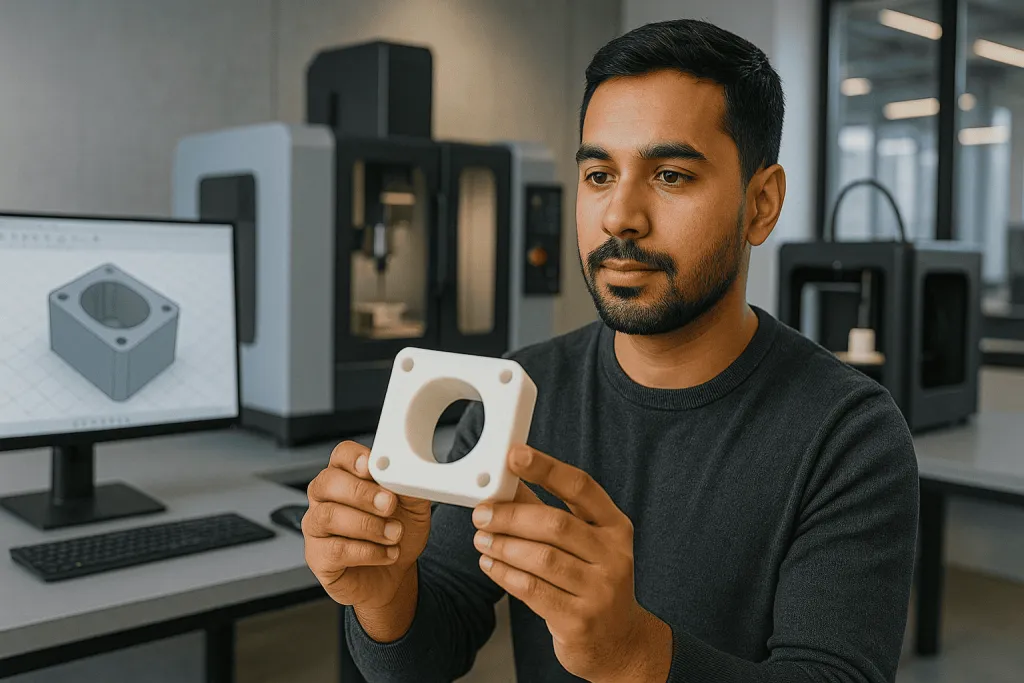
What’s driving the future of prototyping?
Hardware startups no longer need massive budgets or months-long timelines to build testable products. Trends in 3D printing, CNC machining, and low-volume production make high-quality prototyping fast, affordable, and scalable.
Discover how startup founders build and test physical products faster than ever using modern prototyping methods.
3D Printing Is No Longer Just for Draft Models
What’s New
- Multi-material and high-strength filaments
- Professional FDM/SLA machines with short turnaround
- Print farms offering short-run production (20–100 units)
Why It Matters
- Build functional parts quickly
- No tooling costs for initial testing
- Great for MVPs and crowdfunding visuals
CNC Machining Is Becoming More Accessible
What’s New
- Digital quoting from CAD files
- Smaller MOQs from flexible CNC shops
- Automated setups for faster runs
Why It Matters
- High-precision results for metals and enclosures
- Ideal for mechanical or structural parts
- Scales from 1 unit to low-volume with minimal overhead
Low-Volume Production Lets You Launch Without Scaling
What’s New
- Bridge tooling for short runs
- Modular jigs and flexible manufacturing setups
- Vietnam-based production partners for small batches
Why It Matters
- Launch with 25–50 units
- Test on Amazon or Shopify before committing
- Short production cycles = faster iterations
Full-Service Prototyping-as-a-Service Is Growing
What’s New
- End-to-end services (engineering, CAD, 3D print, production)
- Transparent hourly pricing ($25/hour models)
- U.S.-based legal protection + Vietnam-based production
Why It Matters
- Skip vendor juggling
- Direct communication with engineers
- Turn ideas into products in 30–60 days
Smart Founders Use Prototypes as Strategic Tools
What’s New
- Prototypes double as pitch tools and video assets
- Use pre-launch versions to gather feedback
- Helps secure funding or pre-orders
Why It Matters
- Build momentum before you build inventory
- Avoid building something nobody wants
- Validate faster with visual and functional proof
The Future of Prototyping Is Bright
These prototyping trends are empowering startups to move quickly and test intelligently. Whether it’s validating an idea with 3D printing or launching with 25 CNC-machined units, founders now have access to professional-grade methods without enterprise-level investment.
Need a working prototype fast? Want to launch with just 20 units?
Contact PrototyperLab today and turn your idea into a market-ready product—affordably, quickly, and without the usual manufacturing stress.
Get A Quote Today
FAQs
What is the most cost-effective prototyping method for startups?
3D printing is typically the most cost-effective for early-stage prototypes. It requires no tooling, works with many materials, and delivers fast turnaround—ideal for testing product-market fit.
How fast can I get a prototype made?
Startups working with services like PrototyperLab can get a working prototype in about 30 days, depending on complexity.
What’s the best method for prototyping metal parts?
CNC machining is best for functional, high-precision metal parts. It’s more durable than 3D printing and suited for parts like enclosures, mounts, and brackets.
Can I manufacture only 20–50 units to test demand?
Yes. Low-volume production using short-run molding or CNC setups now supports small batch runs starting at 20 units, perfect for testing on Shopify, Amazon, or Kickstarter.
Is low-volume production more expensive per unit?
Typically, yes. But the overall cost is lower than mass production when testing, since you’re not committing to large MOQs or investing in expensive molds upfront.
Send over a sketch, a CAD file, or just a description of what the product needs to do. A real quote comes back within 48 hours.
Get a free quote