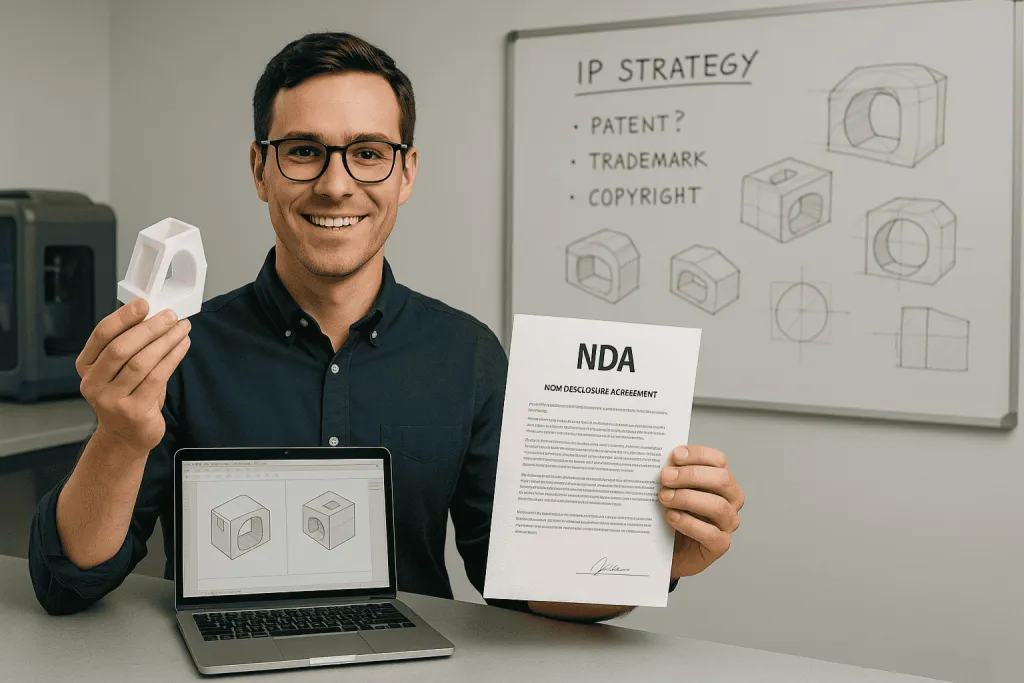
If you’re building a physical product, there’s a moment where you have to share it—with engineers, suppliers, investors, or Kickstarter backers. That moment brings risk. What if someone copies it? What if your idea ends up in someone else’s product listing?
This guide explains exactly how to protect your prototype using the most practical legal tools available to makers and startup founders—without spending $10,000 on a law firm.
Why You Need to Protect Your Prototype Early
Once your CAD files, sketches, or working model are out in the world, they can be copied. Overseas factories, freelance engineers, even potential partners—anyone could take your idea and run with it if you haven’t taken steps to secure your intellectual property (IP).
Founders need protection before:
- Pitching to investors
- Sharing files with manufacturers
- Launching on Kickstarter or Amazon
- Posting videos or social media content
What’s the Fastest Ways to Protect a Prototype?
- NDA (Non-Disclosure Agreement): Stops partners from legally sharing or copying your idea
- Provisional Patent: Temporarily protects your invention while you develop it
- Trademark: Protects your brand name or logo (not your product)
- U.S.-based Contracts: Ensures legal protection even if manufacturing overseas
NDA vs. Patent: What’s the Right Tool?
Many founders ask, “Should I file a patent before prototyping?” The answer: not always. Sometimes an NDA is enough—especially in the early stages.
| Tool | Best For | Cost | Timeline | Limits |
| NDA | Early sharing with contractors, suppliers, or investors | Free–$500 | Immediate | Only protects what’s documented |
| Provisional Patent | Early-stage inventions with unique functionality | ~$75–$1,000 (DIY or assisted) | 1 day (DIY) | Expires after 12 months unless converted |
| Utility Patent | Fully developed inventions | $5,000–$15,000+ | 1–3 years | Costly, complex |
| Trademark | Product names, logos, packaging | ~$250 per class | 3–6 months | Doesn’t protect the product itself |
Pro tip: Use an NDA before any external conversation. File a provisional patent once your idea has a defined shape and function.
Step-by-Step: How to Protect Your Prototype
1. Start with an NDA
Before sharing your concept or files with anyone, use a Non-Disclosure Agreement. It’s a simple contract that says the other party can’t share, copy, or use your idea for their own benefit.
When to use:
- Sending CAD files to engineers
- Talking to manufacturers
- Hiring freelancers for design or development
If you work with PrototyperLab, all engineering is covered by U.S.-based NDAs and contracts.
2. Conduct a Basic Patent Search
Before spending money on a patent, make sure you’re not infringing on someone else’s. Use the USPTO search tool or consult a product development partner who offers patent research.
This helps you:
- Avoid lawsuits later
- “Design around” active patents to create something unique
- Know if your invention is even patentable
PrototyperLab includes this step during the design phase to keep projects legally safe from day one.
3. File a Provisional Patent Application
A provisional patent gives you 12 months of “patent pending” status for around $75 if you file it yourself through the USPTO.
This is ideal for:
- Testing demand on Kickstarter
- Sharing your idea publicly
- Talking to investors confidently
You don’t need finalized production drawings to file—just a clear description and visuals. Use this time to refine your prototype and decide if a full utility patent is worth it.
4. Consider a Trademark (But Don’t Start Here)
Trademarks protect:
- Brand names
- Logos
- Taglines
They do not protect the product’s design or function. Registering a trademark makes sense once your product is ready for market—but don’t waste time or money filing one before you have a working prototype.
5. Use U.S.-Based Legal Agreements for Overseas Manufacturing
Manufacturing overseas without a U.S. contract is a major risk. If something goes wrong—leaked designs, IP theft—you may have little recourse in foreign courts.
That’s why PrototyperLab handles all legal agreements from the U.S. side—giving makers U.S. legal protection while still leveraging cost-effective Vietnam-based production.
Final Advice: Protect Early, Not Late
Legal protection doesn’t have to slow you down. Most IP disasters happen because founders wait too long or assume protection is too expensive.
If you’re already prototyping or preparing to launch, take action now:
- Use NDAs for every external conversation
- File a provisional patent to lock in “patent pending”
- Keep control over your CAD files and sourcing
- Choose partners with U.S.-based contracts and IP expertise
Build and Protect Your Prototype with Confidence
PrototyperLab offers rapid 30-day prototyping, small batch manufacturing, and built-in legal protection through U.S.-based contracts. Get help with NDA templates, patent research, and safe file sharing from day one.
Get a Free Prototyping Strategy Consult
Common Questions about How to Protect Your Prototype
What’s the cheapest way to protect a product idea?
The most cost-effective method is a combo of an NDA and a provisional patent. You can get started for under $100.
Do I need a patent before building a prototype?
No. You can build and test under NDA, then file a provisional patent once you’ve validated the design.
Can someone steal my idea if I don’t have a patent?
Yes, if there’s no NDA or patent, your idea is unprotected. Even if they copy it unethically, you’ll have no legal leverage without documentation.
Can I protect my invention before launching on Kickstarter?
Yes. File a provisional patent and ensure any partners you work with sign an NDA. Don’t publicly share technical details without legal coverage.
How can I protect my idea when working with manufacturers in Vietnam or China?
Use an NDA written under U.S. law, and ensure your manufacturer signs it before receiving any files. Working with a U.S.-based intermediary like PrototyperLab provides stronger legal backing.
Send over a sketch, a CAD file, or just a description of what the product needs to do. A real quote comes back within 48 hours.
Get a free quote