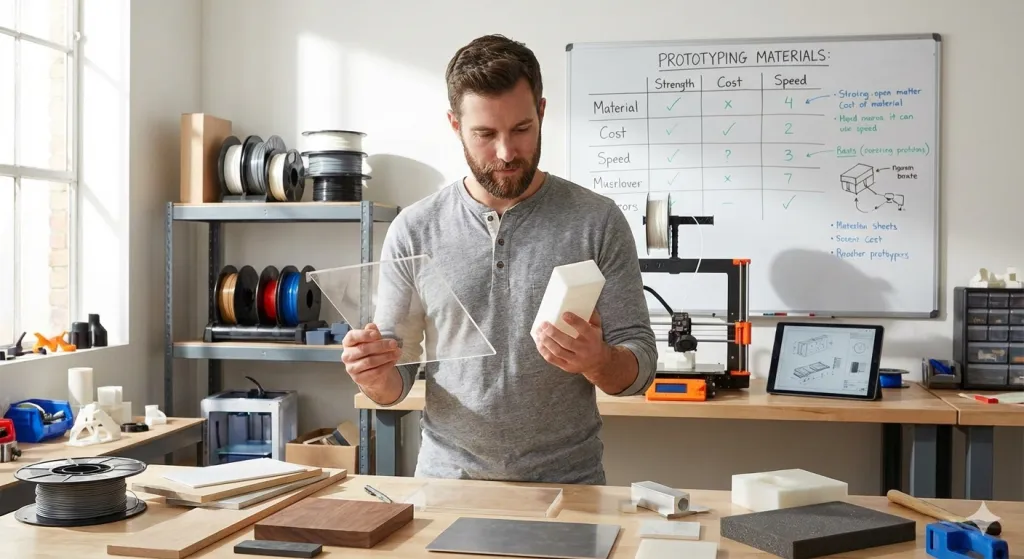
Choosing the wrong materials for prototyping is one of the fastest ways to burn budget, lose time, and end up with misleading test results. Many founders rush into building a prototype using whatever material is cheapest or easiest—only to discover later that it behaves nothing like the final product.
For startup-minded makers, prototyping materials are not about perfection. They are about learning fast, validating assumptions, and reducing risk before committing to tooling or mass production.
This guide breaks down the most practical materials for prototyping, explains when to use each, and shows how to match material choice to product stage—without overspending or over-engineering.
Why Prototyping Materials Matter More Than Most Founders Realize
A prototype is not just a physical object. It is a decision-making tool.
The materials chosen during prototyping directly affect:
- Functional testing accuracy
- Perceived product quality
- Assembly and tolerance validation
- Cost forecasting for production
- Investor or customer confidence
Using the wrong material can lead to false positives—or worse, false confidence.
For example:
- A plastic prototype might “work” mechanically but fail under real-world heat or load.
- A metal prototype may look production-ready but hide manufacturability issues.
- A rigid PCB mockup might ignore signal noise or thermal behavior.
Material selection should always align with what is being tested, not what looks best.
Categories of Materials for Prototyping
Most physical products fall into one or more of the following material categories during development:
- Plastics
- Metals (especially sheet metal)
- Electronics (PCB materials)
- Soft and flexible materials
Each category serves a different purpose and stage in the prototyping process.
Plastic Prototyping: Speed, Flexibility, and Cost Control
Plastic prototyping is often the first step for consumer products, enclosures, and functional components. Plastics are fast to iterate, inexpensive, and compatible with multiple prototyping methods.
Common Plastic Prototyping Materials
- ABS – Durable, impact-resistant, good for housings
- PLA – Fast and cheap for form studies, not for functional stress
- PETG – Balanced strength and flexibility
- Nylon – Strong, wear-resistant, good for moving parts
- TPU – Flexible components like seals and grips
When Plastic Prototyping Makes Sense
Plastic is ideal when validating:
- Form factor and ergonomics
- Fit with other components
- Snap fits and enclosure design
- Early mechanical behavior
Plastic prototyping is especially effective during early iterations, where fast changes matter more than long-term durability.
Limitations to Watch For
Plastic prototypes can mislead teams when:
- The final product will be metal
- Heat resistance or rigidity matters
- Structural loads are underestimated
A plastic prototype that “passes” testing does not guarantee the design will survive real-world use.
Prototype Sheet Metal: When Structure and Strength Matter
Prototype sheet metal is essential when a product depends on rigidity, weight, or load-bearing behavior. It is commonly used in brackets, frames, housings, and structural components.
Common Sheet Metal Materials for Prototyping
- Aluminum – Lightweight, corrosion-resistant, easy to machine
- Stainless Steel – Strong, durable, good for harsh environments
- Mild Steel – Cost-effective for strength testing
What Sheet Metal Prototypes Are Best For
- Structural validation
- Load and stress testing
- Assembly sequencing
- Mounting and fastening evaluation
Sheet metal prototypes reveal issues that plastic never will—such as flex under load, vibration, and real-world tolerances.
Trade-Offs to Consider
- Higher cost than plastic
- Longer lead times
- Less forgiving during iteration
Sheet metal should be introduced once the design has stabilized and functional requirements are clear.
Prototype PCB Board Materials: Testing Electronics the Right Way
A prototype PCB board is where many hardware startups run into costly mistakes. Breadboards and dev kits are useful early, but they cannot replicate real electrical behavior.
Common PCB Materials Used in Prototyping
- FR-4 – Industry standard, affordable, stable
- Aluminum PCB – Better heat dissipation for power electronics
- Flexible PCB (Polyimide) – Wearables, tight spaces
What PCB Prototypes Should Validate
- Electrical integrity and signal behavior
- Thermal performance
- Component placement and routing
- EMI and noise issues
Skipping proper PCB prototyping often leads to failures during certification or production.
Why PCB Materials Matter Early
Using production-like PCB materials early allows teams to:
- Catch overheating issues
- Identify interference problems
- Validate assembly processes
This reduces rework later, when changes become expensive.
Soft Prototyping Materials: Testing Interaction and User Experience
Soft prototyping materials are often overlooked, yet they are critical for products that interact with humans.
Examples of Soft Prototyping Materials
- Silicone (various durometers)
- Rubber compounds
- Foam and elastomers
- Fabric and textile blends
When Soft Materials Are Essential
Soft materials are ideal for testing:
- Grip and comfort
- Sealing and waterproofing
- Impact absorption
- Noise and vibration damping
These materials help validate feel, not just function—an area where many hardware products fail.
Common Pitfalls
- Choosing durometers that are too soft or too stiff
- Ignoring aging and wear behavior
- Treating soft materials as purely cosmetic
Soft materials should be prototyped early if user interaction matters.
Rapid Prototyping Materials: Matching Material to Speed
Rapid prototyping materials are chosen not for perfection, but for learning velocity.
These materials prioritize:
- Fast turnaround
- Easy modification
- Cost efficiency
Examples include:
- 3D-printed plastics
- Laser-cut acrylic
- CNC-machined aluminum
- Quick-turn PCB materials
Rapid materials are ideal for:
- Early validation
- Investor demos
- User feedback cycles
The goal is to shorten the loop between build → test → improve.
How to Choose the Right Materials for Prototyping
Instead of asking “What material should this be?” the better question is:
“What decision does this prototype need to answer?”
Decision-Driven Material Selection
Use plastic when:
- Testing form, fit, or enclosure layout
- Iterating quickly
- Cost sensitivity is high
Use sheet metal when:
- Structural integrity matters
- Load, vibration, or mounting is critical
Use PCB materials when:
- Electronics are core to the product
- Signal and thermal behavior matter
Use soft materials when:
- Comfort, grip, or sealing affects success
Each prototype should have a clear learning objective.
A Practical Example: From Idea to Market-Ready Prototype
Consider a smart home device with:
- Plastic enclosure
- Internal PCB
- Metal mounting bracket
- Silicone button interface
A smart material strategy might look like:
- Early plastic enclosure prototype for size and layout
- Quick-turn prototype PCB board for electronics validation
- Prototype sheet metal bracket for structural testing
- Soft prototyping materials for buttons and seals
Each stage reduces risk before committing to tooling or production.
How PrototyperLab Approaches Prototyping Materials
PrototyperLab works backward from the product goal—not the material.
The approach focuses on:
- Selecting materials that match test objectives
- Avoiding over-engineering early prototypes
- Introducing production-grade materials only when necessary
With:
- 30-day rapid prototyping
- Small batch production starting at 20 units
- Transparent $25/hour engineering pricing
Founders can iterate across plastics, metals, electronics, and soft materials without locking into expensive commitments too early.
U.S.-based leadership ensures clear communication and IP protection, while Vietnam-based production keeps material and fabrication costs under control.
Common Material Mistakes to Avoid
Startup founders often fall into these traps:
- Over-investing in production-grade materials too early
- Using cosmetic prototypes to validate function
- Ignoring how materials affect assembly
- Testing only one material path
The right strategy balances speed, cost, and realism.
Materials Are Strategy, Not Just Components
Materials for prototyping are not just technical choices—they are strategic decisions that determine how fast a product reaches market and how much risk is absorbed along the way.
The smartest founders treat materials as tools for learning, not as commitments.
By choosing the right materials at the right stage, teams can:
- Validate faster
- Spend less
- Launch with confidence
Ready to Build Smarter Prototypes?
PrototyperLab helps startup-minded makers choose the right materials for prototyping, move fast with 30-day builds, and test demand with low-volume production starting at just 20 units.Founders ready to validate ideas without burning capital can start prototyping with PrototyperLab today.
Send over a sketch, a CAD file, or just a description of what the product needs to do. A real quote comes back within 48 hours.
Get a free quote