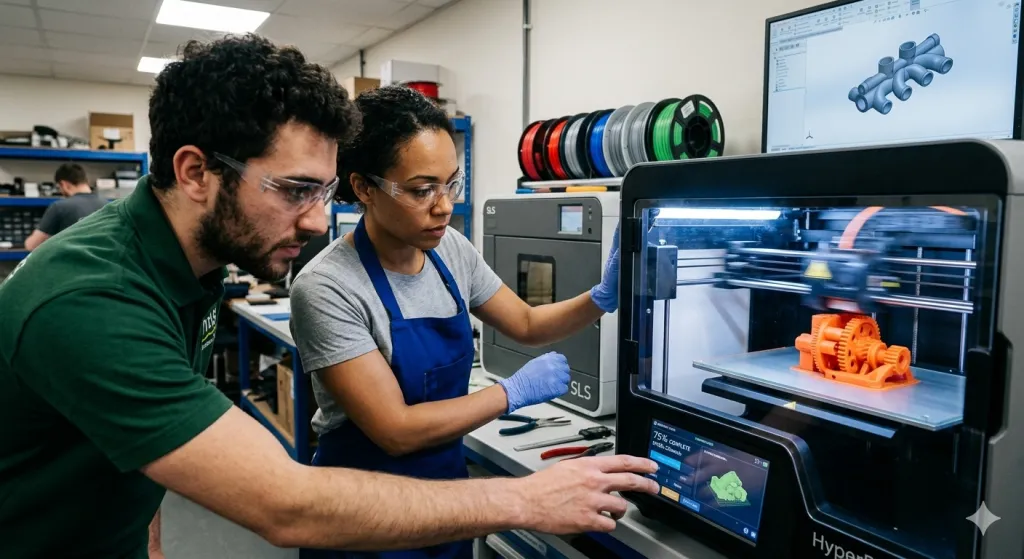
Most hardware startups do not fail because the idea is weak. They fail because the development path is misaligned with how early-stage founders actually operate.
Traditional product development assumes large budgets, long R&D cycles, and high-volume manufacturing. Startup founders need the opposite: speed, cost control, and small-batch validation before scaling.
PrototyperLab was built specifically for that gap.
This article explains what PrototyperLab is, how it works, and why its lean hardware development model is structured for bootstrapped founders, eCommerce entrepreneurs, and early-stage product innovators.
What Is PrototyperLab?
PrototyperLab is a product prototyping services company focused on rapid development and small-batch production for hardware startups.
Core capabilities include:
- 30-day rapid prototyping
- Rapid 3D printing service
- Functional 3D printing prototype service
- Lean hardware product development
- Small batch manufacturing starting at 20 units
- Transparent $25/hour engineering pricing
- U.S.-based legal contracts with Vietnam-based production
The goal is simple: help founders move from concept to testable product quickly, affordably, and with controlled risk.
Unlike traditional factories that require 500–1,000 unit minimum order quantities, PrototyperLab supports early-stage validation through small runs and iterative engineering.
The Problem With Traditional Hardware Development
Most hardware founders encounter three major obstacles:
1. High Development Costs
Engineering firms often require large retainers before a functional prototype is built. Costs can escalate quickly without clear iteration checkpoints.
2. Large Minimum Order Quantities (MOQs)
Manufacturers frequently demand high production volumes. For a startup without validated demand, this introduces significant inventory risk.
3. Slow Iteration Cycles
When development takes months before physical testing occurs, assumptions compound. Errors discovered late become expensive to fix.
The Startup-Minded Maker persona described in PrototyperLab’s internal framework consistently values speed, flexibility, and transparency over corporate-scale development processes .
PrototyperLab’s model directly addresses these pain points.
Rapid 3D Printing Service: Speed as a Strategic Advantage
In early hardware development, speed is leverage.
A rapid 3D printing service allows founders to validate:
- Mechanical fit
- Structural integrity
- Functional movement
- Assembly design
- Ergonomics
However, cosmetic prints are not enough. Many 3D printing prototype services focus primarily on appearance rather than durability and stress testing.
PrototyperLab approaches 3D printing as part of an engineering strategy. Prototypes are designed for functional validation, not just visual presentation. Parts can be tested, modified, and reprinted quickly to accelerate iteration cycles.
When development cycles shrink from months to weeks—or days—founders make faster, data-backed decisions.
Lean for Hardware Product Development: Why It Matters
Lean for hardware product development is not about reducing quality. It is about reducing waste.
Waste in hardware development typically includes:
- Over-engineering features before validation
- Investing in tooling before confirming demand
- Refining aesthetics before solving core functionality
- Producing large volumes before user feedback
PrototyperLab follows a structured loop:
Build
Create a functional prototype using appropriate fabrication methods (3D printing, CNC, molding, hybrid assemblies).
Test
Evaluate mechanical reliability, usability, durability, and performance under real-world conditions.
Improve
Refine weak points, adjust tolerances, optimize materials, and improve performance before committing to production.
This process ensures that capital is allocated toward validated improvements rather than speculative refinement.
Product Prototyping Services That Extend Beyond Printing
While 3D printing is powerful, not all hardware products can rely solely on printed parts.
PrototyperLab’s product prototyping services may include:
- CNC machining for higher-strength components
- Silicone molding for flexible or elastomeric parts
- Hybrid assemblies combining multiple materials
- Electronics integration and housing design
- Mechanical motion systems
The objective is not to choose a single method but to select the most efficient path for validation.
For consumer electronics, IoT devices, automation tools, or specialty hardware, engineering integration often determines product viability.
Case Insight: Developing an Automatic Singing Bowl
Consider a product such as an automatic singing bowl.
This type of product introduces multiple engineering challenges:
- Mechanical actuation of the striker
- Acoustic tuning and resonance
- Motor noise management
- Vibration isolation
- Electronics integration
- Material durability
A traditional mass-production-first approach would require tooling investment before refinement.
A lean development approach begins with:
- Rapid prototyping of housing and structure
- Mechanical testing of striker mechanisms
- Iterative noise reduction adjustments
- Acoustic testing under different material conditions
- Small-batch production to validate user experience
By iterating before scaling, founders reduce the risk of releasing a product that generates poor early reviews or functional failures.
Complex hardware benefits significantly from lean validation cycles.
Small Batch Production: Why 20 Units Changes the Equation
Small batch production is one of PrototyperLab’s defining features.
Instead of requiring 500+ units, founders can begin with as few as 20 units.
This enables:
- Amazon test launches
- Kickstarter fulfillment
- Influencer seeding
- Direct-to-consumer validation
- Real-world durability testing
- Early customer feedback collection
Inventory represents risk. Every unit produced before demand validation increases exposure.
By starting with 20–100 units, founders test demand before scaling. This aligns directly with the Lean Inventor profile described in PrototyperLab’s strategic documentation .
Transparent Engineering Costs: $25 Per Hour
Pricing transparency is rare in product development.
PrototyperLab charges:
- $25 per hour for engineering time
- Material and facility costs at actual rates
- No markup on production materials
Most early-stage projects fall around $2,500, though complexity can increase that range.
Important policies include:
- No upfront payment until the quote is approved
- Clear breakdown of estimated hours
- No additional billing for internal delays
This pricing model is structured to reduce uncertainty and allow founders to budget realistically.
U.S.-Based Legal Protection With Vietnam Manufacturing Advantage
Manufacturing overseas introduces cost advantages but also legal and communication concerns.
PrototyperLab operates under:
- U.S.-based contracts
- U.S.-handled payments
- Vietnam-based engineering and production
This hybrid structure delivers:
- Legal protection
- Reduced production costs
- Established logistics experience
- Familiarity with Amazon and 3PL requirements
Founders benefit from cost efficiency without managing offshore relationships independently.
Who PrototyperLab Is Designed For
PrototyperLab is ideal for:
- Bootstrapped hardware founders
- Amazon and Shopify product sellers
- Kickstarter creators
- IoT and automation startups
- Early-stage product innovators
It is particularly suited for founders who:
- Need a working prototype within weeks
- Want to test with 20–100 units
- Require transparent cost structure
- Value direct communication with engineers
Who It Is Not Designed For
PrototyperLab is not optimized for:
- Large corporations seeking mass production at scale
- 10,000+ unit initial production runs
- Cosmetic-only industrial design services
The focus remains early validation and lean execution.
The Competitive Advantage: Faster Learning Cycles
In hardware startups, time compounds.
A founder who can:
- Prototype in 30 days
- Iterate within weeks
- Launch with 20 units
- Gather feedback quickly
Will outpace competitors stuck in extended R&D cycles.
Decision speed creates strategic advantage.
Lean development shortens the distance between assumption and evidence.
PrototyperLab Is Your Trusted Prototyping Service Provider
Hardware innovation no longer requires massive upfront capital or corporate-scale development structures.
What it requires is disciplined iteration, transparent costs, and controlled production volume.
PrototyperLab combines:
- Rapid 3D printing service
- Functional 3D printing prototype service
- Lean hardware product development
- Product prototyping services designed for startups
- Small batch production starting at 20 units
For founders building physical products who want to validate demand before scaling, this model offers a structured path forward.
If the goal is to move from idea to working product without unnecessary risk, the next step is clear: define the concept, review the transparent quote, and begin building your prototype.
In hardware, momentum favors those who test early and iterate intelligently.
Send over a sketch, a CAD file, or just a description of what the product needs to do. A real quote comes back within 48 hours.
Get a free quote