
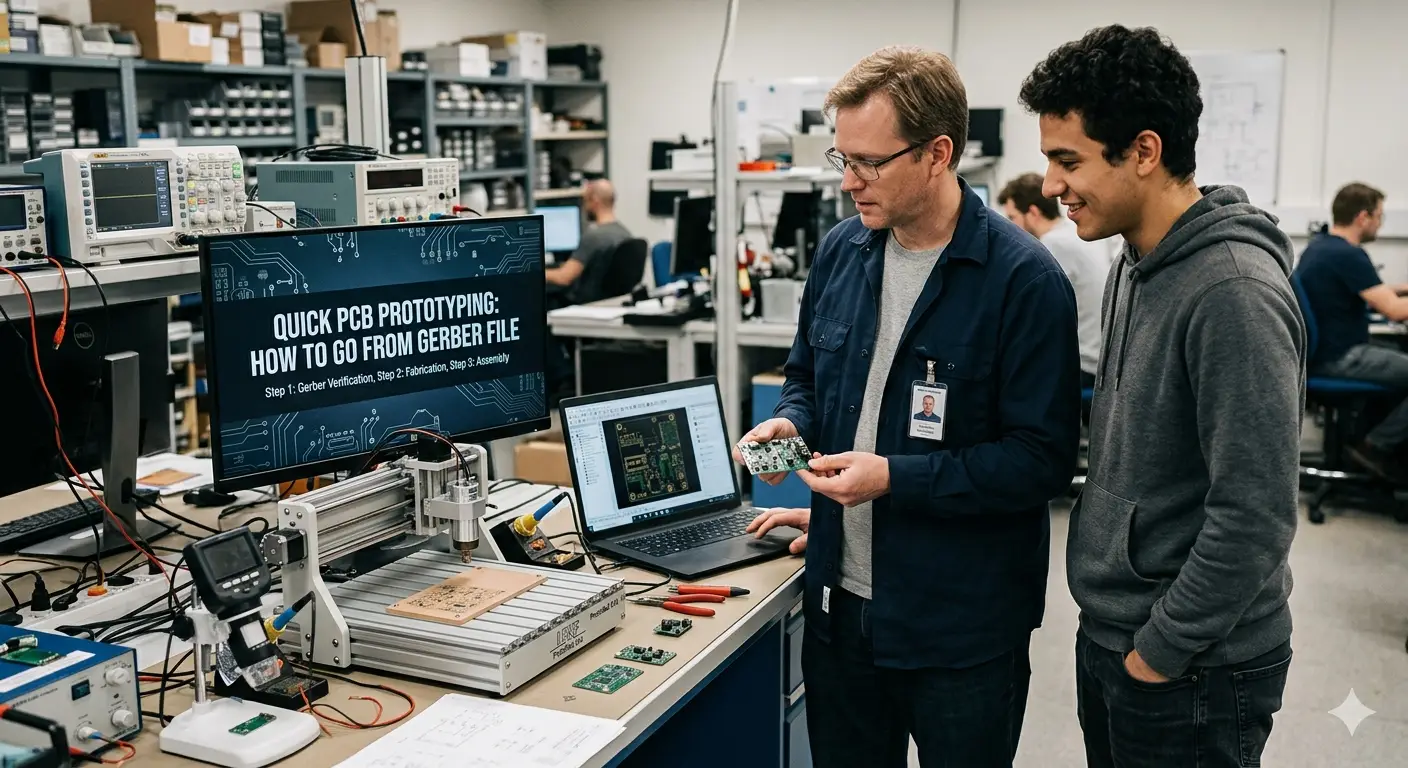
The hardware founder who uploads a Gerber file on Monday and expects assembled boards by Friday isn’t being unrealistic. With the right fast pcb prototyping service, that timeline is achievable. The problem isn’t the technology. It’s that most founders don’t know what separates a service that can actually hit that window from one that quietly adds days at every step of the process.
This guide covers everything a hardware startup founder or electronics product developer needs to know about quick PCB prototyping: how the fabrication-to-assembly pipeline works, what rapid pcb assembly actually involves, where time gets lost, what files to prepare before contacting a service, and what separates a service worth hiring from one that will cost two extra weeks and a redesign.
Why Speed Matters More in PCB Prototyping Than Almost Any Other Stage
A slow software iteration costs a founder a few days of momentum. A slow PCB prototype iteration can cost a product launch.
Hardware development timelines compress from both ends. Investor demos have fixed dates. Manufacturing windows close. eCommerce launch seasons don’t move. And unlike software, a hardware product can’t ship a patch after the fact. The board either works before it goes into a device or the device ships broken.
Quick turn prototype pcb services exist because the traditional PCB manufacturing pipeline, designed for volume production, applies the same queue logic to a 5-board prototype order as it does to a 50,000-unit run. For a founder who needs to validate a circuit design, that wait is a competitive disadvantage measured in weeks.
The founders who move fastest through hardware development aren’t the ones with the best circuit designs. They’re the ones who prototype quickly, test early, and iterate before the competition has received their first board back from a slow-turn service.
Fabrication vs. Assembly: What Quick PCB Prototyping Actually Involves
One of the most common points of confusion for first-time hardware founders is the difference between PCB fabrication and PCB assembly. They’re separate processes, handled by different equipment, and both affect total turnaround time.
PCB Fabrication
Fabrication is the process of manufacturing the bare board itself: the substrate, copper layers, vias, solder mask, and silkscreen. The inputs are Gerber files. The output is an unpopulated board with no components on it.
Fabrication turnaround varies based on:
- Layer count. A 2-layer board fabricates faster than a 6-layer board. Each additional layer adds process steps.
- Material spec. Standard FR4 moves through fabrication faster than specialty materials like Rogers or high-Tg variants.
- Tolerances. Tight trace widths, small vias, and controlled impedance requirements add time because they require additional process controls and inspection steps.
- Order quantity. A 5-board prototype run can often be panelized with other orders and run faster than a standalone production job.
For standard 2-layer FR4 boards with common specs, quick-turn fabrication services can return bare boards in 24 to 72 hours. More complex multilayer boards with tighter specs typically run 3 to 5 business days.
PCB Assembly
Assembly is the process of populating the bare board with components: soldering resistors, capacitors, ICs, connectors, and every other part specified in the bill of materials. The two primary assembly methods are:
SMT (Surface Mount Technology). Components are placed directly on the surface of the board by automated pick-and-place machines and reflowed in an oven. SMT handles the majority of modern PCB components and is the faster, more automated of the two methods.
Through-hole assembly. Components with leads are inserted through holes in the board and soldered on the opposite side. Through-hole is more common for connectors, larger electrolytic capacitors, and components that need mechanical strength. It’s slower because it typically requires more manual labor.
Most real-world PCB designs use a combination of both. A board might be 90% SMT with a handful of through-hole connectors and power components. Rapid pcb assembly services that handle both in-house without outsourcing the through-hole work to a secondary vendor move meaningfully faster.
The Combined Timeline
For a straightforward 2-layer SMT board with a clean BOM and pre-sourced components, a quality fast pcb prototyping service can return assembled boards in 5 to 7 business days. Complex multilayer boards with mixed assembly, custom components, or tight tolerances realistically run 10 to 14 days.
The gap between those two timelines usually comes down to three things: file quality, component availability, and how many questions the service has to ask before production can start.
What PCB Fast Prototyping Actually Requires From the Founder
The fastest services in the world still need complete, correct inputs to move quickly. File problems are the single biggest source of delay in quick turn prototype pcb orders, and most of them are preventable.
The Gerber Package
Gerber files define the physical board layers. A complete Gerber package includes:
- Copper layers (top and bottom at minimum, plus inner layers for multilayer boards)
- Solder mask layers (top and bottom)
- Silkscreen layers (top and bottom)
- Board outline (mechanical layer)
- Drill file (excellon format, with separate files for plated and non-plated holes if applicable)
- Paste stencil layers (if SMT assembly is included)
Missing a layer or submitting outdated files from an earlier design revision are the two most common Gerber errors. Both cause production holds that add days.
The Bill of Materials
The BOM is the complete list of every component on the board: manufacturer part number, value, footprint, quantity, and reference designator. A BOM submitted with generic descriptions instead of specific manufacturer part numbers forces the assembly service to source substitutes, which introduces risk and delay.
For quick turn prototype pcb orders specifically, including approved alternate part numbers for any component that might have availability issues is worth the extra 30 minutes of preparation. Component shortages, particularly for common ICs and passive components, are a real and ongoing constraint. A BOM with no alternates can stall an otherwise fast order by days.
The Centroid File (Pick-and-Place File)
For SMT assembly, the centroid file tells the pick-and-place machine the X/Y coordinates and rotation angle of every component. Most PCB design tools export this automatically. Submitting it with the initial order package rather than waiting for the service to request it removes one back-and-forth from the timeline.
Design Rule Check
Running a DRC in the PCB design tool before submitting catches the most common fabrication errors: trace width violations, clearance violations, unconnected nets. A file that fails the service’s DRC on arrival goes back to the founder for revision. That back-and-forth adds a day at minimum.
Where Founders Lose Time in the PCB Prototyping Process
Beyond file quality, there are specific process points where time disappears in ways founders don’t anticipate.
Component procurement. If the service sources components rather than using a pre-kitted BOM the founder supplies, procurement time is part of the total lead time. For common components, this is fast. For anything specialized, it’s the longest single variable in the timeline.
Design for manufacturability issues. A design that looks correct in CAD may have features that are difficult or impossible to fabricate at standard tolerances. Minimum trace widths, via sizes, and pad geometries that fall outside the service’s standard capabilities trigger an engineering review. That review takes time and may require design changes before production can begin.
Communication gaps. Services that route questions through a ticketing system instead of connecting the founder directly to the engineer handling the project add a delay at every question. A design question that could be resolved in a five-minute conversation can take 24 hours to resolve through a support queue.
Revision cycles. The first assembled prototype almost always reveals at least one issue, whether it’s a component in the wrong orientation, a trace that needs rerouting, or a footprint mismatch. Building one revision cycle into the development plan rather than assuming the first board will be final is realistic planning, not pessimism.
What to Look for in a Fast PCB Prototyping Service
Not every service that advertises quick turn pcb is actually set up to deliver it consistently. Here’s what actually matters when evaluating a fast turn pcb prototype partner.
Real turnaround commitments, not marketing language
“Fast” means nothing without a number. A service worth hiring states specific turnaround times for specific board types and holds to them. Ask: what’s the turnaround for a 4-layer SMT board with 50 components and a clean BOM? If the answer is vague, the timeline will be too.
PrototyperLab delivers physical prototypes in as little as 7 days, a specific commitment built around the reality that startup founders can’t afford open-ended lead times when a demo or launch window is on the line.
In-house fabrication and assembly
Services that fabricate in-house and assemble in-house eliminate the handoff delay between two separate vendors. When fabrication and assembly happen under one operational roof, the bare board moves directly from the fab line to the assembly line. When they’re split between vendors, there’s a shipping leg, a receiving queue, and a new order intake process between them.
Component sourcing capability
A service that can source components rather than requiring the founder to supply a pre-kitted kit handles one of the most variable parts of the timeline internally. That said, a founder who supplies a complete, accurate BOM with alternates moves faster than one who relies entirely on the service for sourcing.
Low minimum order quantities
Traditional PCB assembly houses set MOQs that make no sense for prototype validation. A founder who needs 10 assembled boards to test a design shouldn’t be forced to order 100. PrototyperLab’s small-batch manufacturing starts at 20 units, which covers the range most hardware founders need for real-world validation without the cost exposure of a full production run.
Direct engineer communication
The project manager layer that sits between a founder and the engineer running the boards creates friction at every decision point. A service that assigns a dedicated engineer and allows direct communication resolves questions in minutes rather than days. For a quick-turn order where every hour matters, that difference is real.
U.S.-based oversight
For founders building products that will be sold in the U.S., working with a service that has U.S.-based leadership and legal structure provides IP protection, clear accountability, and communication that doesn’t require navigating time zones, language gaps, or overseas dispute resolution. PrototyperLab operates with U.S. leadership paired with Vietnam-based production, which means founders get competitive production costs without giving up domestic accountability.
Transparent pricing
Hourly or per-project pricing disclosed before the order starts lets a founder budget a development cycle accurately. PrototyperLab operates at $25 per hour. That’s a number a founder can plan around without waiting for a quote to come back three days later.
Common Mistakes in First PCB Prototype Orders
Over-specifying the first prototype
A prototype designed to final production tolerances on the first spin costs more and takes longer than necessary. The goal of the first prototype is validation, not perfection. Standard tolerances, common materials, and conservative design rules keep the first board fast and affordable. Tighten the specs after the design is validated.
Under-specifying the BOM
Generic component descriptions like “100nF capacitor” without a manufacturer part number create sourcing ambiguity. Different packages, voltage ratings, and dielectrics produce different performance. Be specific from the start.
Skipping the design review
Sending files directly to production without requesting an engineering review first is the fastest way to receive a non-functional board. A 30-minute DFM review before the order starts catches the issues that would otherwise show up after the boards come back.
Treating every prototype as a one-off
Quick PCB prototyping is most effective when it’s treated as a repeatable process, not a one-time event. Founders who build a clean file handoff process, maintain an organized BOM, and plan for at least two revision cycles move through hardware development faster than those who approach each prototype as a from-scratch effort.
From PCB Prototype to Small Batch Production
A validated PCB prototype is the starting point for a small production run, not the end of the development process. The bridge from prototype to production involves a few specific steps that affect both timeline and cost.
Design lock. Before ordering a production batch, the design should be frozen. Changes after a production order starts are expensive and disruptive. The prototype stage exists precisely to catch the changes that need to happen.
BOM finalization. The production BOM should include confirmed component availability for the full order quantity. A component that’s available for 10 prototype boards may be on a 12-week lead time for 200 production boards.
Test plan. Production boards need a functional test protocol. Deciding what to test and how to test it before the boards arrive is faster than figuring it out after.
PrototyperLab handles both prototyping and small-batch production starting at 20 units, which means the same engineering team that built the prototype manages the production run. There’s no re-qualification of files, no new vendor relationship to establish, and no translation loss between the prototype that was validated and the production boards that get built.
Start Your PCB Prototype Today
A circuit design that exists only as a schematic isn’t a product. The gap between design and validated hardware closes with a physical board in hand, tested in real conditions, with real data behind the next revision.
PrototyperLab works with hardware startup founders and eCommerce entrepreneurs to move from Gerber files to assembled boards in as little as 7 days, with small-batch production starting at 20 units and transparent pricing at $25 per hour. U.S.-based leadership means direct communication, IP protection, and a partner accountable to the same standards as the founders it works with.
Contact PrototyperLab to get your PCB prototype started.