
When it comes to launching a physical product, the first big decision starts with one big question.
Should you start with small batch manufacturing or jump into mass production?
Get it right, and you minimize risk while validating demand. Get it wrong, and you’re stuck with unsold inventory, wasted capital, or worse—a product that never reaches the market.
This guide breaks down the pros, cons, and best use cases for small batch manufacturing compared to traditional mass production, especially for early-stage founders who need speed, flexibility, and cost control.
What Is Small Batch Manufacturing?
Small batch manufacturing refers to the production of physical goods in limited quantities. It usually starts at 20 to 500 units. It’s the go-to method for startups and e-commerce sellers looking to test the market without committing to massive inventory.
It’s also known as small batch production or low-volume manufacturing, and it’s a strategic choice for those who want to iterate quickly, reduce upfront costs, and stay agile.
What Are the Benefits of Small Batch Production?
Founders often choose small batch production not just out of necessity, but because of its strategic advantages in early-stage product development.
It’s the perfect intersection of speed, control, and lower upfront risk—critical elements when moving fast in an unpredictable market. Unlike rigid, high-volume systems, small batch setups make room for learning and iteration.
Below are the key benefits of this approach for lean product launches.
- Lower Upfront Investment: No need to sink $50K into tooling or inventory. You can start with as few as 20–100 units, which aligns better with tight startup budgets.
- Faster Time to Market: PrototyperLab’s small batch manufacturing services can get your first sellable units produced in just 30 days. That speed lets you ride trends or respond to real-time customer feedback.
- Flexibility for Iteration: Version 1.0 is rarely perfect. With small runs, you can tweak your design or materials between batches without being locked into thousands of units.
- Inventory Risk Is Minimal: Unsold units are a killer for cash flow. Producing in small batches helps you avoid warehouses full of dead stock.
- Better Quality Control: With fewer units to manage, inspection and refinement are easier—especially for premium or customized products.
Downside of Small Batch Manufacturing
Small batch manufacturing is often the smartest way to launch, but it’s not without its tradeoffs. While it minimizes financial risk and accelerates time-to-market, founders should be aware of the operational and cost-related limitations.
Some of the friction points may not be dealbreakers, but they can impact long-term scalability if not planned for early on. For bootstrapped makers and e-commerce entrepreneurs, understanding these challenges up front helps avoid frustration down the line.
Here are the most common downsides to consider.
- Higher Unit Cost: Per-unit pricing is typically higher than mass production due to less automation and fewer economies of scale.
- Limited Supplier Options: Many traditional factories ignore orders under 500 units, making it harder to find partners willing to work at low volumes.
- Less Automation: Small batch processes often require more manual labor, which can limit consistency if not well managed.
- Scaling Requires Planning: Once your product gains traction, transitioning from small batch to mass production can involve retooling, supplier changes, or manufacturing strategy shifts.
What Is Mass Production?
Mass production is the large-scale manufacturing of standardized products using highly automated systems. It’s typically defined by minimum orders of 1,000 units and up. The model is optimized for cost efficiency at volume, making it ideal for well-established products with high demand.
Pros of Mass Production
There’s a reason mass production dominates global supply chains: when executed correctly, it delivers unbeatable unit cost and output consistency. For established products with high demand, it becomes a vital engine for scale and profitability. Here’s where mass production truly shines.
- Low Unit Cost: If you’re producing 10,000+ units, the per-unit cost drops significantly thanks to automation and bulk purchasing.
- Consistent Output: High-volume manufacturing usually means standardized processes, which help with product uniformity and reduced defects.
- Predictable Supply Chain: Larger volumes create more stable production schedules and logistics arrangements, once everything is dialed in.
Cons of Mass Production
Mass production is powerful—but only when the timing and conditions are right. For many startups, it’s a tempting leap that can backfire without proper demand validation or capital reserves.
Before scaling too quickly, it’s crucial to understand where mass production can put a strain on cash flow, logistics, and your ability to adapt. These are the most important drawbacks to factor into your decision.
- High Upfront Investment: Mold creation, tooling, and large material orders add up fast—easily reaching tens or hundreds of thousands of dollars before your first unit ships.
- Inventory Risk: If your product flops or needs a redesign, you’re stuck with thousands of units you can’t sell.
- Longer Lead Times: Mass production setups take time to establish—often 2–6 months—before the first batch even rolls off the line.
- Inflexible for Changes: Any design change mid-production can delay delivery, incur extra costs, or render entire batches obsolete.
Best Use Cases for Small Batch Manufacturing
Small batch manufacturing is ideal for testing waters, creating buzz, and validating ideas without burning through cash. These are the top use cases where small batch production beats mass production every time.
- Market Testing and Product Validation: Want to launch a Kickstarter or test demand on Amazon? A 20–100 unit run lets you test without blowing your entire budget.
- Limited Edition or Niche Products: Seasonal gifts, influencer collabs, or hobbyist gear with low-volume demand are perfect for small batch manufacturing.
- Customization and Iteration: Agile, low-volume manufacturing is better for products that need personalization or frequent updates, such as smart home devices or modular kits.
- Hardware Startups and E-commerce Founders: If you’re launching your first physical product and want to preserve capital, test feedback loops, or build investor traction, small batch manufacturing is the way to go.
When Mass Production Makes More Sense
Not every product is ready for mass production, and not every founder should jump into it. But once you’ve dialed in your product-market fit, built repeatable sales, and forecast predictable demand, scaling up becomes the natural next move.
Mass production makes the most sense when your business model relies on volume, your processes are mature, and you’re ready to prioritize margin and efficiency. A
t this stage, a larger operation isn’t just justified—it’s often required to stay competitive. These are the scenarios where going big makes business sense.
- You’ve Already Validated Product-Market Fit: You’ve tested the product, refined it, and have strong demand forecasts.
- Your Volume Demand Justifies It: You’re already selling hundreds or thousands of monthly units.
- You Need Ultra-Low Unit Cost for Profitability: Your margins only make sense at scale—think consumer staples or high-volume accessories.
- Lead Time Isn’t Critical: You can wait a few months to restock because your logistics pipeline is dialed in.
A Hybrid Approach: Start Small, Then Scale
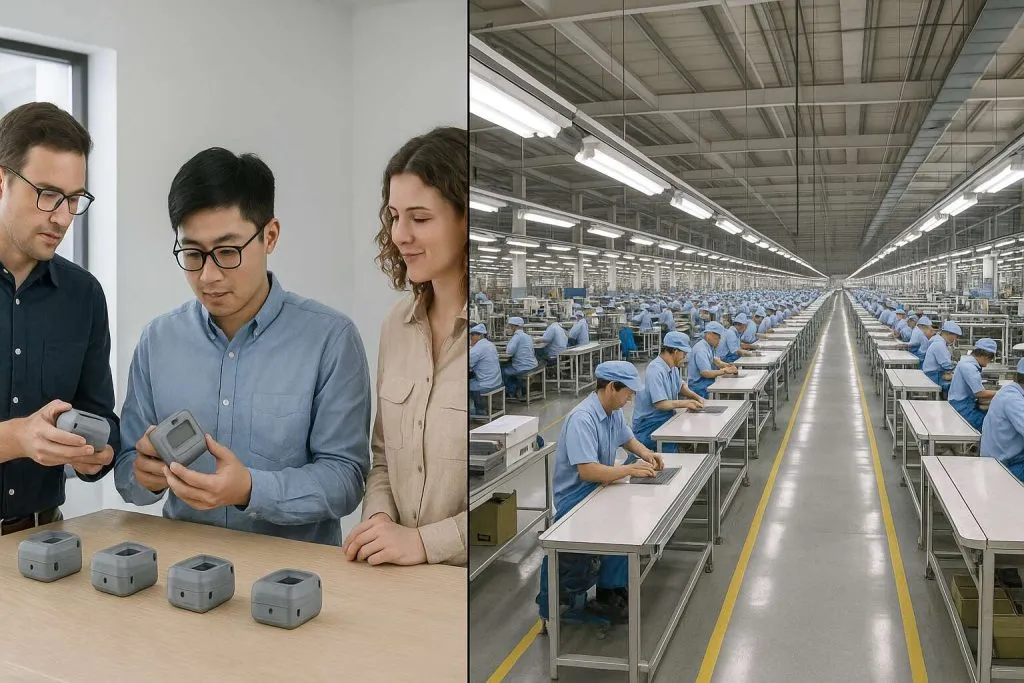
Most successful product launches don’t go straight into mass production—they start with small batch manufacturing. Once customer feedback confirms demand and product quality, scaling becomes less risky.
For example, a solo founder might:
- Prototype in about 30 days through PrototyperLab
- Launch 50 units on Kickstarter
- Use feedback to improve the product
- Scale to 500–1000 units through a vetted production partner
This phased strategy maximizes flexibility and minimizes financial exposure.
Why Experience Matters When Scaling From Prototype to Production
The decision between small batch manufacturing and mass production is rarely about volume alone. It is a strategic product development decision that affects cash flow, inventory risk, manufacturing flexibility, product quality, and long-term scalability. Choosing the wrong approach too early can lead to expensive tooling investments, excess inventory, and costly redesigns.
PrototyperLab combines more than 20 years of product development and engineering experience with hands-on manufacturing expertise to help startups, inventors, and eCommerce brands navigate this transition with greater confidence. Having supported the development of more than 100 SKUs across consumer products, electronics, robotics, automation systems, and custom hardware projects, the team has extensive experience helping founders determine when a product is ready for small batch manufacturing and when demand justifies scaling to larger production volumes.
Rather than treating manufacturing as a separate phase, PrototyperLab integrates rapid prototyping, design validation, small batch production, and manufacturing planning into a single development pathway. This allows founders to identify production risks earlier, gather meaningful customer feedback, validate market demand, and improve manufacturability before committing significant capital to large-scale production.
Supported by U.S.-based project oversight and Vietnam manufacturing capabilities, founders gain access to rapid prototyping resources, low-volume production options, and scalable manufacturing support without the traditional barriers associated with high minimum order quantities. This combination of engineering expertise and manufacturing experience helps reduce risk while creating a more predictable path from concept to commercialization.
For most early-stage products, success comes from validating demand before optimizing for scale. Small batch manufacturing provides the opportunity to learn, improve, and make data-driven decisions before larger production commitments are required.
Why Small Batch Manufacturing Is the Right Starting Point for Most Founders
For e-commerce entrepreneurs, indie hardware makers, and first-time product developers, small batch manufacturing services offer the control, speed, and affordability needed to break into the market without burning through capital.
If you’re still testing the waters, small batch production gives you the agility to pivot, improve, and grow without committing to high-stakes inventory. Once the data and demand are clear, you can scale with confidence.
And with a partner like PrototyperLab—where rapid prototyping takes 30 days and small batch production starts at just 20 units—you get the benefits of low-volume manufacturing without the pain points of traditional factories.
PrototyperLab also offers transparent $25 per engineering hour pricing, US-based legal contracts, and cost-efficient production in Vietnam.
Batch Production vs. Mass Production: Choosing the Right Approach for Prototypes
Prototyperlab works with startups and growing brands to bridge the gap between an idea and full-scale manufacturing, and one of the most important decisions early on is whether to use batch production or mass production. For prototypes, batch production is nearly always the smarter choice—it allows small, controlled runs that are cost-effective, flexible, and fast, while mass production is built for scale and consistency, not iteration.
Batch Production for Prototypes
Small, controlled quantities:
Batch production makes it possible to create sets of 20 to a few hundred units at a time. This volume is perfect for functional testing, investor demonstrations, and early customer feedback.
Flexibility:
Design changes are inevitable during development. With batch production, tweaks to dimensions, materials, or finishes can be implemented between runs without the heavy cost of retooling. This iterative process shortens the time from idea to launch, often reducing development cycles from six months to under two months.
Lower setup cost:
Unlike mass production, which may require molds costing $20,000–$50,000, batch methods rely on versatile equipment such as 3D printers, CNC machines, and small-scale molding tools. This makes the upfront investment manageable and reduces financial risk.
Faster turnaround:
Prototyping thrives on speed. Some batch-produced prototypes can be delivered in just 7–10 days, allowing multiple iterations in the same timeframe it would take a mass-production facility to set up.
Why Mass Production Doesn’t Fit Early Prototypes
High volume:
Mass production is optimized for thousands—or millions—of identical items. That scale is only practical once a design is final and validated.
Lack of flexibility:
Assembly lines are purpose-built. If a design flaw is discovered, retooling is not only expensive but can delay progress by months.
High initial investment:
Specialized tooling, robotics, and line setup often require six-figure investments. For early prototypes that may change after testing, these costs aren’t justifiable.
Risk of loss:
Launching into mass production too soon can result in thousands of unusable units if the design isn’t fully proven.
Key Takeaway
Batch production gives entrepreneurs agility, lower upfront costs, and better quality control for limited quantities. Mass production only makes sense once a product is stable, tested, and ready to meet large-scale demand. By starting with batch production, businesses collect real-world feedback, validate demand, and minimize risk before scaling.
Get A Quote for Your Prototype Production
Send over a sketch, a CAD file, or just a description of what the product needs to do. A real quote comes back within 48 hours.
Get a free quote