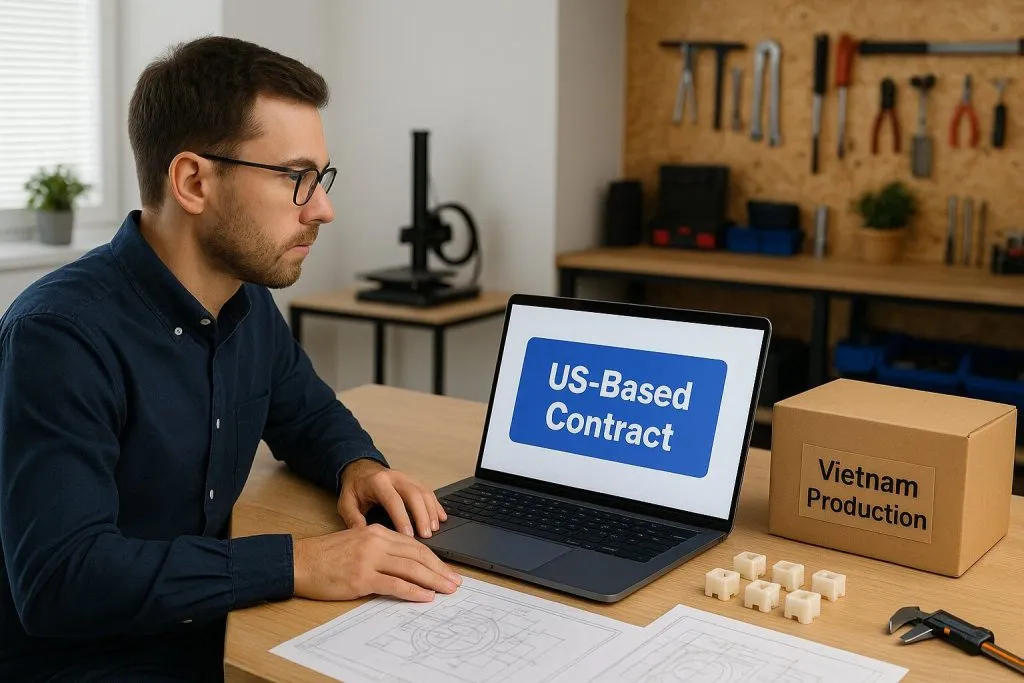
Manufacturing in Vietnam has become a strategic move for startups and e-commerce founders. Costs are competitive. Engineering talent is strong. Small-batch production is far more realistic than in many other regions.
But there is one factor that consistently determines whether these projects succeed or fail:
Where your manufacturing contract is based.
For early-stage founders, bootstrapped inventors, and Amazon sellers, the difference between a US-based contract and a direct overseas factory agreement is not paperwork—it is leverage, protection, and control.
This article explains why US-based contracts for overseas manufacturing are important, how they mitigate risk without increasing costs, and how founders can manufacture in Vietnam safely while moving quickly.
The Real Risk of Manufacturing in Vietnam Isn’t the Factory
Vietnam manufacturing itself is not the issue.
Vietnam offers:
- Skilled engineers and technicians
- Competitive labor and material costs
- Strong capabilities in plastics, metal, wood, textiles, and electronics
The real risk appears when founders sign contracts directly with overseas factories and remove themselves from enforceable legal protection.
Most failed overseas manufacturing projects don’t fail because the factory is incapable. They fail because:
- Disputes cannot be enforced
- IP ownership is unclear
- Tooling control is ambiguous
- Payment leverage disappears after funds are wired
This is not a Vietnam problem. It is a contract structure problem.
What Is a US-Based Contract for Overseas Manufacturing?
A US-based manufacturing contract means:
- The agreement is governed by U.S. law
- Payments are made to a U.S. entity
- Legal jurisdiction remains domestic
- Overseas production is executed under a controlled manufacturing agreement
The product is still manufactured in Vietnam. Costs remain competitive. Timelines remain fast.
What changes is who holds leverage if something goes wrong.
This structure is especially important for:
- Startup manufacturing overseas
- Small batch manufacturing in Vietnam
- First-time hardware founders
- Amazon and Shopify sellers are testing demand
Why US-Based Contracts Matter When Manufacturing in Vietnam
1. Intellectual Property Protection That Can Actually Be Enforced
IP protection is one of the biggest fears founders have when manufacturing overseas—and for good reason.
The issue is not whether an NDA exists. The issue is whether it can be enforced.
When contracts are signed directly with overseas factories:
- IP disputes must be resolved internationally
- Enforcement is expensive and slow
- Small startups rarely have practical recourse
With a US-based manufacturing contract:
- IP ownership is defined under U.S. jurisdiction
- Design files, tooling, and revisions are contractually protected
- Enforcement is realistic, not theoretical
For founders asking how to protect IP when manufacturing overseas, jurisdiction matters more than signatures.
2. Leverage in Disputes, Delays, and Quality Issues
Direct factory contracts often feel efficient—until there is a problem.
Once funds are wired overseas:
- Timeline leverage disappears
- Revision requests become negotiations
- Quality disputes stall production
A US-based contract changes that dynamic:
- Payments are milestone-based
- Performance standards are enforceable
- Accountability exists outside the factory
For startup manufacturing overseas, leverage is not about legal threats. It is about preventing disputes from escalating in the first place.
3. Clear Tooling Ownership and Production Control
Tooling disputes are one of the most expensive mistakes founders make when manufacturing abroad.
Many assume:
“I paid for the mold, so it belongs to me.”
Without a properly structured contract, that assumption often fails.
A US-based manufacturing contract explicitly defines:
- Tooling ownership
- Usage rights
- Restrictions on reuse or resale
For founders producing small batches in Vietnam, tooling clarity protects future revisions, second runs, and scaling plans.
4. Risk Reduction Without Enterprise Legal Costs
A common misconception among founders:
“US-based contracts are expensive and slow.”
In reality, founders overspend when they:
- Hire large law firms prematurely
- Attempt to manage overseas factories alone
- Fix disputes after money has already been lost
A properly structured US-based contract paired with Vietnam manufacturing:
- Reduces total project risk
- Avoids unnecessary legal complexity
- Prevents downstream financial losses
For founders trying to manufacture overseas safely without blowing $10,000, structure matters more than legal volume.
US Contract vs. Direct Factory Agreement: A Practical Comparison
Direct Factory Contract
- Lower upfront friction
- Minimal enforcement options
- Tooling and IP ambiguity
- High risk during disputes
US-Based Contract with Vietnam Manufacturing
- Clear legal jurisdiction
- Defined IP and tooling ownership
- Payment and timeline leverage
- Faster resolution when issues arise
For early-stage hardware and consumer product founders, the second option consistently leads to better outcomes—even at low volumes.
Speed vs. Safety Is a False Tradeoff
Founders often believe legal structure slows product development.
In practice, the opposite is true.
Clear contract structures:
- Reduce miscommunication
- Eliminate rework disputes
- Speed up revisions
- Keep production moving forward
When manufacturing in Vietnam, speed comes from clarity—not shortcuts.
A US-based contract combined with Vietnam manufacturing allows founders to prototype, iterate, and launch without restarting conversations when changes are needed.
Why This Matters Even More for Small-Batch Manufacturing
Founders producing 20–100 units are often ignored by traditional manufacturers.
Large factories prioritize volume. Small startups are deprioritized.
A US-based contract structure ensures:
- Startup-sized projects receive oversight
- Small batches are treated as real production
- Early customers receive consistent quality
This is critical for Amazon sellers, Kickstarter launches, and Shopify brands validating demand.
Founder Checklist: Before You Manufacture in Vietnam
Founders considering overseas production should be able to answer yes to all three questions below before moving forward:
- Is my manufacturing contract governed by U.S. law and enforceable in my home jurisdiction?
If enforcement requires overseas legal action, leverage is already lost. - Is tooling ownership, IP ownership, and production control explicitly defined in writing?
Assumptions do not protect founders—contracts do. - Do I retain payment and timeline leverage if delays, defects, or scope changes occur?
Wiring funds directly overseas removes most negotiating power.
If any answer is unclear, the risk is operational—not hypothetical.
The PrototyperLab Model: U.S. Contracts + Vietnam Manufacturing
PrototyperLab was built around a simple principle:
Founders should not have to choose between speed, affordability, and protection.
Projects are structured with:
- US-based contracts and payments
- Vietnam-based engineering and production
- Clear IP and tooling ownership
- Transparent pricing and timelines
This hybrid model gives founders:
- U.S. legal protection
- Vietnam’s manufacturing cost advantages
- Startup-friendly production volumes
- Fast iteration cycles
It is designed specifically for startups manufacturing overseas and small-batch production.
Final Takeaway
Manufacturing in Vietnam is not a risk.
Manufacturing in Vietnam without a US-based contract is.
For founders who want to:
- Protect IP
- Control production
- Move fast without overspending
- Avoid preventable mistakes
US-based contracts for overseas manufacturing are not optional—they are foundational.
Ready to Manufacture in Vietnam Without the Risk?
Founders do not need enterprise budgets or complex legal teams to do this right. They need the right structure from day one.
- Book a consultation to discuss US-based contracts for overseas manufacturing
- Get a transparent quote for Vietnam manufacturing with US legal protection
- Start small-batch production with a structure built for startups
PrototyperLab helps founders turn ideas into real products—fast, affordably, and with the protection serious launches require.
Send over a sketch, a CAD file, or just a description of what the product needs to do. A real quote comes back within 48 hours.
Get a free quote