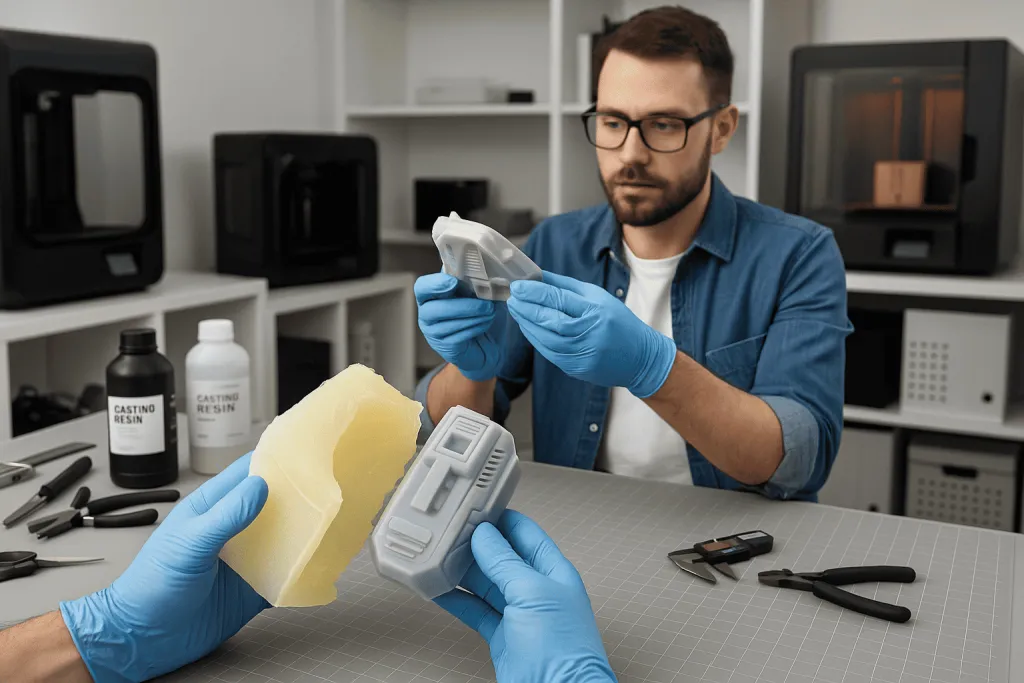
In the world of rapid prototyping, not every method gives you a testable, production-like part without blowing your budget. Vacuum casting is one of the most underrated rapid prototyping techniques for creating high-quality, low-volume parts that look and feel like injection-molded plastic.
Whether you’re testing functionality, preparing for investor demos, or launching a 20-unit beta run, vacuum casting delivers near-production results—without the six-figure tooling cost.
What Is Vacuum Casting?
Vacuum casting is a prototyping process used to create short-run plastic parts. The process involves:
- Creating a master model, typically 3D printed or CNC machined
- Making a silicone mold from the master
- Pouring liquid resin into the mold under vacuum pressure
- Curing the part, usually with heat
The result is a durable, high-fidelity replica with consistent detail, surface finish, and strength—perfect for real-world testing or early market launch.
Why Founders Are Turning to Vacuum Casting
Most early-stage founders hit a wall after basic prototyping. 3D prints are ideal for form studies, but they often lack the surface finish and durability required for real-world use.
Vacuum casting bridges that gap. It offers near-injection-mold quality at a fraction of the time and cost.
Key advantages:
- Cost-effective for small batches (10 to 100 units)
- Production-grade finish and strength
- Faster turnaround than injection molding
- Materials range from rigid to rubber-like and heat-resistant
- Suitable for marketing samples, investor demos, and early launch units
If you’re building something that needs to look, feel, and function like the final product, vacuum casting is a practical next step.
When to Use Vacuum Casting in Your Timeline
Vacuum casting isn’t for every stage of development—but it’s essential once your design is close to final and needs real-world validation.
Best use cases include:
- Pre-production functional testing
- Beta user testing with a polished look
- Kickstarter campaign visuals
- Amazon launch samples
- Soft launches or limited product runs
If you’re moving from validation to market-readiness, vacuum casting can save time and money.
Vacuum Casting vs. Other Rapid Prototyping Techniques
| Method | Best For | Cost per Unit | Surface Finish | Strength | Lead Time |
| 3D Printing | Early form and fit testing | Low | Fair | Moderate | 1–3 days |
| CNC Machining | High-precision metal or plastic | High | Excellent | High | 5–10 days |
| Vacuum Casting | Functional plastics, low volume | Medium | Excellent | High | 5–10 days |
| Injection Molding | Mass production | Low (with high tooling cost) | Excellent | High | 6–12 weeks |
Vacuum casting fits perfectly between rough prototyping and full-scale manufacturing. It gives startups detailed, durable parts fast—without the cost of hard tooling.
How PrototyperLab Uses Vacuum Casting
At PrototyperLab, vacuum casting is integrated into the product development workflow for founders ready to transition from prototype to product testing.
Our process includes:
- Master model creation via 3D printing or CNC
- Silicone mold production for high-fidelity duplication
- Resin selection matched to your product needs
- Vacuum casting under controlled pressure
- Post-processing for finish, paint, or branding
With this workflow, startups receive production-quality prototypes in just days, not months.
Why Vacuum Casting Works for Bootstrapped Founders
Vacuum casting offers startup-friendly benefits:
- No tooling investment
- 7 to 10 day turnaround
- High-fidelity output
- Perfect for 20 to 100 unit soft launches
- Ideal for improving product-market fit before scaling
If you’re launching on Amazon, demoing to investors, or getting your first user feedback—this process gives you a low-risk way to move forward.
PrototyperLab: Affordable Vacuum Casting for Startups
At PrototyperLab, vacuum casting is just one of several rapid prototyping techniques offered to help startups move fast and test smarter.
Here’s how we make it easy:
- Transparent $25/hour engineering pricing
- 30-day prototyping and fast production
- 20-unit minimums for small batch runs
- U.S. contracts with Vietnam-based manufacturing for affordability
- Direct access to engineers, not layers of middlemen
We’ve helped Kickstarter creators, Amazon sellers, and eCommerce founders bring ideas to life with functional, market-ready parts.
Ready to Launch with Confidence?
If your prototype needs to function and feel like the final product—without enterprise-level costs—vacuum casting is the next step. PrototyperLab offers affordable small batch production with full design support and fast turnarounds.
Start your prototype today and see why smart founders use vacuum casting to validate and launch products the lean way.
Get A Quote from PrototyperLab Today
Send over a sketch, a CAD file, or just a description of what the product needs to do. A real quote comes back within 48 hours.
Get a free quote