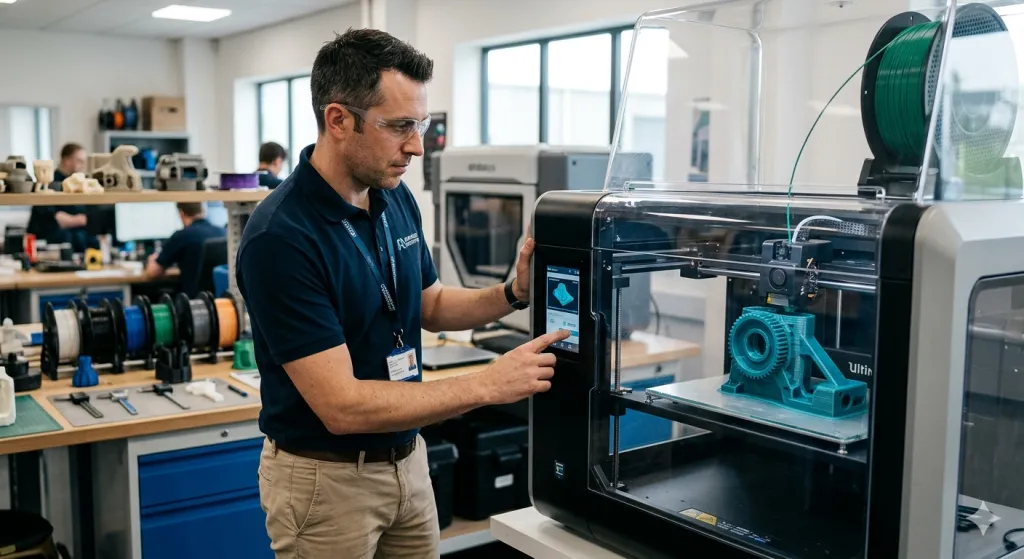
3D printing gets most of the attention in the prototyping conversation—and for good reason.
It’s fast, accessible, and cheap enough that almost anyone can use it to get an early-stage model in hand. But here’s the problem: 3D printed prototypes have real limits.
The surface finish isn’t there. The material properties don’t match production. And when you hand one to an investor, a retail buyer, or a potential customer, they can tell.
If you’re past the early validation stage and need something that actually looks, feels, and functions like a finished product—a premium, production-style prototype—you need to know where to get a prototype made using processes that go well beyond a print bed.
This article covers exactly that.
Why Production-Style Prototypes Matter
Before diving into methods, it’s worth understanding why this distinction matters so much.
The traditional product development process treats prototyping as a single phase. In reality, it’s several. Your first prototype validates a concept. Your second or third validates geometry.
But eventually, you need a prototype that validates the production experience—one that uses real materials, real finishes, and real manufacturing processes.
This is what investors want to see. This is what contract manufacturers need to quote accurately. And this is what you need to truly understand whether your product is ready to scale.
This is also where lean product development for hardware gets serious. Getting a production-style prototype wrong—or skipping it entirely—is one of the most common and costly mistakes hardware teams make before committing to tooling and batch production.
The Limits of 3D Printing for Premium Prototypes
To be clear: 3D printing is a legitimate and powerful rapid prototyping technique. But it has well-documented limitations for premium prototype work:
- Surface finish—Most 3D printed parts require significant post-processing to approach an injection-molded surface quality. Even then, the result is rarely identical.
- Material properties—Rapid prototyping materials used in FDM and SLA printing often don’t replicate the mechanical behavior of production-grade thermoplastics or metals.
- Tolerances—For tight-fitting assemblies or functional mechanisms, 3D printing tolerances can be inconsistent.
- Appearance—Layer lines, resin translucency, and limited color options make 3D printed prototypes look like prototypes.
For internal testing and early iteration, these limitations are acceptable. For a premium prototype intended to represent your final product, they’re dealbreakers.
Where to Get a Premium Production-Style Prototype Made
1. CNC Machining Services
CNC machining is the gold standard for premium prototype product work in metal and engineering plastics. A CNC-machined part is cut from a solid block of real production material—aluminum, stainless steel, polycarbonate, ABS, nylon—using the same tolerances you’d expect from finished goods.
The result is a part that behaves exactly like a production component because it essentially is one, just made one at a time instead of at volume.
CNC is especially valuable for:
- Structural and mechanical components
- Parts that need to interface precisely with other components
- Metal housings, brackets, and enclosures
- Any part where material properties matter for testing
A good prototype manufacturing lab will offer CNC machining alongside other services, letting you combine processes for multi-component products.
2. Prototype Sheet Metal Fabrication
For enclosures, chassis, brackets, and structural elements that will be sheet metal in production, prototype sheet metal fabrication is the correct path. This involves laser cutting, bending, welding, and finishing sheet metal—the same processes used at production scale, just applied to a small number of parts.
Prototype sheet metal work produces parts that are visually and functionally indistinguishable from production sheet metal. Paint, powder coat, anodize—all of it can be applied at the prototype stage to achieve a truly premium finish.
This is a critical step for products in the industrial, consumer electronics, medical device, and appliance categories, where sheet metal forms the visible exterior of the product.
3. Soft Tooling and Bridge Injection Molding
If your product’s final production process is injection molding, the most accurate premium prototype is one that’s actually injection molded—just using soft tooling instead of hardened production tooling.
Prototype tooling and manufacturing using aluminum or soft steel molds allows you to produce injection-molded parts in your actual production material, with actual production surface finishes, at low volumes (typically 50–500 units). The cost is a fraction of full production tooling, and the result is a prototype that is essentially indistinguishable from a production part.
This approach is ideal when:
- You need to validate injection-molded geometry and draft angles
- You want production-accurate material properties for testing
- You’re preparing for a crowdfunding campaign or retail buyer presentation
- You need sample units for regulatory testing or certification
Bridge tooling also supports a lean product development for hardware approach—it lets you validate at low volume before committing to the significant investment of hardened production tooling.
4. Prototype PCB Board Assembly
For products with electronics, the prototype PCB board is a non-negotiable part of a premium prototype build. A production-style electronic prototype goes beyond a breadboard or a development kit.
It uses a professionally fabricated PCB—correct stackup, correct trace widths, correct component placement—assembled with production-grade components using reflow soldering or wave soldering.
A prototype PCB board at this stage should:
- Match the physical form factor of the production PCB
- Use the final component BOM (or close to it)
- Be assembled by a qualified PCB prototype house, not hand-soldered on a dev board
- Be tested under the same conditions the production unit will face
Many prototype manufacturing labs offer turnkey PCB prototype services—gerber review, fabrication, component sourcing, and assembly—as part of a full product prototype package.
5. Urethane Casting (Vacuum Casting)
Urethane casting, also called vacuum casting, is one of the most underrated rapid prototyping techniques for premium plastic parts.
The process involves creating a silicone mold from a master pattern (often a high-quality CNC or SLA part), then casting polyurethane resin into that mold to produce parts that closely replicate injection-molded surfaces and material properties.
Urethane casting is fast, cost-effective for quantities of 10–50 units, and produces a finish quality that is dramatically superior to direct 3D printing. It supports overmolding, multiple durometers, and a wide range of colors and surface textures.
For consumer products, medical devices, and any product where tactile quality matters, urethane casting is often the best path to a premium prototype product before committing to injection mold tooling.
How to Choose the Right Method
The right approach depends on your product’s construction, your timeline, and what you need to validate.
Most premium prototypes are multi-process builds—a CNC-machined aluminum housing, prototype sheet metal internal brackets, a prototype PCB board, and urethane-cast plastic panels, all assembled into a single unit.
Here’s a quick reference:
| Component Type | Recommended Process |
| Metal structural parts | CNC machining |
| Sheet metal enclosures | Prototype sheet metal fabrication |
| Plastic housing (small volume) | Urethane casting |
| Plastic housing (injection-molded accuracy) | Soft tooling / bridge molding |
| Electronic assemblies | Prototype PCB board fabrication |
| Mixed-material assemblies | Multi-process prototype lab |
What to Look for in a Prototype Manufacturing Lab
Not every shop that calls itself a prototype manufacturing lab is equipped for premium production-style work. When evaluating partners, look for:
- Process breadth—A capable lab offers CNC machining, sheet metal fabrication, and finishing under one roof, or has established subcontractor relationships for processes they don’t run in-house.
- Finishing capabilities—Premium prototypes require premium finishing. Anodizing, powder coating, painting, silkscreening, and texture application should all be available.
- PCB capabilities—If your product has electronics, confirm they can handle prototype PCB board fabrication and assembly, or have a qualified partner who can.
- NDA and IP protection—Any serious prototype partner will sign an NDA without hesitation. If they push back, walk away.
- References and portfolio—Ask to see examples of production-style prototypes they’ve built in your product category.
Where to Get a Prototype Made: Your Practical Options
Depending on your stage, budget, and location, here are the practical channels for finding a premium prototyping partner:
- Specialized prototype manufacturing labs—The best option for complex, multi-component products. Search for shops that explicitly advertise production-style or pre-production prototyping, not just 3D printing services.
- Contract manufacturers with NPI programs—Some contract manufacturers offer New Product Introduction (NPI) services that include prototype tooling and manufacturing as part of a path toward production. This can be efficient if you’re close to scale.
- Industrial design and engineering firms—Many firms that offer virtual product design and engineering services also manage prototype builds through their supplier networks. This is a strong option if your product is still being refined.
- Online on-demand manufacturing platforms—Services that offer CNC machining and sheet metal on demand (with DFM review) are a practical option for individual components, though they typically don’t handle full product assembly.
Why Rapid Prototyping Is Needed Even at the Premium Stage
It might seem counterintuitive—if you’re spending real money on CNC machining, soft tooling, and prototype PCBs, why is that still called “prototyping”? Because the purpose hasn’t changed.
Why are prototypes made, even expensive, production-accurate ones? To validate. To test. To catch what virtual product design can’t show you.
A premium prototype is still a learning tool—just one that’s close enough to the final product to give you high-confidence answers before you commit to production tooling, batch production, and everything that follows.
This is why rapid prototyping is needed at every stage of the hardware development journey, not just the beginning. The methods change. The cost goes up. But the fundamental goal—validate before you scale—never does.
Why Rapid Prototyping Is Needed Before You Scale to Production
The difference between a product team that succeeds and one that doesn’t often comes down to one decision: did they validate thoroughly before committing to production? Premium production-style prototypes—built with CNC machining, prototype sheet metal, soft tooling, and prototype PCB assembly—are the highest-confidence way to do that validation.
If you’re past the 3D printing stage and need a prototype that represents your real product, find a prototype manufacturing lab that specializes in multi-process, production-accurate builds. The investment is significant. The alternative—finding your design flaws after your first production run—is far more so.Ready to find a prototype manufacturing lab for your next product? Look for partners who understand the full range of rapid prototyping techniques and can support you from single-component CNC work all the way through pre-production builds.
Send over a sketch, a CAD file, or just a description of what the product needs to do. A real quote comes back within 48 hours.
Get a free quote