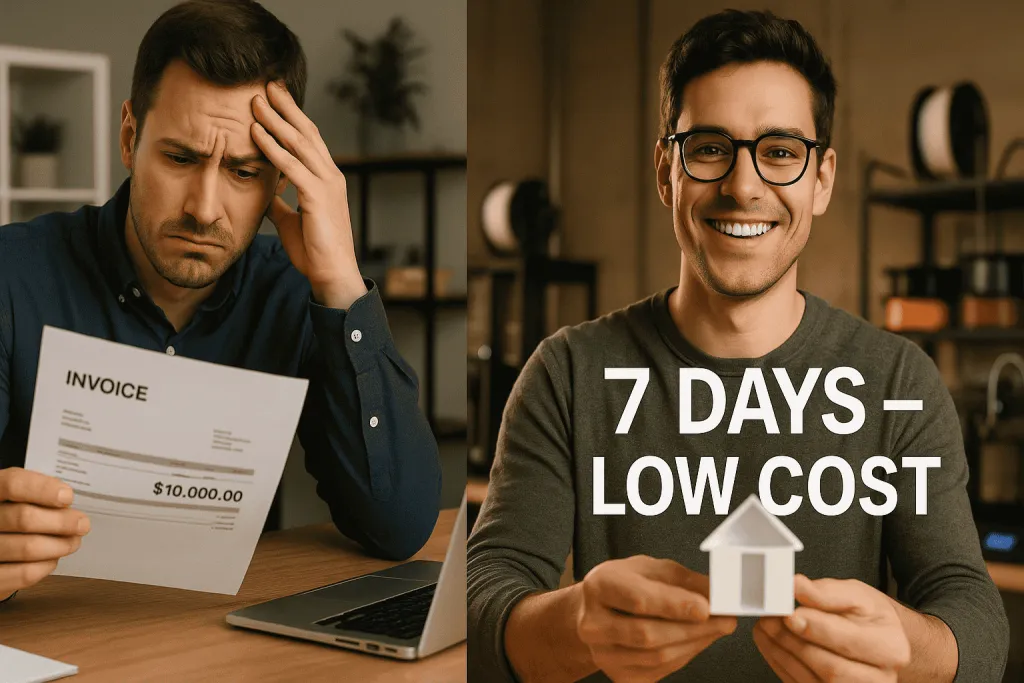
For most e-commerce founders, the first major roadblock isn’t the idea—it’s the cost of turning that idea into a real product. Traditional prototyping can drain $10K or more before you even know if customers want what you’re selling.
The good news: there are smarter, leaner ways to get a working prototype without breaking the bank.
This guide shows exactly how to build a prototype without blowing $10K by using rapid, transparent, and low-volume services designed for startups.
Why Prototyping Costs Spiral Out of Control
Large design firms and traditional manufacturers still operate on outdated models. That means:
- Expensive retainers for industrial designers
- High minimum order requirements (500+ units)
- Slow timelines that stretch into months
- Added costs for revisions, logistics, and testing
By the time the first prototype is in hand, a founder may already be $10,000 in the hole—with no proof of demand.
Smarter Alternatives for Startups
Here’s how e-commerce startups keep prototype costs lean while still getting a market-ready product.
1. Use Rapid Prototyping Services
Instead of waiting months, founders can now get a prototype in 30 days. Services that specialize in startups use in-house 3D printing, CNC machining, and molding to keep costs transparent and turnaround fast.
2. Start with Small Batch Manufacturing
Skip the 500-unit requirement. With small batch manufacturing (as low as 20 units), you can test your product on Amazon, Shopify, or Kickstarter without draining your cash flow.
3. Demand Transparent Pricing
Look for partners who charge flat engineering rates (like $25/hour prototype engineering) and separate material costs. This way, you’re never paying for hidden fees or padded invoices.
4. Choose Scalable Services
A true prototype to production service ensures you won’t waste money redesigning later. You start lean, test with a small run, and then scale smoothly if the product gains traction.
Real-World Cost Breakdown
Here’s how building affordably compares with traditional paths:
| Approach | Cost Range | Timeline | Units Produced | Risk Level |
| Traditional Design Agency | $8K–$15K | 3–6 months | 1 prototype | Very High |
| Freelance Mix (designer + factory) | $5K–$12K | 2–4 months | 1–500 units | High |
| Rapid Prototyping Service | $1K–$3K | 7–30 days | 1–100 units | Low |
This approach resonates with startups because it puts validation first, not massive upfront investment.
Where to Apply Lean Prototyping
- Prototype to Kickstarter Launch: Build 20 units, showcase to backers.
- Prototype to Amazon FBA: Test customer reviews before scaling.
- Prototype Design for Shopify Sellers: Validate with a small online release.
Instead of gambling on one big bet, founders can test multiple ideas affordably.
Common Mistakes That Waste Money
- Overbuilding the first version. Your prototype only needs to prove function, not win design awards.
- Paying for unnecessary features. Start with the must-haves; add refinements later.
- Skipping IP checks. Redesigning around existing patents after the fact is costly.
- Choosing the wrong partner. Avoid anyone who can’t give clear cost and time estimates.
So, How Do You Build A Prototype on a Budget?
Figuring out how to build a prototype without blowing $10K comes down to avoiding traditional traps: high MOQs, inflated design fees, and slow cycles. By using rapid prototyping, small batch runs, and transparent pricing, founders can launch faster, test smarter, and keep budgets lean.
Ready to test your idea without draining your savings? Get started with rapid prototyping in 30 days and small batch runs starting at just 20 units.
Build Your Prototype Without Blowing $10K
Send over a sketch, a CAD file, or just a description of what the product needs to do. A real quote comes back within 48 hours.
Get a free quote