
Children’s Products and Toys Prototyping and Small Batch Production
From concept to a tested, certified prototype. We design and build children’s products and toys with CPSC compliance built into the process from day one, not bolted on at the end.
Starting from
$2,500
single-feature product + materials
$2,500
Starting price
Single-feature product
CPSC
Accredited partner lab
Third-party testing arranged for you
ASTM F963
Toy safety standard
Designed in from day one
48 hrs
Quote turnaround
Every request
Three real products built by solo inventors, small teams, and our own client work. Every one of them needed real engineering, real safety testing, and real manufacturing discipline before it reached a child’s hands.
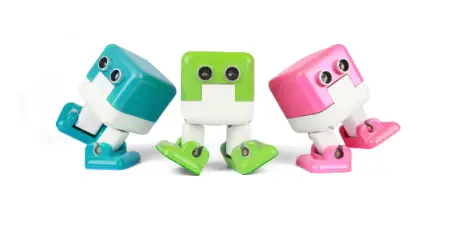
Example 1 — modular STEM robotics / education hardware
Torotic set out to solve a real problem in children’s coding education: students write code but rarely see it work in the physical world. The goal was a robot that was affordable, modular, and ready to use out of the box. Kids plug in a sensor, write a block of code in a custom Blockly interface, hit upload over USB, and the robot responds in real time.
PrototyperLab supported Torotic through the full cycle: concept, electronics design, firmware, 3D-printed enclosures, and a custom Blockly integration. The CenterCube Core Unit serves as the modular hub. Students attach plug-and-play input modules (sound sensor, distance sensor, button, IR receiver) and output modules (LED screen, multicolor LED, speaker) without any wiring knowledge.
Total development: 690 engineering hours. 360 hours on hardware design, 70 hours on programming and firmware, and 260 hours creating a 150-hour STEM curriculum. 20-unit minimum production run validated demand before scaling.
What this took: Custom circuit board design, Blockly visual programming integration, 3D-printed modular enclosures, USB firmware upload system, plug-and-play sensor and output module architecture, and a full STEM curriculum alongside the hardware.
Hardware: 690 engineering hours | Modules: CenterCube + plug-and-play sensors | Curriculum: 150 hours
Example 2 — creative tool / STEM toy
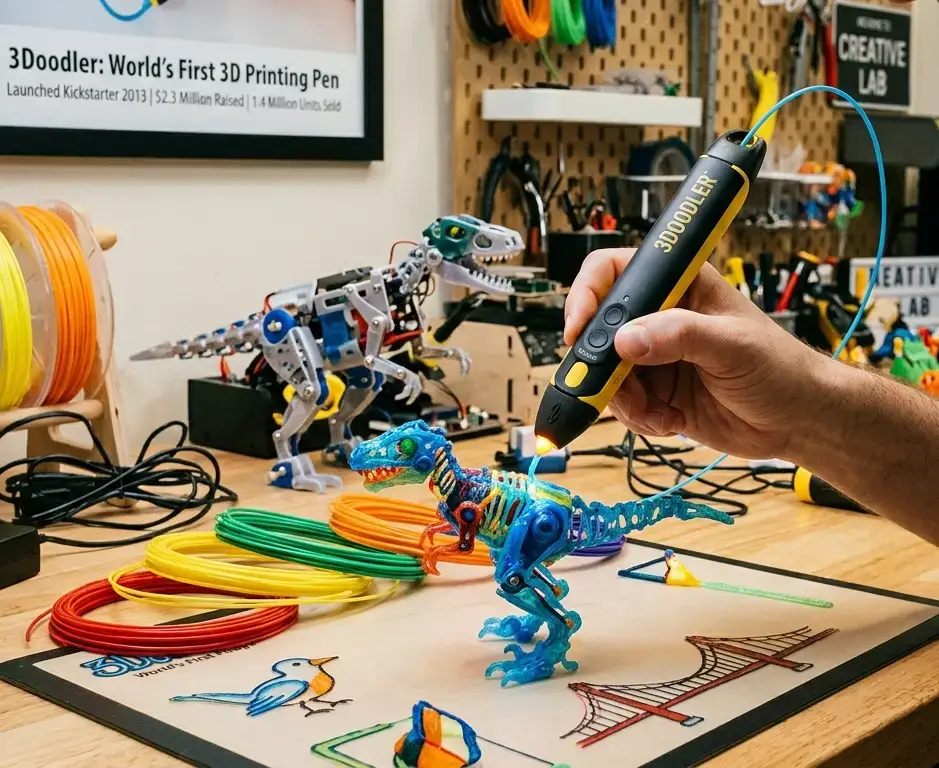
Max Bogue and Peter Dilworth were 3D printing a robotic dinosaur leg when their printer skipped a line, leaving a gap. One of them joked that you could just take the nozzle off the printer and fill the gap by hand. They realized nothing like that existed, so they built it.
The 3Doodler extrudes heated plastic that cools almost instantly into a stable structure, letting anyone draw three-dimensional objects freehand. They launched on Kickstarter in 2013 with a $30,000 goal and raised $2.3 million from over 26,000 backers. A second campaign in 2015 raised another $1.5 million.
The company later released the 3Doodler Start, a completely kid-safe version using cool-touch, non-toxic plastic with no heating element — built specifically to meet the safety bar required for a children’s product. More than 1.4 million 3Doodler pens have been sold across all versions.
What this took: A patented heating and cooling extrusion mechanism, ABS/PLA-compatible plastic threading system, ergonomic housing design, and for the kid-safe version, a complete redesign around non-toxic cool-touch materials and child safety testing.
Kickstarter: $2.3M raised, 26,457 backers | Kid-safe version: cool-touch, non-toxic | 1.4M+ units sold
Example 3 — construction toy / injection-molded plastic
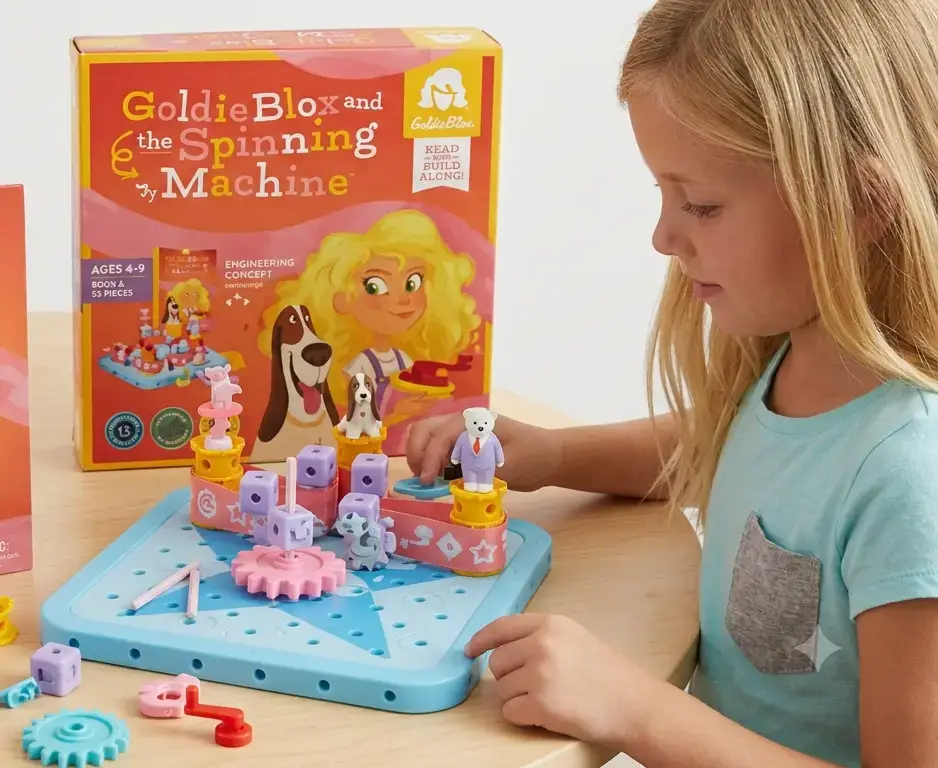
Debbie Sterling, a Stanford-trained engineer, noticed that construction toys were marketed almost entirely to boys. She built her first GoldieBlox prototype by hand in her living room using wooden blocks, a wooden frame, thread spools, clay, and velcro, then tested it directly with girls in the Bay Area to see what held their attention.
She took the validated design into CAD and found a factory in China that could produce quality injection-molded plastic parts. The minimum production run the factory would accept was 5,000 units, more than she could fund alone, so she launched on Kickstarter to cover it. The campaign hit its $150,000 goal in 4 days and ultimately raised $285,881 from 5,519 backers.
The Kickstarter video went viral after the campaign ended, generating tens of thousands of pre-orders. The factory scaled the first production run from 5,000 to 40,000 units to meet demand. GoldieBlox went on to sell in Toys R Us and Amazon.
What this took: Hand-built prototype iteration and direct user testing, CAD translation for injection molding, sourcing a factory capable of ethical, quality plastic production, and CPSC-compliant toy safety testing before the product could ship to retail.
Kickstarter: $285,881 raised in 4 days | Production: 5,000 to 40,000 units | Retail: Toys R Us, Amazon
01
A sketch, photo, or description of your toy or children’s product. Tell us the target age range and any electronics, small parts, or materials involved. We flag likely CPSC requirements before any design work starts.
Deliverable: Brief and compliance scope confirmed within 24 hours
02
Line-by-line quote covering design, materials, fabrication, electronics, and finishing. If third-party testing applies to your product, we include that cost and timeline up front, not as a surprise later.
Deliverable: Quote with timeline, milestone plan, and testing scope
03
50% deposit locks in your project. Milestone updates at CAD review, build, and finishing. For products requiring CPSC testing, we coordinate sample submission to our accredited partner lab as part of the build.
Deliverable: Prototype and test-ready samples in 25 to 45 days
Compliance and Safety Testing
Every children’s product sold in the United States must be tested by a third-party, CPSC-accepted laboratory and certified with a Children’s Product Certificate before it can legally ship. We work with an accredited CPSC testing lab partner so you don’t have to find, vet, and manage that relationship yourself.
Lead content and lead paint, per federal limits
Phthalates in plastic and soft materials
Small parts and choking hazards (age-graded)
Sharp points, edges, and accessible hazards
Toy safety per ASTM F963, including mechanical and physical requirements
Battery compartment security and button cell battery rules, where applicable
Test samples submitted directly to our accredited CPSC partner lab
Full test report in English, tied to your specific production lot
A completed Children’s Product Certificate (CPC) ready to file
Guidance on which children’s product safety rules apply to your specific product
Support for periodic retesting as your production continues
Flagging of small batch manufacturer (SBM) exemptions if your volume qualifies
We scope likely testing requirements at the brief stage, before you commit to a design, so certification costs are part of your quote from the start, not a surprise after your prototype is built. Note: federal law requires every children’s product to be tested by a CPSC-accepted lab before sale in the US, regardless of where it is manufactured.
Nearly all products designed or intended primarily for children 12 and under require third-party testing and a Children’s Product Certificate before they can be sold in the US. The specific tests depend on your product’s materials, age grading, and features. We help you identify exactly which rules apply before you commit to a design.
A Children’s Product Certificate (CPC) is required for products intended for children 12 and under, and must be based on testing from a CPSC-accepted third-party lab. A General Certificate of Conformity (GCC) applies to general-use products and does not always require third-party lab testing. We confirm which one applies to your product.
Registered small batch manufacturers may qualify for relief from certain testing requirements (Group B rules) if they meet CPSC’s revenue and unit thresholds. This does not exempt lead, phthalate, or core toy safety testing. We can tell you whether your production volume qualifies.
Typical turnaround is 2 to 4 weeks once samples are submitted, depending on the number of tests required. Cost varies by product complexity. A simple toy with no electronics or small parts costs less to test than one with batteries, multiple components, or soft materials. We include estimated testing cost in your quote.
Yes. Electronics-integrated children’s products require additional testing for battery compartment security, button cell battery rules where applicable, and electrical safety on top of standard toy safety testing. We scope this during the brief stage so nothing is missed.
Yes. We typically build and approve a working prototype first, then submit final production-representative samples for testing once the design is locked. This avoids paying for testing on a design that may still change.
Have questions about payment terms, refunds, or shipping? Visit our full FAQ page.
Every stage of your product journey covered.
Service
20 to 100 units. Production price per unit, quoted per project.
Quoted per project
Service
Real injection-molded plastic parts from 50 units. Aluminum molds.
From $500/mold
Service
Production-scale steel molds for volume manufacturing.
From $3,000
Service
CNC hardwood, flatpack design, and electronics in wood.
From $1,000
Service
PCB, firmware, wireless connectivity, and enclosure in one team.
From $3,000
Service
Full-stack electronics: hardware, firmware, and enclosure.
From $3,000
Service
Payment terms, refunds, shipping, and process questions.
prototyperlab.com/faq/
Design, strategy, and process services that support every stage of product development.
Other Service
Engineer your product to ship flat, reduce dimensional weight, and cut Amazon FBA fees.
Quoted per project
Other Service
Turn a concept sketch into a production-ready design reviewed for manufacturability.
Quoted per project
Other Service
Already in production but your per-unit cost is too high? We find savings without sacrificing quality.
Quoted per project
Other Service
Competitor analysis, customer survey design, and Amazon niche analysis before you commit to prototyping.
Quoted per project
Other Service
Retail packaging, mailer boxes, custom inserts, and FBA-compliant prep in one project.
From $1,000